Classroom culture · 7 min read
Teaching Children to Disagree Well
How to build a classroom where disagreement is productive, not destructive
Published 2026-05-12
Most primary classrooms are, in practice, agreement-oriented. The teacher asks a question. Children answer. The teacher responds to the answer, usually by affirming it or gently redirecting it. The social norm is that children don't challenge each other's answers, and they certainly don't challenge the teacher's.
This creates a comfortable surface. It also produces a classroom where real thinking is quite rare — because real thinking often involves disagreement.
Teaching children to disagree well is not a soft skill. It's one of the most academically and personally valuable things you can do in a primary classroom.
Why disagreement matters
Productive disagreement requires multiple cognitive skills operating simultaneously: you have to understand the position you're disagreeing with well enough to articulate why you disagree; you have to separate the idea from the person holding it; you have to construct a counter-argument; you have to hold your position under challenge, or update it if the challenge is good.
These are hard things. They're also the things that define intelligent engagement with any complex subject, and arguably with democratic society.
A child who has learned to sit in a classroom where everyone agrees with the teacher is not well-prepared for the reality of engaging with ideas where people genuinely differ.
What gets in the way
**The social fear.** Children worry about being wrong, about seeming rude, about status damage from challenging someone who's right. This is particularly acute in classrooms where being right is over-valued. The culture piece comes first: children need to believe that expressing disagreement is safe.
**Lack of language.** Children often don't know how to disagree without sounding aggressive. 'That's wrong' is what you get when children haven't been given better tools. The language needs to be explicitly taught.
**The teacher's discomfort.** Some teachers find disagreement in the classroom threatening, particularly when children disagree with them. This is worth examining. A classroom where children never challenge the teacher's answers is a classroom where independent thinking is being suppressed.
**Conflating disagreement with disrespect.** These are different things. Disagreeing with an idea is not personal. Teaching children to make this distinction is one of the most important things you can do.
The language of productive disagreement
Explicitly teach and use sentence frames for disagreement. Display them. Model them. Praise their use.
**Disagreeing with another student:** - 'I see it differently because...' - 'I think there might be another way to look at this...' - 'I'm not sure I agree — what about...?' - 'Can I push back on that? I think...'
**Disagreeing respectfully with the teacher:** - 'I'm not sure that's right — I thought it was...?' - 'Could it also be...?' - 'I might be wrong, but I think...'
**Updating your position when someone makes a good point:** - 'That's a good point — I hadn't thought about that.' - 'I'm changing my mind because...' - 'You've convinced me.'
The last category is as important as the first two. The goal isn't to win arguments — it's to think together. Modeling and praising the act of changing one's mind in response to good evidence is culturally powerful.
Structures that create productive disagreement
**Structured controversy.** Give groups a position to argue — not necessarily one they agree with. One group argues the case for, another argues the case against. Then groups switch. This separates 'disagreeing' from 'attacking' because the positions are assigned, not owned.
**Agree/disagree cards.** Every child has a card showing agree (green) and disagree (red). When a statement is made, children hold up their card simultaneously, then select two or three children to explain their response. The simultaneous reveal means children commit to their answer before they see what others think.
**Hot seating with challenge.** A child (or the teacher) takes a position on a question. Others in the class must try to challenge it. The person being challenged has to respond. Explicit role definition here removes the social awkwardness — 'your job right now is to push back.'
**Discussion protocols.** Simple protocols like think-pair-share include a specific step: 'Tell your partner what you think differently to them.' Making divergence the task, not just the optional outcome, normalizes it.
The teacher's role
The most powerful thing a teacher can do to build a culture of productive disagreement is to be genuinely disagreeable with themselves.
Present a position. Invite challenges. When a child makes a good counter-argument, change your stated position out loud. 'You know what — I think you're right about that. My original answer wasn't quite correct.'
This is disorienting at first. Children have strong expectations that the teacher is always right. When you model publicly updating your view — and frame this as intellectual honesty rather than weakness — the cultural message is powerful: changing your mind when the evidence is good is something to be respected.
It also, usefully, creates a classroom where children feel their contributions can have real impact. They're not just producing answers to be evaluated. They're genuinely participating in the thinking of the room.
What to expect
In the first few weeks of building this, disagreement will be cautious and polite. Children will need reassurance. Some will test the limits — disagreeing more provocatively than the context calls for, or agreeing too readily just to please.
Over time, if you hold the culture consistently — praising good challenges, modeling your own fallibility, separating ideas from people — you'll start to see something that looks like genuine intellectual exchange in a primary classroom.
That's a remarkable thing to have built. And it's worth the investment.
Free bundle for this topic
Cover Day Survival Pack
9 resources for cover days and routines, including behavior systems and morning meeting scripts.
Practical resources for this
Take this further
Printable, classroom-ready resources for the topics in this article.
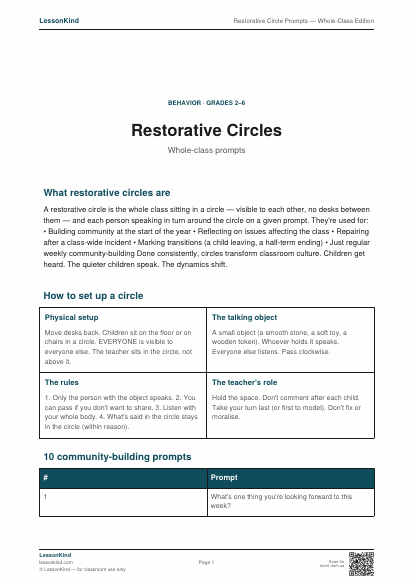
Restorative Circle Prompts — Whole-Class Edition
Whole-class restorative circle prompts for community-building and after class-wide incidents. 30 prompts across 4 categories, plus how to set up and run the circle.
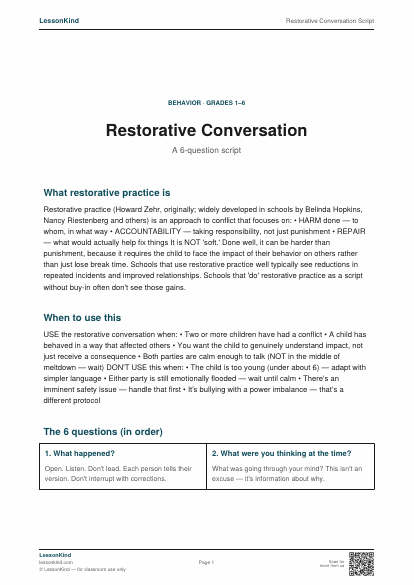
Restorative Conversation Script
A simple 6-question script for restorative conversations after a behavior incident. Follows the standard restorative practice format — focused on harm, accountability, and repair.
Keep reading
Teaching strategy
Cold calling without humiliation
Cold calling — picking children to answer rather than asking for hands up — has become a fashionable technique. It works brilliantly in some classrooms and creates anxiety in others. The difference is everything in how you set it up.
7 min read
Classroom culture
The Power of Slow
The instinct in teaching is to cover ground. The evidence says something different: slowing down, revisiting, and dwelling on hard ideas produces deeper and more durable understanding than moving fast.
7 min read