EAL & inclusion · 5 min read
Supporting Bilingual Children: Moving Beyond 'EAL as Deficit'
A shift in framing that changes everything about how you teach multilingual learners
Published 2026-05-25
The language around EAL in schools is predominantly about deficits. 'EAL pupils' is used as shorthand for children who cannot yet communicate effectively in English — as if multilingualism were a problem to be solved rather than an achievement to be celebrated.
This framing has practical consequences. Provision designed around what children lack produces different outcomes from provision designed around what they bring.
What bilingual children bring
A child who speaks two or more languages has a richer understanding of how language works than a monolingual child. They understand — implicitly or explicitly — that the same concept can be expressed in different ways, that words are not the same as the things they represent, that rules govern language and rules can be different.
Bilingual and multilingual children consistently outperform monolingual peers on tasks requiring cognitive flexibility, working memory, and the ability to hold two ideas simultaneously. The 'executive function advantage' of bilingualism is one of the most replicated findings in cognitive science.
Practical asset-based approaches
**Use the home language as a cognitive tool.** Allowing children to think in their home language before translating — or to use their home language for planning and drafting — supports higher-quality outputs than requiring all thinking to happen in English.
**Invite expertise.** A child who is learning about Roman numerals may have already encountered them differently in their home culture or language. Asking rather than telling — 'how would you say this in [language]?' — positions the child as a linguistic authority rather than a deficient learner.
**Display home languages.** Classrooms with visible multilingual content send a message about whose knowledge counts. Dual-language labels, greetings in multiple languages, and international books are all signals.
**Celebrate code-switching.** Moving between languages — a natural feature of multilingual communication — is often treated as a failure to commit to English. It is actually a sign of sophisticated linguistic competence.
**Connect to home culture.** The fastest route to engagement for many bilingual children is curriculum content that connects to their cultural background — not as tokenism (a special week about their country) but genuinely: historical links, mathematical traditions, scientific contributions from their home culture's history.
Free bundle for this topic
SEND Inclusion Toolkit
7 essential SEND resources covering autism, ADHD, dyslexia and emotional regulation.
Practical resources for this
Take this further
Printable, classroom-ready resources for the topics in this article.
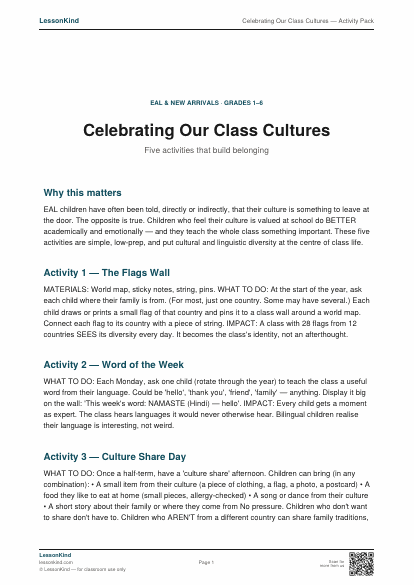
Going deeper
Books on bilingual and EAL education
Books we'd recommend on the topics raised in this article.
For teachers
Convenience links to Amazon. As an Amazon Associate we earn from qualifying purchases at no extra cost to you. Read our affiliate disclosure.
Keep reading
EAL & inclusion
10 EAL Strategies Every Mainstream Teacher Should Know
Most EAL pupils spend the majority of their school day with mainstream class teachers, not specialist EAL staff. Here are ten evidence-informed strategies any teacher can use immediately.
7 min read
EAL & inclusion
The Stages of English Acquisition: What Teachers Need to Know
EAL pupils are not a homogeneous group — they may be at any of five distinct stages of English acquisition. Understanding which stage a pupil is at changes everything about what appropriate support looks like.
6 min read