Teaching strategy · 5 min read
The Art of the Three-Second Pause
Why the most powerful teaching tool you have is silence
Published 2026-06-11
Walk into any elementary classroom and time the pauses. The teacher asks a question. They wait. How long? Almost always less than two seconds. Then they answer it themselves, rephrase it, or pick the first hand up.
This is the single most fixable habit in elementary teaching. And the fix has three parts: notice, count, hold.
What the research found
In the 1970s, a researcher named Mary Budd Rowe sat at the back of countless classrooms with a stopwatch. She found that the average WAIT TIME after a teacher's question — the silence before someone answered, or before the teacher moved on — was around 0.9 seconds.
She pushed teachers to extend that wait time to three seconds. The change was dramatic. The number of children participating went up. The length of children's answers went up. The number of unsolicited but on-topic remarks from children went up. The number of "I don't know" answers went down.
Three seconds. That's all.
Why it works
A child needs time to think. The faster a teacher fills silence, the less thinking happens. If the average teacher gives 0.9 seconds, the only children answering are the ones who already knew, or who had a guess loaded and ready. Everyone else has been excluded from the thinking.
Extending the pause changes who gets to think. Children who needed to process — to actually consider, to retrieve from memory, to formulate words — now have a window. Many of them will have things worth saying. They just needed to be allowed to think.
Three pauses worth practising
There are actually three different pauses, and elementary teachers tend to be bad at all three.
**Pause 1 — after asking a question.** The classic. Ask, then wait three seconds before doing anything else. Three seconds feels like an eternity to the teacher; it feels normal to the children.
**Pause 2 — after a child answers.** Just as important, and rarely done. The child finishes a sentence; you immediately move on. But often, if you wait, they'll add more — and what they add is deeper than what they said first. "Tell me more" is the spoken version. The pause is the silent one.
**Pause 3 — between activities.** The transition pause. "Right, books out, we're moving on…" can be replaced with a quiet count of three after closing one task before opening the next. It signals: take a breath. We're switching focus. Children settle faster, not slower.
How to actually do it
Notice. For one lesson, just count how long YOUR pauses are after questions. You'll be shocked.
Count. Internal "one, two, three" counts work. So does looking at a different child each second.
Hold. The hardest part is holding through the discomfort. Three seconds of silence FEELS like the lesson is dying. It isn't. It's the moment children start thinking.
What you'll notice in two weeks
A few specific things tend to show up:
- Children who never raised their hand start raising it. They had thoughts. They just needed time. - The same talkative children no longer dominate. They have to wait too. - Answers get longer and more interesting. So do follow-up answers. - Your voice carries less of the lesson. The children's voices carry more.
It's free. It's invisible to anyone watching. It's based on solid evidence. And it might be the single biggest thing you can change in how you teach.
Try counting "one… two… three" after your next question. Then watch what the children do.
Practical resources for this
Take this further
Printable, classroom-ready resources for the topics in this article.
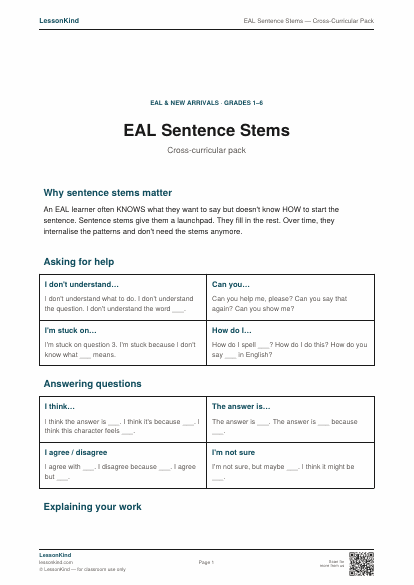
EAL Sentence Stems — Cross-Curricular Pack
Sentence starters for every part of the school day — answering questions, giving opinions, explaining work, asking for help. Print, laminate, give the child their own copy.
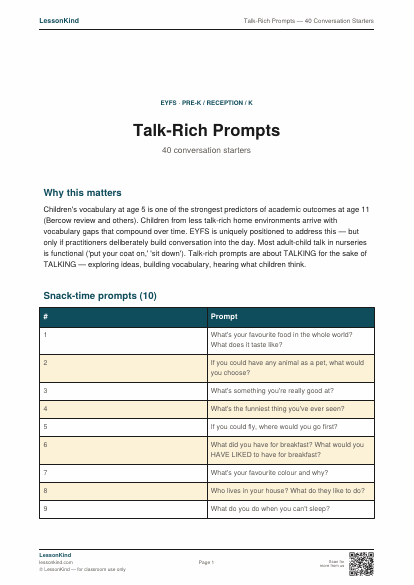
Talk-Rich Prompts — 40 Conversation Starters
40 prompts that get EYFS children TALKING — for snack time, circle time, walks, transitions. Beyond 'tell me about your weekend.'
Keep reading
Teaching strategy
What I Wish I'd Known About Classroom Talk
We ask thousands of questions a year. Most of them produce shallow answers. Here's how to ask better ones — and what to do with the answers.
6 min read
Assessment & feedback
How to Give Feedback That Actually Changes the Work
Most marking has almost no effect on student work. Here's what does — and what to stop doing immediately.
7 min read
Assessment & feedback
Feedback That Changes the Work
Decades of research on feedback in education converge on one uncomfortable finding: most feedback given in classrooms produces little or no improvement. Here's what actually works.
7 min read