Teaching strategy · 6 min read
What I Wish I'd Known About Classroom Talk
Why most class discussions don't deepen thinking — and how to fix it
Published 2026-05-28
The average elementary teacher asks somewhere between 200 and 400 questions a day. That's roughly one question every two minutes of teaching time. After a 30-year career, that's nearly two million questions.
You'd think, given the sheer volume, that we'd be world-class at this skill. Most of us, including me, are not.
What's wrong with most classroom questions
Three things, mostly.
First — they're closed. "What's the capital of France?" "Who wrote Charlotte's Web?" These have one right answer. They check whether someone heard you. They don't push thinking.
Second — they're aimed at the same five kids. The hands shoot up. The teacher picks. The same handful of confident children answer over and over. The other 25 sit, partly because no one's asking them, partly because they've learned they don't need to think — someone else will.
Third — the wait time is too short. Research from Mary Budd Rowe in the 1970s showed that the average teacher waits about ONE SECOND after a question before either rephrasing, calling on someone, or answering it themselves. One second isn't enough time to think. Push that wait to three seconds and the quality of answers goes up dramatically — and a wider range of children join in.
Better questions
The biggest single shift you can make: ask fewer questions, but make each one bigger.
Instead of "what's the capital of France?", ask "if you were planning a school trip to Paris, what three things would you want to see, and why?". The first invites a fact. The second invites thinking — values, geography, judgment. There's no single right answer. Every child can have a go.
Some sentence-stem prompts that change the conversation:
- "What's another way to think about that?" - "Can you build on what _____ said?" - "What would have to be true for that answer to be wrong?" - "Who can disagree respectfully?" - "Tell me more — why do you think that?"
These don't require fancy training. They require you to slow down and resist the urge to fill silence.
Better routines
A few small structural changes that compound:
**No-hands-up questioning.** Tell the class up front: "I'm going to ask the question, then pick someone." Every child has to think, because anyone might be picked. Use lollipop sticks, a random name generator, or just your finger.
**Think-pair-share.** Ask the question. Give 30 seconds of silent thinking. Then 60 seconds of paired discussion. THEN call on people. The quality of answers goes up because everyone's already rehearsed once.
**Build, don't just answer.** When a child gives an answer, your next move shouldn't be "good — now next question." It should be "tell me more," or "can someone build on that?" or "who agrees / disagrees and why?". This stretches one question into three minutes of real thinking.
**Wait time after the answer.** Almost as important as wait time before. Don't move on the second a child finishes. Wait. Often they'll add more — and what they add is usually deeper than what they said first.
The sound of a good classroom
If you stand outside a great primary classroom for ten minutes, you'll hear something specific: long stretches of children talking, with the teacher dropping in short prompts to push thinking. You'll hear children saying "I disagree because…" and "what do you mean by…?" and "could you say more about…?".
That doesn't happen by accident. It happens because the teacher has, slowly, taught the class to TALK that way. The questions you ask become the thinking your children do. Make them count.
Practical resources for this
Take this further
Printable, classroom-ready resources for the topics in this article.
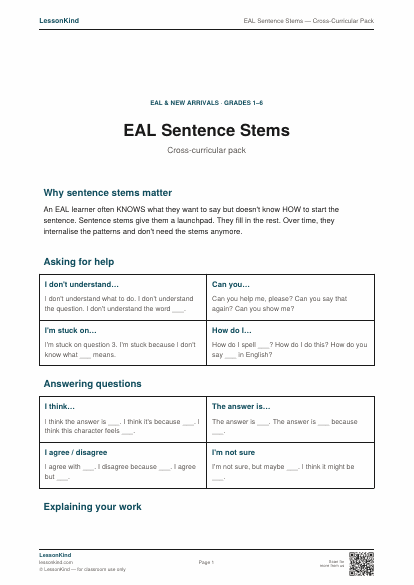
EAL Sentence Stems — Cross-Curricular Pack
Sentence starters for every part of the school day — answering questions, giving opinions, explaining work, asking for help. Print, laminate, give the child their own copy.
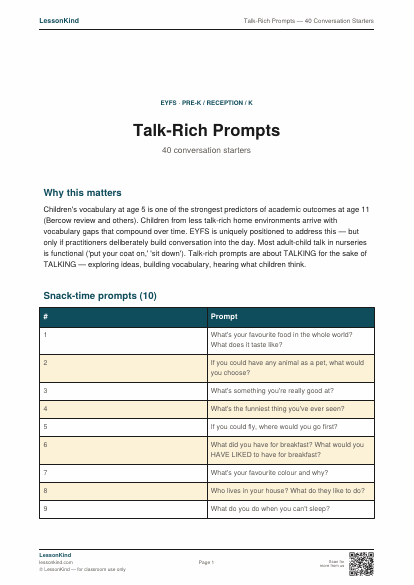
Talk-Rich Prompts — 40 Conversation Starters
40 prompts that get EYFS children TALKING — for snack time, circle time, walks, transitions. Beyond 'tell me about your weekend.'
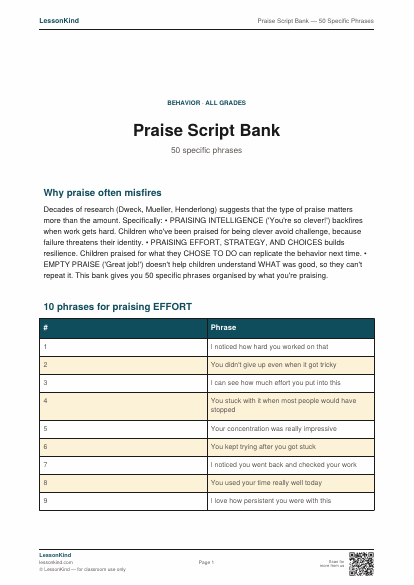
Praise Script Bank — 50 Specific Phrases
50 specific praise phrases you can use in the classroom — focused on effort, strategy, and behavior, not ability. Built around the research on what kinds of praise actually motivate children.
Going deeper
Talk, dialogue and questioning — recommended reading
The texts that have shaped current thinking on classroom talk.
Foundational
Convenience links to Amazon. As an Amazon Associate we earn from qualifying purchases at no extra cost to you. Read our affiliate disclosure.
Keep reading
Teaching strategy
The Art of the Three-Second Pause
The most underused tool in elementary teaching is the pause. Here's why it works — and how to make it part of your practice.
5 min read
Assessment & feedback
How to Give Feedback That Actually Changes the Work
Most marking has almost no effect on student work. Here's what does — and what to stop doing immediately.
7 min read
Assessment & feedback
Feedback That Changes the Work
Decades of research on feedback in education converge on one uncomfortable finding: most feedback given in classrooms produces little or no improvement. Here's what actually works.
7 min read
EYFS & early years
Play-Based Learning Isn't Lower Expectations — It's Different Expectations
Walk into a Reception classroom and you'll see children playing. Walk into a Year 3 classroom and you'll see children working. The mistake most adults make is assuming the second is more rigorous than the first.
8 min read