Parent communication · 6 min read
The Newsletter Nobody Reads (And How to Fix Yours)
Most class and school newsletters get 30% open rates. The fix is not better content — it's a fundamentally different format.
Published 2026-09-26
Most primary school newsletters — the weekly or monthly missives sent home from class teachers, year leads, or head teachers — are read by perhaps 30-40% of families. Of those, perhaps half scan the first paragraph. Of those, a tiny fraction actually retain the information.
This is not a parental engagement problem. It's a format problem.
The newsletter, as we currently produce it, evolved in an era when communication from school to home was scarce, formal, and read carefully because there was little else competing for parents' attention. None of those things are true anymore. Parents receive emails from work, WhatsApp messages from class groups, app notifications from school systems, group emails from PTA, plus everything else in modern life. Your two-page newsletter has perhaps 90 seconds before it gets archived.
This article is about why most newsletters fail and what works instead.
Why most newsletters fail
A few common patterns.
**They're too long.** Two pages, sometimes three. Twelve sections covering everything from football club to lost property to the upcoming author visit. By the time the reader gets halfway down page one, they've forgotten what was at the top. Anything genuinely important gets buried.
**They're written for inspectors, not parents.** "We are pleased to inform you that during the previous half-term, our pupils have demonstrated remarkable engagement across the breadth of the curriculum, with particular success in our cross-curricular STEM week..." This is institutional voice, not human voice. It tells parents nothing they can act on, share, or remember.
**They're generic.** "Year 3 have been studying the Romans." Nothing specific. Nothing memorable. Nothing that helps a parent ask their child about it. The contrast: "Year 3 made their own Roman mosaics this week — ask your child about the symbol they chose for theirs."
**They mix urgent and trivial.** A note about a reading volunteer day next week sits next to a paragraph about lost property. Parents have no signal about what matters.
**They're delivered too late.** "Don't forget the trip on Monday — we leave at 9am" sent at 6pm Friday after parents have planned their weekend. The information was useful 5 days earlier; now it's just stress.
**They're sent by an institution, not a person.** "From the Head Teacher" or "From Year 4." Anonymous voice with no relational pull. Compare: "From Mrs Hassan" or simply "Hi from Year 4 — Sarah here."
**They include too many photos that take time to load.** Email opens and the reader sees... a wheel of doom. By the time the photos load, they've moved on.
What works instead
A few patterns that produce dramatically better engagement.
**Short and scannable.** One screen on a phone. Bullet points. Subject headers. No paragraphs of prose. The brain processes lists faster than narrative.
**Specific and memorable.** Not "we did art" but "we made self-portraits using mirrors and watercolours." Not "PE went well" but "Sam's group came up with a new game and taught it to the class — ask them to demo it at home."
**One clear ask per newsletter.** If you want parents to do one thing — practise spellings, return a permission slip, attend the open evening — make it visible. Not buried in paragraph 6.
**Sent at the same time, same day, every week.** Friday afternoon. Tuesday morning. Whatever you choose. Build the rhythm. Parents start to expect it. They scan it instinctively because the muscle of "what does this say" gets practised.
**From a person.** Sign your name. Write in your voice. Use first person. "I'm thrilled with..." beats "The class has demonstrated..."
**Mixed format.** Some weeks an email. Some weeks a child-completed round-up sheet. Some weeks a photo with a caption. Variety keeps it fresh.
**Action-oriented.** What can parents DO? Read for 10 minutes a day. Ask their child about [specific thing]. Practise this week's spellings: list, written, friend.
**Photos of children's work, not children's faces.** Faster to load. No safeguarding/consent issues. Often more interesting anyway.
What to actually try
If you want to genuinely improve your newsletter game, here's a sequence to try over a half-term.
**Week 1: Cut your usual newsletter in half.** Take whatever you'd normally send, and ruthlessly cut. Subjects we won't cover: anything that isn't time-sensitive or specifically helpful. The exercise alone often reveals how much filler you've been including.
**Week 2: Try the "Friday Three" format.** Three bullet points only. What we did. What's coming up. One specific request. Sent same day every week. See if parents notice the change.
**Week 3: Include a quote from a child.** Something a child said this week that captures the spirit of class. Real quotes, real voices. Parents love this — it makes the school feel alive.
**Week 4: Add a "this weekend, ask your child about..." section.** Give parents three concrete conversation starters. This single addition transforms how parents engage with what's happening at school.
**Week 5: Try a photo-led format.** One photo of work, with a paragraph of context. "These are this week's volcano cross-sections — see if your child can explain the difference between magma and lava."
**Week 6: Ask parents what they think.** A two-question survey. "Do you read our newsletter? What would make it more useful?" Often eye-opening.
After half a term, you'll have data on what works for YOUR community. Different communities respond to different formats. Try several. Measure (informally — what gets mentioned to you at the door?). Iterate.
A word on platforms
WHERE you send the newsletter matters almost as much as what's in it.
**Email** is universal but easy to ignore. Open rates for school emails tend to sit around 50-60%. Better than nothing.
**Class Dojo / Seesaw / similar apps** often have higher engagement because they're notification-based. Parents see the badge and tap. Better engagement, but only with the families who actually use the app.
**Paper sent home** is loved by some demographics, hated by others. Reaches every family but doesn't get into emails / archives easily. Often the best for genuinely important info that needs not to be missed.
**WhatsApp class group** (where school policies allow) — highest read rate of any format, but not appropriate for one-way newsletters. Better for time-sensitive reminders.
**Best practice for most schools is multi-channel.** Email for the main newsletter. App notification with a teaser. Paper home for the most important things. WhatsApp group (run by a parent rep, not the teacher) for time-sensitive reminders. Each channel reaches different families.
What about head teacher / whole-school newsletters?
Whole-school newsletters have a harder job. They have to speak to families across year groups, in different stages of the school journey, with very different needs. A perfect class newsletter is achievable; a perfect whole-school newsletter probably isn't.
The same principles apply, but with extra emphasis on:
**Segmentation where possible.** EYFS-only news in EYFS-only newsletters. Year 6 transition info to Year 6 families. Most platforms now allow this; lots of schools still don't use it.
**Brevity.** A whole-school newsletter that's longer than a class newsletter is usually wrong. If anything, it should be SHORTER, because it's covering more general info.
**Personality.** Even an institutional newsletter can have a voice. The head's letter at the start can sound like a person if you write it like one.
**Diary first.** What dates do parents actually need? List those clearly at the top. Everything else is secondary.
A final note
Newsletters aren't the most important thing teachers do. They probably shouldn't take more than 15-30 minutes a week to write. If you're spending an hour and a half on a newsletter most parents barely read, that's an hour you could spend doing something with bigger impact.
Done well, the weekly note from school is a small, regular thread between home and class. It doesn't need to be exhaustive. It needs to be specific, brief, warm, and reliable. Build that rhythm and your communication with families becomes infrastructure — quiet, dependable, present — rather than a sequence of marketing-style efforts that nobody quite knows whether to read.
Cut. Specifically. Personally. Briefly. Reliably. That's the recipe.
Practical resources for this
Take this further
Printable, classroom-ready resources for the topics in this article.
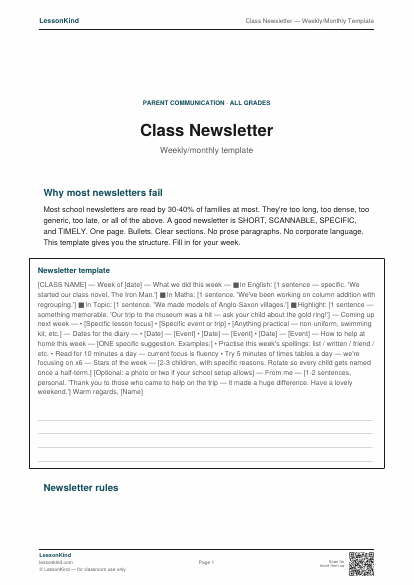
Class Newsletter — Weekly/Monthly Template
A simple, scannable class newsletter template — what we did, what's coming up, important dates, how to help. Designed to actually get read.
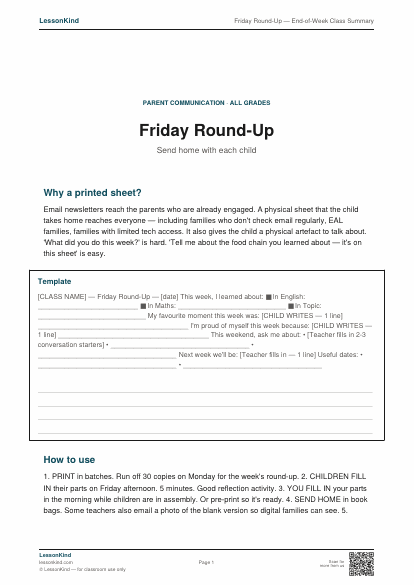
Friday Round-Up — End-of-Week Class Summary
A printable Friday round-up sheet children can take home — what they did this week, what's next, and conversation starters for parents.
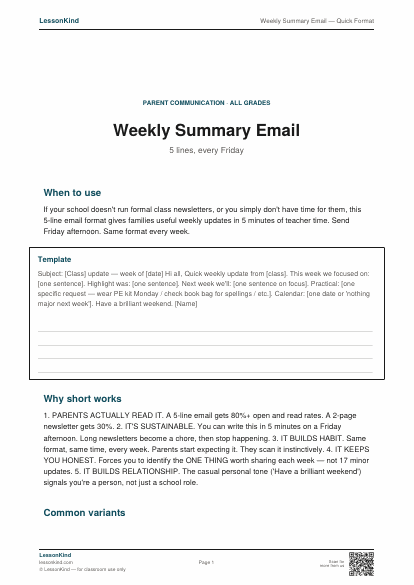
Weekly Summary Email — Quick Format
A 5-line summary email teachers can send Friday afternoon — for schools without a formal newsletter system, or for teachers who don't want the overhead.
Keep reading
Parent communication
The Difficult Parent Meeting — A Better Approach
Telling parents something they don't want to hear is one of the hardest skills in teaching. Most teachers learn it the hard way, by getting it wrong. There's a better path.
7 min read
Parent communication
Talking to Parents About Difficult Things
Sooner or later, every elementary teacher has to tell a parent something they don't want to hear. Here's how to do it well.
6 min read