Parent communication · 7 min read
The Difficult Parent Meeting — A Better Approach
Why most parent meetings about behavior, SEND, or progress concerns go wrong — and what works
Published 2026-09-27
The parent in front of you is going to hear something they don't want to hear. Their child isn't progressing as expected. Their child has been involved in an incident. You'd like them to consider a SEND assessment. The issue you raised in October is still happening in February.
This is one of the most common professional conversations in teaching, and one of the worst-prepared. Initial teacher training spends hours on planning, less on classroom management, almost nothing on the parent-on-the-other-side-of-the-table conversation. Most teachers learn it the hard way — by getting it wrong, and watching trust collapse.
This article is what I wish I'd been told before my first year of these conversations.
Why the obvious approach fails
The obvious approach to delivering difficult news is to say it clearly and immediately. "I'm worried about Sam's reading. He's behind where he should be." Direct. Honest. Efficient.
It's also, almost always, the wrong opening.
Here's why. When a parent hears something difficult about their child, several things happen at once. Their nervous system activates. The thinking parts of their brain partially shut down. They may feel shame (have I failed as a parent?), defensiveness (this teacher doesn't understand my child), grief (the future I imagined isn't quite arriving), or a mix of all three. Whatever you say next will be filtered through that emotional state.
If you've started with the difficult news, the rest of the conversation is now happening to a parent in mild crisis. You can talk for the next 10 minutes about your strategies and your concerns and your plans, and they will absorb maybe 20% of it.
What actually works
Better-handled difficult conversations follow a consistent shape. Not a script — a shape.
**They start with the relationship, not the message.** "Thanks for coming in. How was the journey?" "How's [child] been feeling about school this week?" Two minutes of human contact before the substance lowers the parent's nervous system. They don't yet know they're about to hear difficult news, and that's the point — you want them regulated before they have to process anything heavy.
**They establish that you see the child as a whole person, not a problem.** This is usually 2-3 specific positive things. Not flattery — actual things you've noticed about the child. "Sam has been brilliant in our maths discussions this week." "I love that he asks me questions about books." "He's been a really kind friend to [other child]." This is genuinely important. Parents whose children have struggled have often been told their child is a problem. Hearing them seen as a person before hearing the difficult thing changes how it lands.
**They name the difficult thing clearly, but contextually.** "I want to talk to you about something I've been noticing — and I want to be honest with you about it." Pause. Then state it. Specific. Not "Sam's a bit behind in reading" but "Sam is reading at roughly a Year 1 level, and I'd expect him to be reading at Year 2 by now." Specific is kinder than vague. Vague leaves them imagining the worst.
**They acknowledge the emotional response.** Pause after delivering the difficult thing. Watch their face. If they look upset, name it. "I can see this is hard to hear." If they look defensive, also name it gently. "You might be thinking I'm not seeing what you're seeing." Don't barrel on through their reaction. Give them a moment to land.
**They invite the parent's perspective before sharing solutions.** "What does this look like at home? What are you noticing?" Most parents have a perspective. Sometimes it changes what you thought you knew. Often it adds context that helps. Always, hearing it makes them feel partner not patient.
**They share what's already happening.** Don't make it sound like you've just noticed and are now asking them to fix it. "What I've already done is [specific things]." This signals that the school is acting, not just observing.
**They invite shared next steps.** "What would help, do you think?" or "Here's what I'd like to suggest — what's your take?" Avoid dictating. Most things you want a parent to do will go better if it's been jointly decided.
**They end on a forward-looking, warm note.** "Let's keep talking. I'll let you know how things go this week, and we can check back in." The conversation closes with continuation, not finality.
Specific landmines
A few common errors worth flagging.
**Saving up.** "I've been wanting to talk to you for a while about..." If it's been a while, that's already an admission of failure. Difficult things should come up early, not be saved for parents' evening or for a moment when "you've finally got time." Earlier is kinder than later, almost always.
**The diagnosis you're not qualified to make.** "I think Sam might have ADHD." You may suspect this. You may be right. But diagnosis is not your job, and diagnostic language from a class teacher is risky. Better: "I've noticed [specific behaviours]. I'd like us to think about whether to ask the SENDCo to look more closely." Specific, descriptive, and within your remit.
**The list of past infractions.** When discussing current behavior, don't recite every past infraction. It feels punitive and exhausts the parent before you've even arrived at what to do next. Stay focused on the current concern. If a pattern matters, name it briefly: "This has happened a few times this term."
**The "I'm disappointed" framing.** "I'm disappointed in Sam." This makes the issue about your feelings, not the child's needs. It's also passive-aggressive. Stick to facts.
**The wall of consequences.** "If this continues, then..." Listing consequences threatens parents and makes them defensive. Better to focus on what we'll do TOGETHER.
**Comparing children.** "His sister was much stronger at this age." Even implicitly. Avoid.
**Dropping a bombshell at pickup.** Don't deliver serious concerns at the door at 3:15 with 26 other parents in earshot. Find a real time. Phone if necessary.
**The empty meeting.** Inviting parents in just to express concern, with no plan, no actions, no follow-up, leaves them feeling they wasted their afternoon. Always have something to do, even if small.
When parents push back
A few categories.
**The parent who disagrees with you.** "I don't see that at home." Often true — children behave differently in different settings. Don't argue. Hear what they see. "Tell me what you do see." You might learn something. They might land on the difference between school and home themselves, which is more useful than you arguing.
**The parent who blames you.** "If you'd handled this better..." Don't defend reflexively. Often there's some truth — maybe you could have communicated earlier, handled an incident better. Acknowledge what's fair. "I think you're right that I should have got in touch sooner. That's on me." Then continue. Honesty disarms.
**The parent who cries.** Pause. Tissues. Don't fill the space. Some parents need a minute. "Take all the time you need." When they're ready, they'll signal. Continue gently.
**The parent who gets angry.** Lower YOUR voice. Slow YOUR pace. Don't match their energy. "I can see this has hit hard. Let's pause." If aggression escalates, end the meeting and reschedule with a senior leader present. Your safety matters too.
**The parent who is silent.** Sometimes parents shut down. Wait. "Take your time. I know this is a lot." If they remain silent, name it. "I think this might be quite a lot to absorb in one go. Shall we leave it here and meet again next week?"
**The parent who agrees too readily.** "Yes, you're right, we'll fix it." Sounds good but often signals the parent is fleeing, not engaging. Slow down. "I really want us to think about this together — what does this look like from your end?" Don't accept superficial agreement.
After the conversation
The follow-up matters as much as the conversation itself.
**Same-day email summary.** "Thanks for coming in today. We agreed: [bullet list of next steps]." Confirms shared understanding. Catches misunderstandings before they fester.
**Earlier follow-up than promised.** If you said "let's check back in two weeks," check back in one. The parent will be slightly surprised — in a good way.
**Specific updates, not generic.** "Sam read independently for 8 minutes today, which is the longest yet." Specifics beat "things are going well."
**Bring positives unprompted.** If you only get in touch when there's bad news, the parent learns to dread your name. Mix in genuine positives — and not in a fake way. Real moments of progress, kindness, growth.
A final note on power
The parent-teacher conversation has an inherent power asymmetry that most teachers underestimate. The teacher has institutional power — they hold the gates, write the reports, decide what happens to the child each day. The parent has emotional vulnerability — this is their child being discussed, their parenting on implicit trial. Most parents going into a "difficult conversation" feel deeply outmatched.
Knowing this changes the dynamics. The kind, patient, specific-rather-than-vague teacher who sits at the same level (literally — sit, don't stand), uses the parent's name, listens twice as much as they speak, and frames everything as partnership rather than verdict — that teacher gets very different responses than the teacher who walks in with a clipboard.
You are not on trial. The parent isn't either. The child isn't there, and isn't a thing to be solved. The whole conversation is best framed as: two adults who care about this child, sitting down to think about what would help.
If you can hold that frame in your own head as you walk in, the rest gets much easier.
Practical resources for this
Take this further
Printable, classroom-ready resources for the topics in this article.
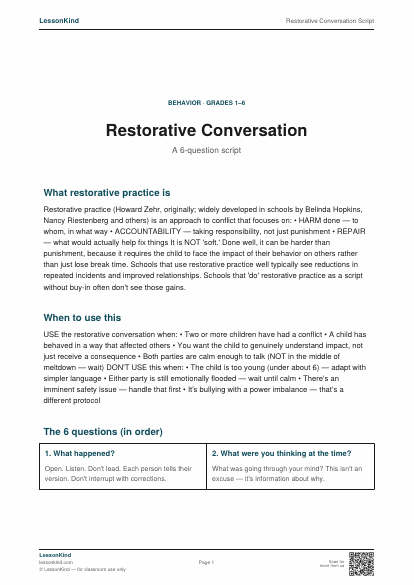
Restorative Conversation Script
A simple 6-question script for restorative conversations after a behavior incident. Follows the standard restorative practice format — focused on harm, accountability, and repair.
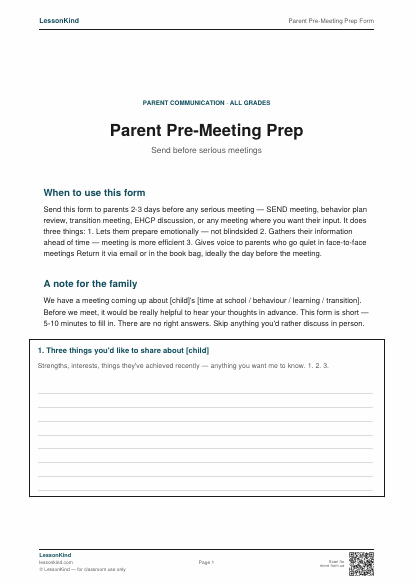
Parent Pre-Meeting Prep Form
A short form to send to parents before a serious meeting — what they want to discuss, what's working at home, what's worrying them. Saves 20 minutes in the meeting and gives them voice.
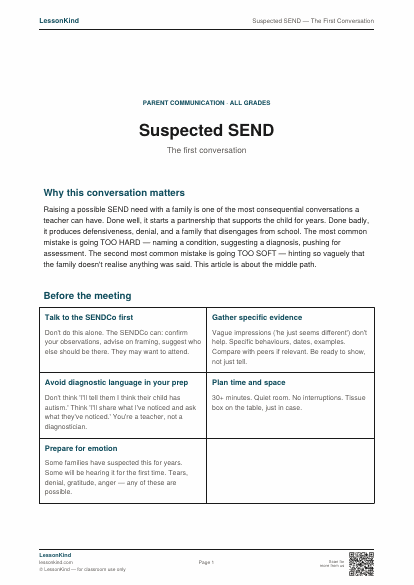
Suspected SEND — The First Conversation
How to raise the possibility of a SEND need with a family for the first time — without diagnosing, without panicking parents, and without backing off when you shouldn't.
Going deeper
Books on hard parent meetings
How to handle the parent meeting you're dreading.
Practitioner
Convenience links to Amazon. As an Amazon Associate we earn from qualifying purchases at no extra cost to you. Read our affiliate disclosure.
Keep reading
Parent communication
Talking to Parents About Difficult Things
Sooner or later, every elementary teacher has to tell a parent something they don't want to hear. Here's how to do it well.
6 min read
Parent communication
The Newsletter Nobody Reads (And How to Fix Yours)
Schools spend hours producing newsletters that most parents barely skim. The reason isn't lazy parents — it's that newsletters as a format have stopped working. Here's what works instead.
6 min read