First-year teaching · 7 min read
The Paperwork Nobody Warned You About
A first-year teacher's guide to the administrative reality of the job
Published 2026-05-12
One of the shocks of the first year is administrative. Not the lesson planning — you expected that. Not the marking — you expected that too. The shock is the sheer volume of tasks that exist *around* teaching: forms, records, emails, logs, reports, meeting notes, safeguarding paperwork, data entry, permission slips.
Nobody in teacher training mentioned any of this. And in your first year, when you're still working out how to teach, the admin layer lands on top of everything else.
This is a rough map of what's coming, and how to approach it.
The categories of teacher paperwork
**Statutory safeguarding records.** These are non-negotiable and cannot slip. Any concern about a child's welfare needs to be logged — usually via your school's system, sometimes on a paper form. You should know who your Designated Safeguarding Lead is on your first day. If you don't, ask immediately. When in doubt about whether something warrants a log, log it anyway. You'll never be criticized for over-recording safeguarding concerns.
**Planning documentation.** Different schools have very different expectations here. Some want detailed weekly plans submitted by Friday afternoon. Some want a simple outline. Some want lesson-by-lesson objectives in a shared drive. Ask your mentor or line manager exactly what's expected — don't guess. Planning documentation requirements vary so much between schools that any general advice here might contradict your school's practice.
**Assessment and tracking.** You will almost certainly be expected to record data about your students at regular points in the year — termly or more frequently. This usually involves a spreadsheet, an assessment system, or both. Find out how your school tracks data in your first week, not your first month. Getting behind on data entry is surprisingly hard to recover from.
**Communication logs.** Every time you speak to a parent about something significant — a concern, a behavior issue, an achievement — log it briefly. Date, who you spoke to, what was said. This protects you. Schools sometimes ask teachers to show evidence of parent communication, and 'I spoke to them but didn't write it down' is an uncomfortable position to be in.
**Meeting minutes and action points.** Staff meetings, year-group meetings, SEN reviews, parents' evenings — most of these involve notes of some kind. In your first year, don't volunteer to take minutes; your brain will be too busy trying to absorb the content of the meeting. But do keep your own notes of any action points you're assigned.
**IEP and support plan documentation.** If you have children with special educational needs, you'll likely have Individual Education Plans or similar documents for some of them. These need to be reviewed at set points in the year. Know which of your students have these, and know when reviews are due. Missing an IEP review is the kind of thing that creates problems.
The most common first-year mistake
It's trying to do too much of the admin perfectly, and letting the wrong things slip as a result.
Paperwork exists to serve teaching. Most of it is genuinely useful. But when you're exhausted and have two hours to spend on school work after dinner, the question is always: what's actually important right now?
A rough hierarchy: safeguarding records first, always. Communication about a child concern, second. Statutory assessment data, third. Everything else, ordered by how soon someone will ask for it.
Planning documentation — despite how much attention it gets — is usually lower down the list than it feels. A good teacher with a scrappy plan usually outperforms a struggling teacher with a polished one.
Building sustainable systems in your first year
**Use templates for everything you write more than once.** Parent communication, meeting agendas, end-of-day notes. Copy from last year's versions if they exist. Don't reinvent wheels.
**Set up a simple physical or digital folder for each student.** Nothing elaborate. Somewhere to drop any notes, records, or relevant paperwork for each child. At the end of the year, this becomes your handover document.
**Reply to emails within 24 hours during term time.** Not immediately — that sets an expectation you can't sustain. But within 24 hours. Emails that go unanswered for days tend to escalate.
**Find out your school's actual non-negotiables.** There are two categories of school admin: things that genuinely must happen by a certain date, and things that would be nice to have but have more flexibility. Ask your mentor which is which. You'll be surprised how much flexibility exists in things that feel urgent.
The good news
Administrative workload tends to get significantly easier in your second and third year. Not because there's less of it, but because you've built the systems, you know what's actually important, and you're not processing everything for the first time.
The first year is genuinely hard — partly because of the teaching, and partly because of the admin stack underneath the teaching. That's normal. You're not doing it wrong.
Free bundle for this topic
The Starter Pack
18 free resources spanning every subject — the universal new-teacher starter.
Practical resources for this
Take this further
Printable, classroom-ready resources for the topics in this article.
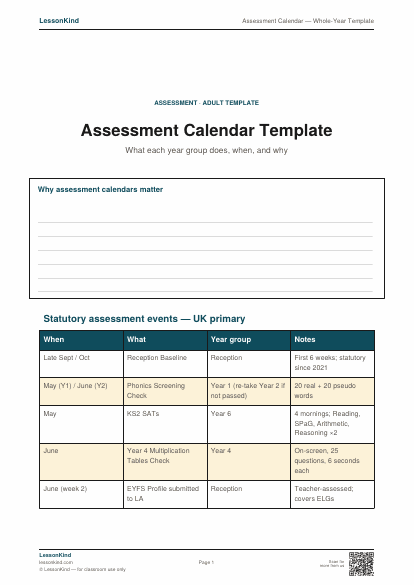
Assessment Calendar — Whole-Year Template
A whole-school assessment calendar template — when each year group does what, how it links to reporting, and how to keep assessment proportionate. The reference document an assessment coordinator builds in September and refers back to all year.
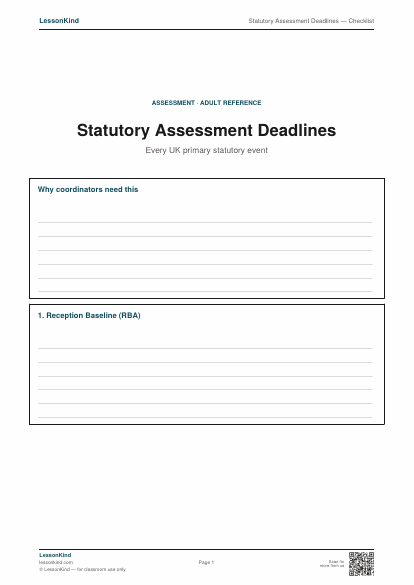
Statutory Assessment Deadlines — Checklist
Every statutory assessment deadline UK primary schools face — Reception Baseline, Phonics Screening, Y4 Multiplication Check, KS2 SATs, EYFS Profile. With prep timelines, coordinator's actions, and what gets flagged when.
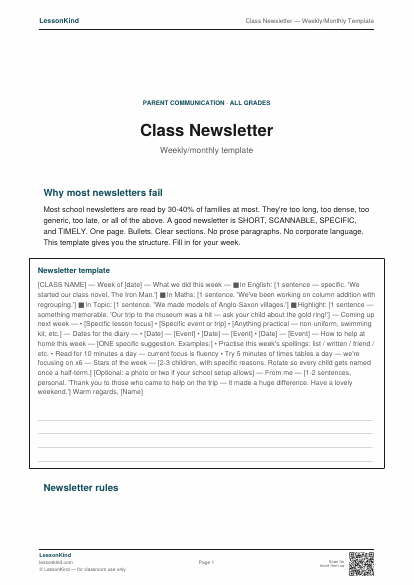
Class Newsletter — Weekly/Monthly Template
A simple, scannable class newsletter template — what we did, what's coming up, important dates, how to help. Designed to actually get read.
Keep reading
First-year teaching
What They Don't Tell You in Teacher Training
Teacher training prepares you for lesson planning. It does not prepare you for what your first term as a class teacher actually feels like. Here's the honest version.
7 min read
First-year teaching
The hidden curriculum of staff meetings
The hardest thing about your first year isn't teaching. It's reading the room — knowing who to ask, what's actually expected, who really runs which thing. None of this is in the induction pack. Here's a guide.
7 min read
Assessment & feedback
The Marking Trap
Most teachers spend hours every week on marking that produces almost no learning gain. Here's what the evidence says about feedback that actually works.
5 min read