Assessment & feedback · 5 min read
The Marking Trap
Why most marking doesn't help children learn — and what actually does
Published 2026-10-26
A common scene: a Year 4 teacher sits at her kitchen table on a Sunday afternoon, marking 30 books. She writes a comment in each one — "Lovely use of adverbs! Next time, try adding more detail to your description." She circles spelling errors. She adds a smiley face. The marking takes three hours. By Monday, the books go back to the children, who briefly glance at them, notice the smiley face, and turn the page to start the next lesson.
That three hours produced almost no learning.
This isn't a criticism of the teacher. She did exactly what most marking policies require. The problem is structural: the type of marking many schools require has been shown, repeatedly, in research, to be one of the least effective uses of teacher time.
The good news is that effective feedback exists. It just doesn't look like traditional marking.
What the research actually says
The Education Endowment Foundation has reviewed dozens of studies on feedback. Their findings are consistent:
- Feedback that focuses on the *task* and the *next step* is highly effective. - Feedback delivered *immediately* (in the lesson) is far more effective than delayed feedback (next day in books). - Written comments in books, especially long comments children read briefly, have minimal impact. - Marking codes (✓, S for spelling, // for new line) and brief next-step comments are more effective than long encouraging comments.
The biggest single insight: it's not about *quantity* of marking, but about whether children act on it.
Why traditional marking doesn't work
Several reasons:
**1. Children don't read it.** Most teachers know this. Children look at the page, see the smiley face, sometimes look at the comment, and move on. Deep engagement with feedback is rare.
**2. The feedback is delayed.** A comment written on Tuesday evening about Tuesday's writing is read on Wednesday afternoon, three lessons later, when the child has already moved on cognitively.
**3. The child can't act on it.** "Try adding more detail to your description" — but they're not writing another description today, so the advice never gets applied.
**4. The cognitive load on the teacher is unsustainable.** Three hours of marking, week in week out, eats teacher energy that would be better spent on lesson preparation.
What works instead
**1. Live marking during the lesson.**
You walk around the room as children work. You spot a misconception, kneel next to the child, point at it, ask "What does this need?", they self-correct. Total time: 30 seconds. The feedback was immediate, specific, and acted upon.
This isn't lazy — it's vastly more effective than any after-school marking.
**2. Whole-class feedback sheets.**
Instead of writing in each book, scan the books, identify the 3-4 most common issues, and address them collectively next lesson. "Yesterday I noticed lots of you weren't using full stops at the end of sentences. Look at this example. Now check your own work."
10 minutes of teacher prep, vastly more impact on the class than 3 hours of individual comments.
**3. Self-marking and peer-marking.**
Children mark their own (or each other's) work using a clear answer key or success criteria. They identify their own errors. The metacognitive work — "what did I get wrong and why?" — is the learning.
This requires explicit teaching of how to self-mark, but once trained, it's extraordinarily efficient.
**4. Verbal feedback codes.**
A small "VF" stamp in the book signals "I gave this child verbal feedback during the lesson". The marking is the conversation, not the writing.
What about the marking policy?
Many teachers reading this are thinking: "Yes, but my school's policy requires written comments in every book." Fair.
Two paths:
**Path A: Comply, but minimize.** If policy requires written comments, write the briefest possible useful comment. "Forgot capital letters — fix three." Not "I really enjoyed your writing! You used some great vocabulary! Next time try to remember capitals." Same purpose, 1/5 the time.
**Path B: Lobby for change.** If you have any influence (head of year, subject lead, etc.), the EEF research is your friend. Marking policies are increasingly being rewritten in the direction of "feedback-not-marking" because the evidence is overwhelming. Your school's policy can probably be improved.
The professional question
The deeper issue isn't really about marking technique. It's about whether teachers' time is being spent on what most helps children learn, or on what's most visible to inspectors and parents.
Marking is visible — books are inspected, parents flick through, leaders check. Live feedback isn't visible — it happens in the moment and leaves no trace. Many marking policies exist to produce *evidence of feedback*, not feedback itself.
A profession serious about children's learning would prioritise the latter, even at the cost of the visible artefacts. Whether your school is willing to is a real question.
What to do this week
If you can do nothing else, do this: in your next lesson, walk the room as children work. Stop at five children. Give each 30 seconds of specific verbal feedback. Tell them you're doing it. Then mark the rest of the books with just ticks and the comment "VF given to: [names]".
Three hours saved. Probably more learning gained.
That's the trade.
Free bundle for this topic
KS2 Maths Pack
10 maths resources designed for retrieval practice and low-stakes review.
Practical resources for this
Take this further
Printable, classroom-ready resources for the topics in this article.
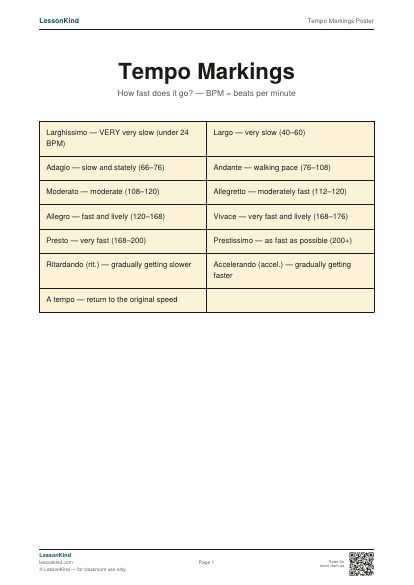
Tempo Markings Poster
Italian tempo terms with BPM ranges. Useful for music reading and ensemble work.
Tempo Markings Poster
Italian tempo terms with BPM ranges. Useful for music reading and ensemble work.
Tempo Markings Poster
Italian tempo terms with BPM ranges. Useful for music reading and ensemble work.
Going deeper
Books on feedback and marking
Books we'd recommend on the topics raised in this article.
Foundational
Convenience links to Amazon. As an Amazon Associate we earn from qualifying purchases at no extra cost to you. Read our affiliate disclosure.
Keep reading
Assessment & feedback
How to Give Feedback That Actually Changes the Work
Most marking has almost no effect on student work. Here's what does — and what to stop doing immediately.
7 min read
Assessment & feedback
Feedback That Changes the Work
Decades of research on feedback in education converge on one uncomfortable finding: most feedback given in classrooms produces little or no improvement. Here's what actually works.
7 min read
Teaching strategy
The Quiet Power of Low-Stakes Quizzing
Frequent low-stakes quizzes might be the single highest-impact, lowest-effort change you can make to your teaching this year.
6 min read
First-year teaching
What They Don't Tell You in Teacher Training
Teacher training prepares you for lesson planning. It does not prepare you for what your first term as a class teacher actually feels like. Here's the honest version.
7 min read