Behavior & classroom management · 7 min read
The Supply Teacher Who Makes Them Want to Listen
What separates a brilliant cover day from a chaotic one — and why it's not what most supply guides say
Published 2026-10-12
Schools talk about supply teachers in two categories. The ones they hope never come back, and the ones whose name they save in their phone and call first.
The difference between the two looks small from outside. The teacher walks in with a folder. They greet the children. They run a day. They write a handover note. They leave. The structure is identical.
What's different is invisible from the corridor and visible to anyone in the classroom. It's the way 30 children, with no relationship to this stranger, find themselves wanting to listen by 9:15. The way the morning's work gets done at the right pace. The way the difficult Wednesday-afternoon lull never comes. The way the supply leaves at 3:30 and the regular teacher, returning Monday, finds the work in books, the room tidy, the children settling on the carpet for story time as if nothing had changed.
This article is about what those teachers actually do — which is rarely what supply training tells you to do.
The advice you usually get
Most published advice for supply teachers focuses on the same handful of things:
- Be firm from the start - Don't smile until Christmas - Establish your authority quickly - Threaten consequences if needed - Don't try to be their friend - Use the school's behavior system
Some of this is fine. Some of it actively makes things worse. None of it is what the great supply teachers actually do.
The 'be firm' advice imagines that children will misbehave unless they're afraid of you. The teachers who succeed in unfamiliar classrooms know better — children misbehave when they're bored, anxious, confused, or being treated badly. None of these get fixed by firmness. Firmness on top of any of them produces escalation.
The 'establish your authority' advice imagines that authority is something you grab. In the classroom, authority is something children GIVE you, often within the first 5 minutes, based on what they read about you. If they read steadiness, competence, and warmth, they grant authority. If they read anxiety hidden behind volume, they don't.
The 'use the school's behavior system' advice is sometimes useful but often misses what's actually possible. Behavior systems work for the teachers children know. For a stranger, the system is barely a tool — there's no relational weight behind it. Different things work for the relationship-less day.
What the great ones actually do
Watch a supply teacher who gets called back. A few patterns repeat.
**They walk in 30 minutes early.** Not 5 minutes. Half an hour. They find the room. They look at the timetable. They scan the cover folder. They write the day's outline on the board. They put resources where they'll need them. By the time the children arrive, they're not improvising — they're delivering. The bell-time stress that ruins many cover days is largely about preparation. The first half-hour of the day determines the rest.
**They greet at the door.** Each child by name (using the class list) where possible. Eye contact. Five seconds. This single act, more than any 'firm authority' move, shifts the children from 'a stranger is here' to 'an adult I am known by.' The whole day gets easier from this moment.
**They state expectations briefly and start.** Not a 5-minute speech about rules. Not 'I expect...' Not 'in this classroom...' Just: 'I'm Mr/Mrs X. Mrs Walker is away today. We're going to have a brilliant day. First, we're doing maths. Books out, please.' Confidence. Onwards. Don't dwell.
**They use first names within minutes.** 'Sam, well done for being ready.' 'Sofia, thank you for getting out your pencil.' Naming children is an enormous psychological move. It tells them you've SEEN them. It puts you in the position of 'adult who knows you,' not 'stranger filling in.'
**They catch positive behavior immediately.** The first 10 minutes have at least 3 specific named compliments. 'Liam, your handwriting is so neat.' 'This row are working really well together.' This is not flattery — it's setting the climate. Children pick up VERY fast on what gets noticed. If positives get noticed, they perform positives.
**They speak at lower volume than the room.** Not louder. Quieter. Children lean in to listen. The teacher who SHOUTS over noise to be heard signals that they can't manage the noise. The teacher who speaks below it commands attention by being the only calm thing in the room.
**They don't compete with the regular teacher.** No 'Mrs Walker doesn't let you, but I'm easier.' No 'in MY classroom we...' They just teach the day's content with their own competence. Children respect not having to choose sides.
**They keep the day moving.** Five minutes of dead time on a cover day = trouble. The good ones plan transitions, fillers, and shifts in pace. The day flows. There's no 'now what?' moment that gives drift its opening.
**They use the children to learn.** 'Sofia, where do you put finished work?' 'Liam, who normally does the register?' Children love being useful. They love showing the new adult how things work. The information you need IS in the room — children will give it to you if you ask kindly.
**They keep their own composure.** When something is hard — a difficult child, a confusing situation, an unexpected event — they slow down rather than speed up. The supply teacher's nervous system is the most important variable in the room.
**They write a useful handover.** Not a list of complaints. Specifics about what got done, who needed support, what works. This is the second-most-important thing they do. The class teacher reads it on the morning of their return; it shapes everything that follows.
What the bad ones do
The patterns also repeat in the other direction.
**They walk in 5 minutes before the bell.** No prep. They're already behind. The day's improvised. Things go wrong because they're not set up to go right.
**They start with rules and threats.** 'I won't tolerate any disruption today. I will be giving out cards/sending children to the head/keeping people in at break.' Children read it as: this person is anxious. They will produce exactly what is feared.
**They speak loudly to be heard.** Children realise within minutes that the supply needs volume to function. They escalate the noise. The supply escalates further. By 10am the supply is hoarse and the class is in chaos.
**They take it personally.** A child rolling their eyes is read as defiance and addressed publicly. A whispered comment is treated as a calculated insult. The supply gets drawn into individual battles instead of running a productive day.
**They give up.** By 11am, they've decided this is a 'bad class' and reduced their effort accordingly. Children sense it. The afternoon dissolves. By 2pm they've put on a video.
**They write a defensive handover.** A list of children who 'should be punished.' Vague accusations of misbehavior. No specifics, no celebration. The class teacher reads it Monday and groans — they have to repair what the supply created.
A note on 'difficult' classes
Schools sometimes warn supply teachers about difficult classes. 'Just to let you know, this class can be tricky.'
Two responses are possible.
The bad supply takes the warning as licence to expect chaos. They start the day already defensive, already braced for problems, already running a discount version of teaching because 'they wouldn't engage anyway.'
The good supply takes the warning as USEFUL INFORMATION and adjusts. Tighter transitions. Shorter blocks. More movement. More named compliments. More precision in expectations. They don't run a worse day for the difficult class — they run a more carefully designed one.
Notably, the good supply often finds the 'difficult' class isn't that bad. Children who have been read as difficult often respond brilliantly to clear expectations, calm authority, and named appreciation. The reputation comes from teachers who didn't bring those things.
What schools could do better
A note for schools who book supply teachers.
**Pay enough that the good ones come back.** Supply rates that vary widely between agencies and schools mean the best teachers cluster at the schools that pay properly. If you're getting consistently disappointing supply, your rate may be a factor.
**Have a real cover folder.** Not last week's printout. A genuine emergency pack with class info, today's plan, all resources. Schools that prepare these find supply teachers WANT to come back.
**Brief the staff to support.** A welcoming year partner, a friendly office, a senior leader who pops their head in to say hello — all of these matter. The schools where supply teachers feel held are the schools that get the good ones.
**Be honest about challenges.** A class with a known difficulty can be supported if the supply knows. Not flagging it, in the hope that today will be different, sets the supply up to fail.
**Read their handover.** And respond. A good supply who writes a thoughtful handover and gets no acknowledgment slowly stops writing thoughtful handovers. The feedback loop matters.
A final word
The supply teachers schools call first are not the firmest, the strictest, or the loudest. They're the ones who walk in prepared, greet by name, work calmly, catch positive behavior, keep the day moving, and write a useful handover at the end.
These are basic things. They're also the things most supply training doesn't actually teach. The 'be firm' advice gets the focus, but the actual skills — walking in 30 minutes early, the discipline of a quiet voice, the specific named compliment — are what separates the supply who gets called back from the one who doesn't.
If you're a supply teacher reading this, internalising these is the work. If you're a school leader reading this, supporting these is the work. Either way, the day gets dramatically better when these are happening — for the children, for the teacher, and for the regular teacher returning Monday morning to find the room they recognise still there.
Free bundle for this topic
Cover Day Survival Pack
9 resources for any cover day, including behavior strategies and morning meeting scripts.
Practical resources for this
Take this further
Printable, classroom-ready resources for the topics in this article.
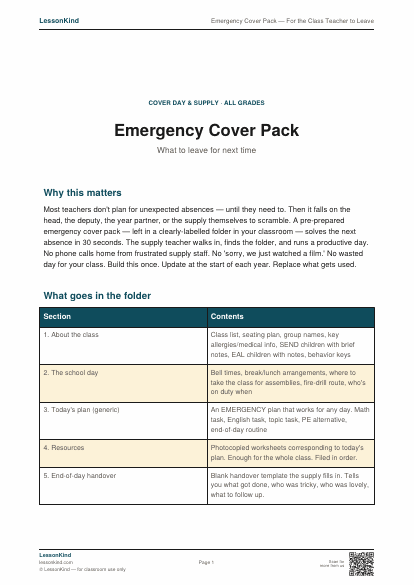
Emergency Cover Pack — For the Class Teacher to Leave
What every class teacher should keep printed in their classroom drawer — a one-day emergency cover pack so a supply teacher can run the day without disrupting learning. Builds itself from your existing materials.
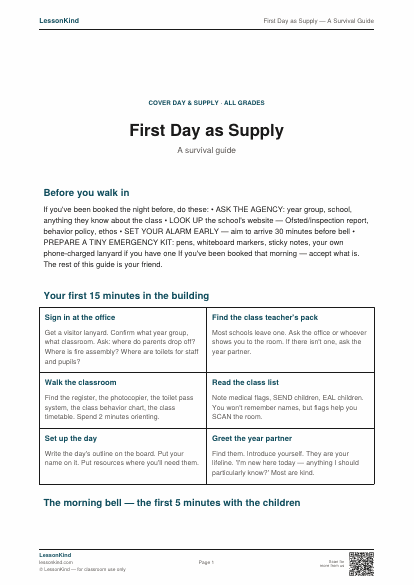
First Day as Supply — A Survival Guide
What to do in your first 15 minutes in an unfamiliar classroom. How to win the morning before the children arrive. How to manage the rest of the day. Field-tested supply teacher survival.
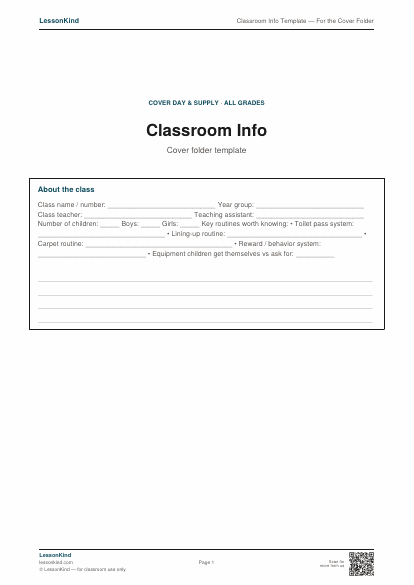
Classroom Info Template — For the Cover Folder
A printable template for the 'about your class' page that goes in the emergency cover folder. Class list, seating plan, medical flags, SEND notes — all in one page.
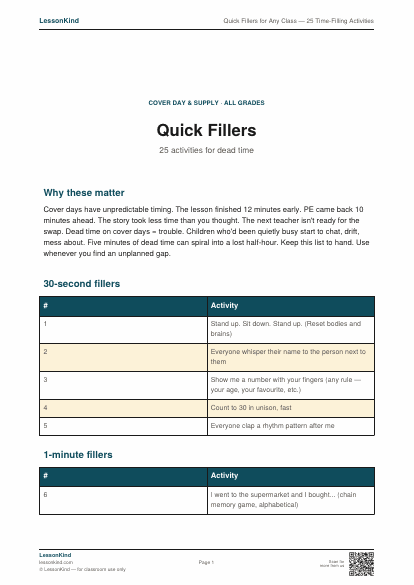
Quick Fillers for Any Class — 25 Time-Filling Activities
25 quick activities for the dead time that happens on cover days — finished a lesson early, transition went fast, the class arrived back from PE 10 minutes early. From 30 seconds to 15 minutes long.
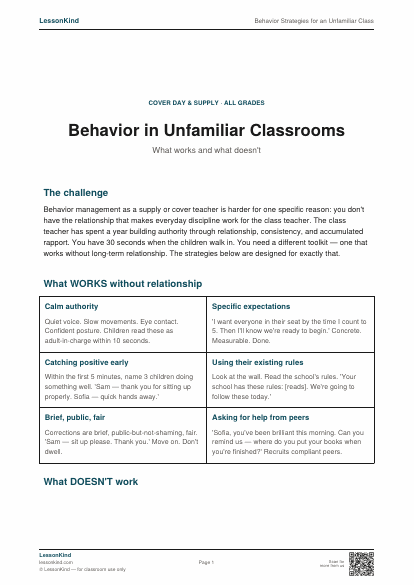
Behavior Strategies for an Unfamiliar Class
What works (and what doesn't) when you don't know the children, the school's rules, or where the head's office is. Quick-deploy strategies for the unfamiliar classroom.
Keep reading
Behavior & classroom management
The First Two Weeks: The Behavior Foundation You Can't Build Later
Most teachers know the first two weeks matter. Few know how MUCH they matter, or what to do with them. The behavior of your class in June is largely determined by what you do — or fail to do — in September.
8 min read
Classroom culture
Why Your Routines Matter More Than Your Lesson Plans
First-year teachers spend hours on lesson plans and almost no time on routines. The teachers whose classrooms run beautifully have it the other way around.
6 min read