Behavior & classroom management · 8 min read
The First Two Weeks: The Behavior Foundation You Can't Build Later
Why September is when the year is decided — and what to actually do with those 14 days
Published 2026-09-01
There's an unromantic truth about teaching that experienced teachers rarely tell new ones: the behavior of your class in June is mostly determined by what you do in the first two weeks of September.
This is not because the rest of the year doesn't matter. It does. But the foundation you build (or don't build) in those first 14 days sets the ceiling for everything else. A class with strong routines, clear expectations, and good relationships in mid-September can be stretched, challenged, and developed throughout the year. A class without those things spends the year being managed.
If you're an experienced teacher, none of this will be news. If you're newer, this article is what I wish someone had told me before my first September.
Why those first two weeks are different
In any social group — a workplace, a sports team, a class of children — the early days set the norms. People are watching to learn how things work here. What's tolerated. What's expected. Who's who. Whether the leader can be trusted to hold the line.
Children do this faster and more sharply than adults. By the end of week one, they have a mental model of you and your class:
- Is the teacher consistent or inconsistent? - Is the teacher fair or arbitrary? - Is the teacher kind, or does kindness have to be earned? - Are the rules real, or do they bend? - Who in this class can be relied on? - Who's likely to be trouble? - What can I get away with?
Once formed, these mental models are very hard to change. A teacher who's seen as inconsistent in week one is treated as inconsistent in week twelve, even if their behavior has tightened up. A class that has decided the teacher is fair will give them the benefit of the doubt for months.
This is why September is asymmetrically important. You don't get to undo a sloppy September with a tighter November. You get to limit the damage.
What you actually need to do
A few non-negotiables. None are clever. None are particularly exciting. But each one matters disproportionately.
**Stand at the door every morning.** Not because it's cute. Because it's the first signal of the day that you are present, in charge, attentive, and have noticed each child individually. Greet every single one of them by name. Eye contact. Smile. "Morning, Marcus. Good weekend?" Doing this for two weeks (and then on most mornings of the year) saves more behavior incidents than any other single act. The child who has been greeted by name is in the room differently than the child who slipped in unnoticed.
**Teach your routines explicitly.** Not "show them where things are." Actually teach how to enter the room, how to put a coat on a peg, how to sit on the carpet, how to put a hand up, how to walk through the school, how to come back from break, how to pack up at the end of the day. Each routine should take 5-10 minutes to teach in detail. Do it with the air of someone teaching something important, not someone explaining something obvious.
**Hold the line on small things.** A child sits with their feet up on the chair. You quietly say, "feet down, please." They put their feet down. Why does this small moment matter? Because what you do here decides whether the rule is real. If you let it slide once, you've taught the class that the rule is performative, not real. If you hold the line — kindly, but firmly — you've taught them it's real. Hold a hundred small lines in week one, and you'll spend the year holding ten.
**Praise specifically and immediately.** When a child does something right, name it. "Sofia, thank you for getting started straight away." "Marcus, I noticed you put your chair in. That's exactly what I asked for." Specific praise teaches the class what counts as right. Vague praise ("good job!") teaches them nothing. Within two weeks, children should know precisely what behaviors get noticed.
**Don't try to be popular.** New teachers, especially new young teachers, often try to be liked in the first weeks. Children pick up on this immediately. They like the teacher who is consistent, fair, and kind — much more than the teacher who is desperate to be liked. The popularity comes later, as a side effect of being a good teacher. It can't be the strategy.
**Be unfailingly polite.** "Could you please...?" "Thank you for that." "I'd really appreciate it if..." Children mirror the manners around them. A polite teacher gets a polite class. A teacher who barks orders gets a class that barks at each other. This is one of the cheapest interventions in education.
The relational layer
Routines and rules are necessary but not sufficient. The other half of the foundation is relational: the children deciding, by the end of week two, whether they trust you.
Trust in primary school is built from very specific things:
- **Predictability.** They can predict how you'll respond. The same situation gets the same response. This is more important than the response being perfectly calibrated. Imperfect-but-consistent beats perfect-but-erratic.
- **Fairness.** The same rules apply to everyone, including teacher's-pet types and the child who's already in trouble. Children have unfailing radar for differential treatment. Lose this in week one and you lose the year.
- **Curiosity about them.** You ask questions and listen. You remember what they told you yesterday. You notice the new shoes, the haircut, the football shirt. None of this is fake — it's the genuine interest of someone who wants to know who's in the room.
- **Recovery from mistakes.** They watch what happens when something goes wrong — when a child mucks up, when YOU muck up. Do you stay calm? Do you apologise when you should? Do you not carry incidents into the next day? Recovery shows them what kind of person you are.
The most overlooked of these is the last one. New teachers especially can be tempted to be flawless — never make a mistake, never apologise, never be wrong. Children rarely respond well to flawlessness. They respond well to a teacher who handles mistakes (theirs and their own) with grace. It models the very recovery they need to learn themselves.
Things you should NOT do in the first two weeks
A few traps.
**Don't make threats you can't keep.** "If anyone speaks at the line, we won't go to the swimming pool!" Don't threaten consequences you have no intention of imposing. Children test this within hours.
**Don't punish the whole class for individuals.** "Because of Marcus, the whole class will miss break." Almost guaranteed to backfire. The class doesn't blame Marcus — they blame you.
**Don't reset the rules every day.** "Today we're going to try something new." Children need stability. New approaches every day = no approach at all.
**Don't rely on telling them off.** Telling off works rarely and badly. The children who needed it most have heard it from a hundred teachers and developed defences. The children who didn't need it are now scared. Use telling-off sparingly, calmly, privately when possible.
**Don't worry about being friends yet.** That comes much later, and only if you've been a competent teacher first. Trying to be friends with children in week one usually undermines authority and confuses everyone.
**Don't change the seating plan in week three because of the falling-out.** First, you need data. Second, the seating plan is part of the routine — change too early and you signal everything is up for grabs. Hold the structure for a half-term unless someone is in real distress.
What success looks like by mid-September
By the end of two weeks, you should be able to walk into your classroom in the morning and have:
- The room set up correctly because the children know where things go - A class that arrives quietly because they've been taught how to arrive - Children getting started on the day's first task because they know what to do - A working relationship with each child — even the difficult ones - A few clear, well-understood routines that the class can perform without prompting - A sense of yourself as the teacher of this class, not a visitor in their room
You won't have a perfect class. You won't have solved any deep behavior issues. The autistic child will still find transitions hard. The child with ADHD will still fidget. The anxious child will still need reassurance. But the FOUNDATION will be there, and you can build on it.
If you don't have these things by mid-September, you can still recover — but it will take much longer than building them properly in the first place.
A final thought
The first two weeks of September are also when YOU are deciding what kind of teacher you want to be. Patient or hurried. Calm or frantic. Curious or controlling. Specific or vague. Consistent or unpredictable.
Children learn who you are by watching what you do under pressure — and the first two weeks are nothing but pressure. New names. New routines. New systems. Parents you don't know. Colleagues you barely know. A class that doesn't yet know you.
Be deliberate about who you're being. Be specific about what you're teaching. Be patient with the slowness. Be kind to yourself when it's hard. The foundation will build, day by day, even when it doesn't feel like it.
By half term, you'll know whether the September foundation held. If it did, the rest of the year is yours to build. If it didn't, you'll know what to fix next time. Either way, the year is decided in those first 14 days more than anywhere else.
Free bundle for this topic
Cover Day Survival Pack
9 resources for any cover day, including behavior strategies and morning meeting scripts.
Practical resources for this
Take this further
Printable, classroom-ready resources for the topics in this article.
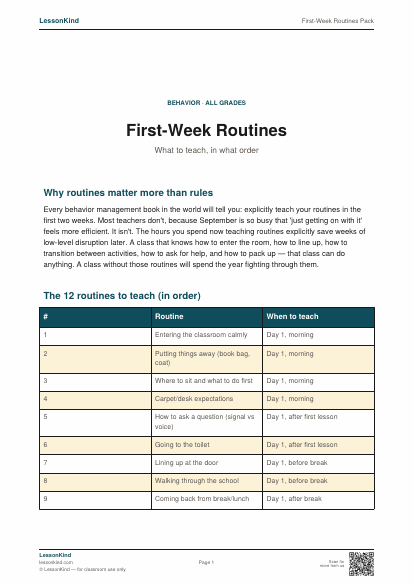
First-Week Routines Pack
The 12 routines you must establish in the first two weeks — entry, transitions, lining up, asking for help, finishing work, end of day. With explicit teaching scripts.
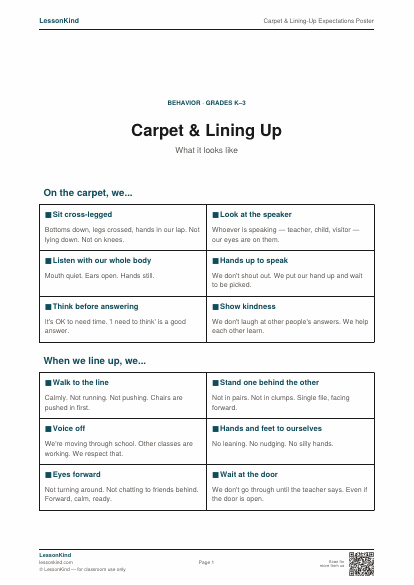
Carpet & Lining-Up Expectations Poster
A two-poster set showing exactly what 'good carpet' and 'good lining up' look like. Visual support for younger children — print A3, mount where children can see.
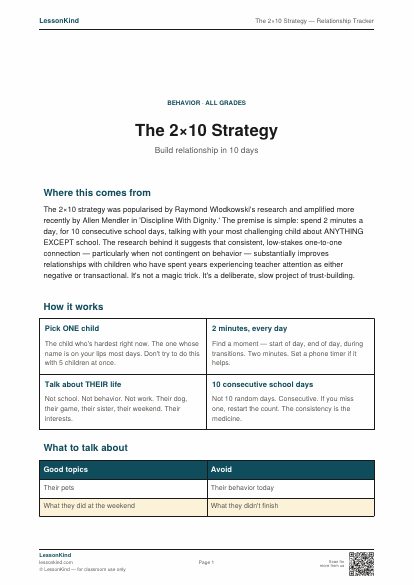
The 2×10 Strategy — Relationship Tracker
An evidence-informed approach to building relationship with the most challenging child in your class — 2 minutes a day, 10 days, talking only about non-school topics. With a tracking sheet.
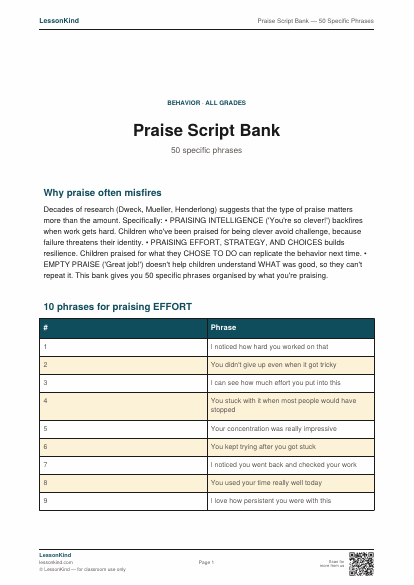
Praise Script Bank — 50 Specific Phrases
50 specific praise phrases you can use in the classroom — focused on effort, strategy, and behavior, not ability. Built around the research on what kinds of praise actually motivate children.
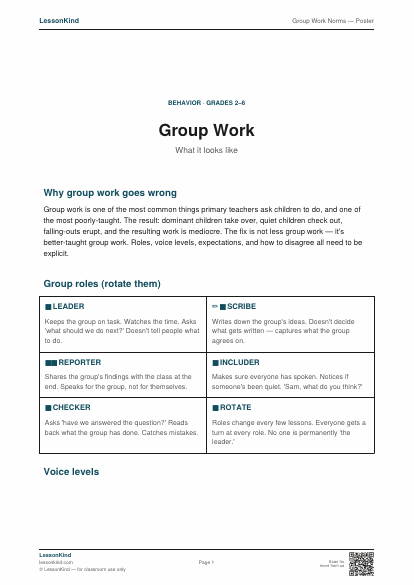
Group Work Norms — Poster
A visible reference for what good group work looks like — roles, voice levels, how to disagree, how to share work fairly. Print A3, mount, refer to often.
Going deeper
Books on first-week behaviour and routines
These are the texts that shape how we approach the start-of-year behaviour foundation.
On routines and class culture
On warmth + boundaries
Convenience links to Amazon. As an Amazon Associate we earn from qualifying purchases at no extra cost to you. Read our affiliate disclosure.
Keep reading
Classroom culture
The Most Important Week of the Year
Most teachers think the first week is for getting to know the children. The teachers whose classrooms run beautifully use it for something quite different.
6 min read
Classroom culture
Why Your Routines Matter More Than Your Lesson Plans
First-year teachers spend hours on lesson plans and almost no time on routines. The teachers whose classrooms run beautifully have it the other way around.
6 min read
First-year teaching
Five Mistakes I Made as a New Elementary Teacher
If I could go back and shake my first-year teacher self by the shoulders, here's what I'd say.
7 min read
Classroom culture
Five Minutes That Change the Day
A short, deliberate morning circle changes how the rest of the day runs. Here's why it works — and why teachers who skip it end up paying for it.
5 min read