Classroom culture · 6 min read
Why Your Routines Matter More Than Your Lesson Plans
The invisible architecture of a good classroom
Published 2026-05-07
You can have the best lesson plan in the world. If your class spends fifteen minutes settling, you've lost a third of it.
This is the unspoken truth of elementary teaching: routines are not the boring background to the real work. Routines ARE the real work. They are the invisible architecture that lets everything else happen.
What a routine actually is
A routine is a repeated, predictable sequence the children can do without you having to direct it. The children walk in, hang up bags, choose a book, sit on the carpet — every morning, the same way, without you saying a word about it. A routine is the difference between issuing thirty individual instructions and the room running itself.
The routines that matter most
Some routines are make-or-break. If you only invest in five, make them these:
**Entry.** What happens between the bell and the start of teaching? In a well-routined room: bags away, books out, settling task on the board, register taken silently. In an unrouted room: shouting, lost pencils, three children still in the corridor.
**Transitions.** The shift from carpet to desks, from one subject to the next, from inside to outside. Transitions are where 80% of classroom time is lost. Time them. Practice them. Make them silent or near-silent.
**Talking.** Children should know the difference between (a) silent independent work, (b) partner whisper, (c) full-volume group discussion, (d) the teacher's-listening hand signal. A different cue triggers each. They should never wonder which one applies.
**Resources.** Where pencils, scissors, glue, paper live. Who hands them out. Who collects them in. How they end up neat at the end of the day. If three children are wandering at any moment looking for a sharpener, your routine isn't tight enough.
**Endings.** The last ten minutes of the day. Tidying, reflecting, preparing for tomorrow. If endings are chaotic, mornings will be worse.
How to teach a routine
You teach a routine the same way you teach a math procedure. You explain it. You demonstrate it. The children practice it. You give feedback. They practice again. They get better.
This means September is genuinely about teaching procedures, not content. New teachers feel guilty about this — "but I've barely covered any maths in week one" — and end up with classrooms that bleed time for the next ten months. Resist that pressure. The most experienced teachers in your school spent the first two weeks rehearsing how to walk through a corridor in silence. They knew what they were doing.
When a routine breaks
It will. Children get tired, the weather changes, a fire drill cuts a lesson in half, you yourself have a wobbly day. When a routine starts slipping, don't yell more or threaten consequences. Re-teach it. "We've got a bit out of practice with our quiet line. Tomorrow we'll practice — for real, I'll time us." Then practice it. Then praise it.
What to drop
The hours you spend designing the perfect lesson plan in PowerPoint. The lesson is going to be 60% routine and 40% content. If the routines are tight, almost any clear, well-paced lesson will work. If the routines are loose, even a brilliant lesson will be hostage to chaos.
Plan less. Routine-build more. Your future-self in February will thank you.
Free bundle for this topic
Cover Day Survival Pack
9 resources for cover days and routines, including behavior systems and morning meeting scripts.
Practical resources for this
Take this further
Printable, classroom-ready resources for the topics in this article.
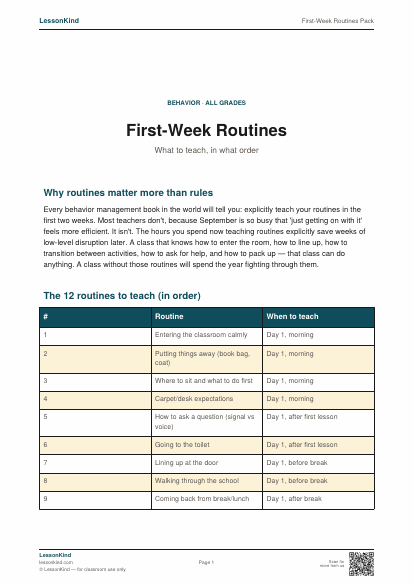
First-Week Routines Pack
The 12 routines you must establish in the first two weeks — entry, transitions, lining up, asking for help, finishing work, end of day. With explicit teaching scripts.
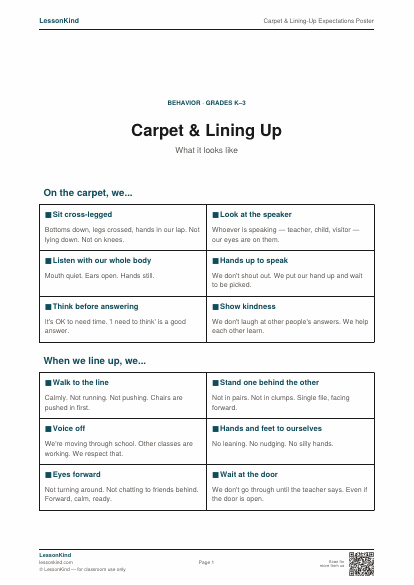
Carpet & Lining-Up Expectations Poster
A two-poster set showing exactly what 'good carpet' and 'good lining up' look like. Visual support for younger children — print A3, mount where children can see.
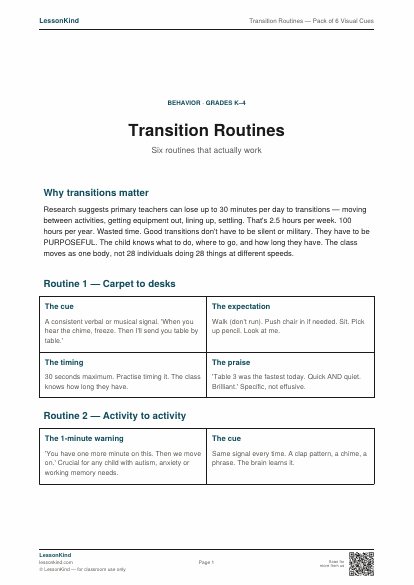
Transition Routines — Pack of 6 Visual Cues
Six classroom transition routines that genuinely work — from carpet to desks, between activities, lining up, end of day. Visual cues, scripts and timing.
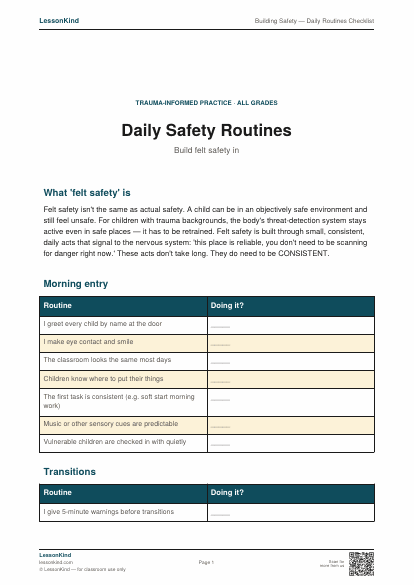
Building Safety — Daily Routines Checklist
The small daily routines that build felt safety for children with trauma backgrounds — entry rituals, transitions, exits. Audit your day.
Going deeper
Books on classroom routines and culture
The texts that argue routines deserve more attention than they typically get.
Foundational
Convenience links to Amazon. As an Amazon Associate we earn from qualifying purchases at no extra cost to you. Read our affiliate disclosure.
Keep reading
Behavior & classroom management
The First Two Weeks: The Behavior Foundation You Can't Build Later
Most teachers know the first two weeks matter. Few know how MUCH they matter, or what to do with them. The behavior of your class in June is largely determined by what you do — or fail to do — in September.
8 min read
Classroom culture
The Most Important Week of the Year
Most teachers think the first week is for getting to know the children. The teachers whose classrooms run beautifully use it for something quite different.
6 min read
Behavior & classroom management
What Trauma-Informed Teaching Actually Means in Year 4
'Trauma-informed' has become a school slogan, sometimes deployed by leadership without actually changing anything. This article is about what genuinely changes when the framework is taken seriously — and what doesn't.
9 min read