Teaching strategy · 6 min read
The Transition to Secondary School (And How to Support It)
What primary teachers can do for Year 6 to make Year 7 easier
Published 2026-11-13
Picture this: your Year 6 class spent the last term doing brilliantly. Confident readers, capable mathematicians, articulate writers, well-behaved, kind to each other. They left primary in July full of pride.
In late October, you bump into one of their parents. "How's Sarah getting on at secondary?" you ask. The parent's face falls slightly. "She's struggling, actually. She's quiet, hardly talks at home, and her teachers are saying she's behind the others. We're worried."
This is so common it should have a name. Let's call it the Year 7 dip — the well-documented phenomenon of children losing confidence and academic momentum in their first term at secondary. It's a real, measurable effect.
What's actually happening in Year 7
The transition from primary to secondary is enormous, in ways adults often underestimate:
**1. Class size scales up.** A child who knew every face in a 30-pupil class is suddenly in a 250-pupil year group. The friend group dilutes overnight. The "best at maths" child discovers there are 30 children better than them in their cohort.
**2. The relationship with teachers fragments.** In primary, one teacher knew the child intimately. In secondary, 8-10 teachers each have 200+ students and barely know any of them by face for the first half-term. The personalised attention that drove confidence in primary largely disappears.
**3. The work suddenly looks harder.** Year 7 maths after the summer feels harder than Year 6 maths just before. This is partly because curriculum content jumps in pace, but mostly because the supports children leaned on in primary (hints from the teacher, paired work, immediate feedback) thin out dramatically.
**4. Independence demands explode.** Move classrooms each lesson. Find your way around. Manage your own diary. Do homework without prompting. Bring the right books. Children who've never had to organise themselves at this level often crash badly.
**5. Social pressures intensify.** The shy child becomes the invisible child. The friendly child has to make new friends from scratch. The bullied child often finds bullying continues with new vigour from a wider pool.
For some children, the combination is overwhelming. They go from confident Year 6 to anxious, withdrawing Year 7 in weeks.
What Year 6 teachers can do
The good news: Year 6 teachers have unusual leverage on the transition. Specific moves matter.
**1. Build genuine independence in the spring term.**
By Easter of Year 6, children should be: - Completing tasks without immediate teacher feedback - Self-marking some of their work - Working independently for 30+ minute stretches - Recovering from setbacks without adult intervention - Tracking their own progress over time
Many Year 6 classes are still highly scaffolded right up to leaving. These children find Year 7 brutal. The classes that gradually withdraw scaffolding through Y6 produce children who cope much better.
**2. Take them through structured 'cold' challenges.**
Periodically give them a task with no warm-up, no front-loading, no examples — just "do this, you have 30 minutes". This simulates secondary expectations. The first time, they panic. The fifth time, they handle it. By Year 7, this is normal.
**3. Discuss secondary explicitly.**
Don't mythologise it. Don't sugar-coat it. Don't terrify them. Just talk about it honestly: - "Most teachers won't know your name on day one. That's normal." - "You'll feel lost for the first two weeks. That's normal." - "The work will feel harder. That's because the volume is higher, not because you're worse." - "If you're struggling, every secondary has support. Ask your form tutor."
Naming the experience in advance lets them recognise it when it happens, instead of believing they're uniquely failing.
**4. Send them with a strong organisational system.**
Teach diary-keeping. Teach how to use a daily checklist. Teach how to pack a school bag the night before. These look like life-skills not curriculum, but they're often the difference between coping and crashing in Year 7.
**5. Be honest in your transition information.**
The "All About Me" forms that go to secondary are often filled with vague positives. "Sarah is a kind, hardworking student who has made progress this year." This tells the secondary teacher nothing.
A useful transition note: "Sarah is shy and won't volunteer answers. Cold-call her in non-pressured ways or she'll go invisible. She's strong at writing but needs structure for maths. Watch the silent struggle."
That kind of note actually helps. The vague version doesn't.
**6. Celebrate the leaving, but warn about week three.**
"You'll have a big leavers' assembly. You'll hug each other. You'll feel like you're saying goodbye to childhood. Some of you will cry. That's all fine and normal.
Then in three weeks at secondary you'll be sitting in a maths lesson feeling completely lost. That's also normal. It will get better. It always does. By Christmas you'll be settled. By Year 8 you'll wonder why you were ever scared."
Naming what's coming gives them anchors when the storm hits.
What parents can do (if they ask you)
Parents of Year 6 children often ask for advice about the transition. The honest things to say:
**1. The first half-term will be hard. That's normal, not a problem.** Don't panic if your child seems quieter, more tired, more withdrawn in September. That's typical. Watch, support, but don't catastrophise.
**2. Don't compare to primary.** Your child will not be the same kind of student in Year 7 as they were in Year 6. The expectations are different. Comparing is unhelpful.
**3. Sleep matters more than ever.** The cognitive load of secondary needs sleep to consolidate. A tired Year 7 is a struggling Year 7. Bedtime routines matter through October at least.
**4. Build the relationship with the form tutor.** That one teacher is your link into the school. Email them with concerns, don't try to navigate the whole school's systems. Form tutors are usually willing to help if approached.
**5. Make space for talking — without forcing it.** Walk to the shops together. Drive to grandma's. Don't ask "How was school?" because they won't tell you. Just be present, available. Most secondary children open up eventually if you're nearby and listening.
What to avoid
**Don't tell Year 6 children "secondary will be amazing".** It often isn't, especially at first. Setting them up to expect amazing means crushing them when reality lands.
**Don't tell them "secondary teachers will be tough on you".** Some are, some aren't. The blanket warning makes them defensive on day one.
**Don't drill them on Year 7 maths content over the summer.** Work-readiness in September matters less than wellbeing-readiness. Spend the summer letting them be children, not pre-prepping them.
**Don't make a big deal of every "I miss primary" comment in autumn term.** Acknowledge it, sit with it, then redirect. They are also missing childhood, family routines, simpler social dynamics — not just primary specifically. Helping them adjust matters more than agreeing primary was better.
The longer view
Children mostly survive the transition to secondary. Most are settled by Christmas of Year 7. By Year 8, the dip is usually a memory.
But the children whose Year 6 teacher set them up well — with genuine independence, honest framing, organisational habits, and emotional preparation — have a noticeably easier landing. Sometimes the difference between coping and crashing is one or two structural things they were taught in the spring of Year 6.
It's worth the work. The children themselves often only realise it years later, but it's one of the most consequential pieces of teaching primary practitioners do.
Practical resources for this
Take this further
Printable, classroom-ready resources for the topics in this article.
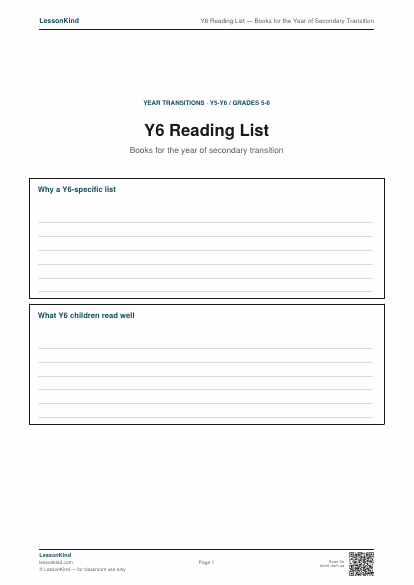
Y6 Reading List — Books for the Year of Secondary Transition
Books for Y6 children — the year before secondary, where reading taste matters most and reading is the strongest predictor of secondary attainment. Calibrated for the Y6 cohort specifically — friendship, identity, change, growing up.
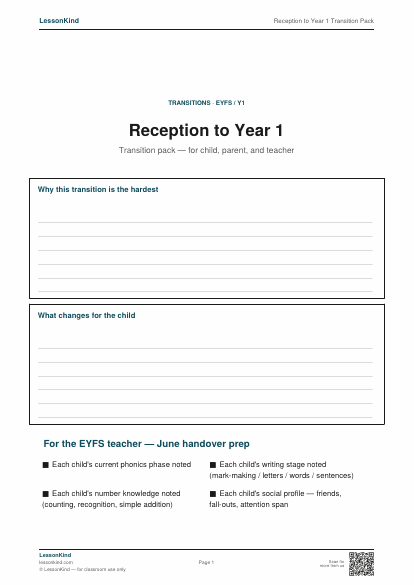
Reception to Year 1 Transition Pack
The single biggest transition in primary — from play-based EYFS to a more structured Year 1 classroom. Activities, parent letter, classroom routines, and EYFS-to-KS1 staff handover sheet for the gentlest possible move.
Going deeper
Books for the primary-secondary transition
Books we'd recommend on the topics raised in this article.
Practitioner
Convenience links to Amazon. As an Amazon Associate we earn from qualifying purchases at no extra cost to you. Read our affiliate disclosure.
Keep reading
First-year teaching
What They Don't Tell You in Teacher Training
Teacher training prepares you for lesson planning. It does not prepare you for what your first term as a class teacher actually feels like. Here's the honest version.
7 min read
First-year teaching
Your First Parents' Evening (And How Not to Dread It)
Parents' evening can feel like 30 high-stakes interviews with strangers. Here's the structure that works, and the phrases that get you out of awkward moments gracefully.
5 min read