First-year teaching · 5 min read
Your First Parents' Evening (And How Not to Dread It)
The structure that takes the panic out of 30 ten-minute slots
Published 2026-10-18
For most NQTs, the first parents' evening is more nerve-wracking than any lesson observation. You're meeting 30 families in three hours, you don't know which children's parents are going to be lovely and which are going to be combative, and you have to sound authoritative about a child you've taught for six weeks.
The good news: 95% of parents at parents' evening are nervous too. They're worried about their child, hoping you'll say good things, and they want it to go smoothly as much as you do. With a clear structure, almost every meeting is fine.
The structure that works (10 minutes per family)
**Minute 0-1: Greeting and frame**
"Hi, lovely to meet you, do come and sit down. So I'm going to talk to you for a few minutes about how [child] is doing — what's going well, where they're working on things — and then we'll have time at the end for any questions you might have."
This sentence does a lot of work. It establishes that *you* are running the meeting, not them. It tells them when questions are coming (so they don't interrupt). It frames the meeting as collaborative.
**Minute 1-4: What's going well**
Always start positive. Find three specific things the child does well. Not "she's lovely" — be specific. "She's a confident reader, she takes care with her presentation, and she's a kind friend in the playground."
Specificity matters. Vague praise sounds insincere; specific praise sounds like you actually know the child.
**Minute 4-7: What we're working on**
The phrase to use is "what we're working on" — not "weaknesses" or "concerns" (unless there's a real concern). Frame everything as something the child is in the process of getting better at.
"We're working on stamina in writing — she has good ideas but the pieces are quite short. We're going to focus this term on building those up." Then say what you're doing about it: "I'm using paired writing and short daily journal writes."
This positions you as actively supporting, not just diagnosing.
**Minute 7-9: Their questions**
"What questions do you have for me?" Then *listen*. Most parent questions are easy — "How can we help at home?", "Is she making friends?", "What's the homework expectation?"
If they ask something you don't know — "Yes, I'll need to check that and email you" is a perfectly fine answer. Better than guessing.
**Minute 9-10: Wrap up**
"Lovely to meet you both. Thanks for coming. Anything urgent please email — and we'll catch up at the end of term." Stand up. Smile. Walk them to the door if you can.
The phrases that save you
**For the parent who asks "Is she gifted?":** "She's a strong learner. We don't formally label children as gifted — but I'm planning challenge work for her in [subject]."
**For the parent who is angry about their child being told off:** "I can see that's been frustrating. Can I tell you what happened from my end, and we can work out together what would help?"
**For the parent of the child who's clearly struggling:** "I want to be straight with you — I'm a bit concerned about [specific thing]. I don't think it's serious, but I want us to keep an eye on it together. Could we have a longer meeting in two weeks?"
**For the parent who's monopolising your time:** "I'd love to talk about this more — could you email me and we set up a longer meeting? I've got Mrs Smith waiting and I want to give her her time too."
**For the parent who wants to know why their child got X grade not Y:** "That's a great question — let me show you the assessment and walk you through how we got there."
**When you genuinely don't know the child well enough yet:** "It's still early days — I've only had her for six weeks. What I can tell you so far is..."
The mistakes new teachers make
**Don't promise things you can't deliver.** "I'll move her up a group next week" said to please a parent will haunt you. Be honest: "I'll think about that and get back to you."
**Don't talk about other children.** Even by accident — "Yes, [child] is much further ahead than [other child]" is a disaster waiting to happen.
**Don't sound defensive.** If a parent disagrees with your assessment, say "That's interesting — can you tell me more about what you've noticed at home?" Listening costs you nothing. Defensive teachers escalate small disagreements into real problems.
**Don't run over time.** It's unfair on the next family. If you need more time with a parent, schedule a separate meeting.
The truth about "difficult parents"
You'll have one or two difficult parents — every teacher does. They're not difficult because of you. They're often dealing with anxiety about their child that has nothing to do with school. The teacher's job is to be calm, professional, and not take it personally.
Most "difficult parent" situations resolve when:
- You listen to what they're actually worried about (not the surface complaint) - You take one specific action they've asked for (or explain clearly why you can't) - You follow up by email a week later with what you've done
The parents who are genuinely hostile are very rare. If you have one, get senior leadership involved early. Don't try to handle a hostile parent alone.
What to do the next morning
After the dust settles, write a quick list of:
- Anything you promised to follow up on - Children whose parents flagged something to watch - Anything the parents told you that you didn't know (often crucial — divorces, bereavements, health issues)
Then file it. Most schools want a brief log of parent meetings — five lines per family is enough. You'll thank yourself in March when you can't remember which parents said what.
Free bundle for this topic
The Starter Pack
18 free resources spanning every subject — the universal new-teacher starter.
Practical resources for this
Take this further
Printable, classroom-ready resources for the topics in this article.
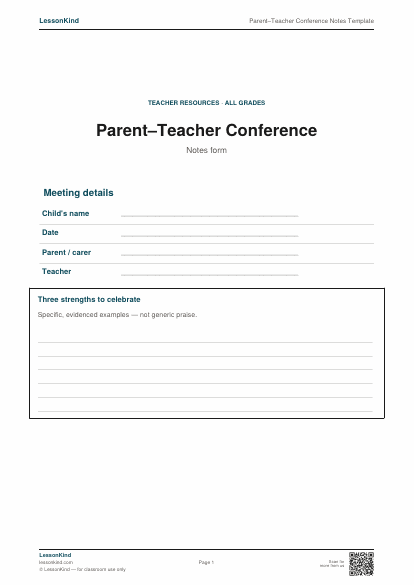
Parent–Teacher Conference Notes Template
Structured conference notes form — strengths, areas to develop, agreed actions, parent comments.
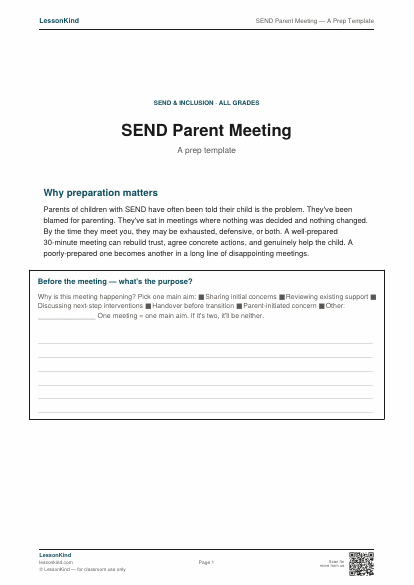
SEND Parent Meeting — A Prep Template
A template for preparing for parent meetings about a child with SEND — what to say, what to listen for, and how to leave with concrete next steps.
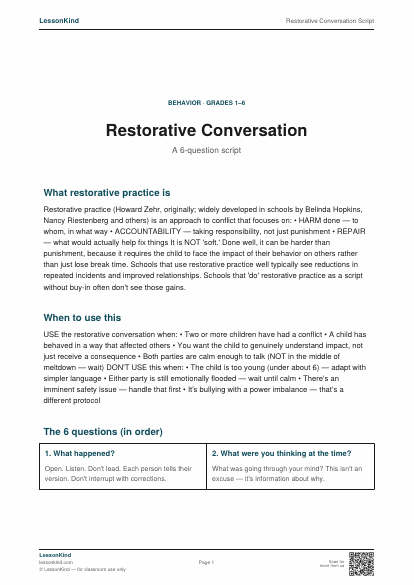
Restorative Conversation Script
A simple 6-question script for restorative conversations after a behavior incident. Follows the standard restorative practice format — focused on harm, accountability, and repair.
Going deeper
Books on parent communication
Books we'd recommend on the topics raised in this article.
Practitioner
Convenience links to Amazon. As an Amazon Associate we earn from qualifying purchases at no extra cost to you. Read our affiliate disclosure.
Keep reading
Parent communication
The Difficult Parent Meeting — A Better Approach
Telling parents something they don't want to hear is one of the hardest skills in teaching. Most teachers learn it the hard way, by getting it wrong. There's a better path.
7 min read
Parent communication
Talking to Parents About Difficult Things
Sooner or later, every elementary teacher has to tell a parent something they don't want to hear. Here's how to do it well.
6 min read
First-year teaching
What They Don't Tell You in Teacher Training
Teacher training prepares you for lesson planning. It does not prepare you for what your first term as a class teacher actually feels like. Here's the honest version.
7 min read