Math · 5 min read
The Trouble with Fractions (and How to Actually Fix It)
Why so many children get stuck on fractions — and the small mental shift that fixes it
Published 2026-10-15
Ask a class of Year 5s "What's 1/2 + 1/4?" and you'll get a familiar split: some confidently say 3/4, others say 2/6, and a few add up everything they can see and confidently announce 8.
The 2/6 answer (1+1=2, 2+4=6) isn't stupidity. It's the perfectly logical extension of how children have been taught to add for the previous five years. They're applying the rule "add the top numbers, add the bottom numbers" because that's what addition has always meant.
Fractions are where the rules of arithmetic first get strange — and they don't get un-strange unless someone rebuilds the mental model.
Where fractions go wrong
Most children meet fractions for the first time in Year 1 or 2 as "halves and quarters of a shape". They shade in half a circle, half a rectangle. Fine.
Then in Year 3, fractions suddenly become numbers — things you can add, subtract, compare. And the children who learned fractions as *shapes* hit a wall, because shapes don't add up by adding the numerator and denominator separately.
The crucial insight that most curricula skip past: a fraction is not a thing. It's an *operation*. 3/4 doesn't mean "three quarters of a circle" — it means "divide one whole into 4 equal parts, take 3 of them". Until children grasp that, every subsequent fractions lesson is built on sand.
The two pre-requisites that get skipped
Two ideas have to be rock-solid before fractions stop being terrifying:
**1. The fraction is one number, not two.** 3/4 is a single point on the number line, between 0 and 1, closer to 1. Children who think of 3/4 as "a 3 and a 4" cannot reason about it numerically. Use a number line *constantly* in fractions teaching — not pizza diagrams. Pizza diagrams reinforce the wrong mental model.
**2. The denominator names the size of the unit.** 1/4 isn't smaller than 1/3 because 4 is bigger than 3. It's smaller because if you cut a cake into 4 pieces, each piece is smaller than if you'd cut it into 3. The bigger the denominator, the smaller the slice. Most children have never heard this said clearly.
What actually fixes fractions teaching
**Use number lines obsessively.** Put 0, 1/2, and 1 on a line. Now ask: where does 1/4 go? Where does 3/4? What about 1/8? 5/8? Children develop a sense of where fractions *live*, which makes adding and comparing much more natural.
**Stop using pizzas after Year 2.** They're great for "this is what 1/4 looks like", but disastrous for "1/2 + 1/4 = 3/4". For arithmetic, switch to bar models or number lines.
**Equivalent fractions before adding.** Children should spend serious time on "1/2 = 2/4 = 4/8 = 50/100" before they ever try to add 1/2 + 1/4. The reason addition needs a common denominator only makes sense if you understand equivalence.
**Connect to division.** 3/4 is just "3 ÷ 4". Children who can do division can do fractions, once you tell them they're the same operation written differently.
The lightbulb moment
The fraction lesson where the year-group fell silent and *got it* started like this: "Imagine I have one chocolate bar to share between 4 children. How much does each child get?" — "A quarter." — "Right. Now I have 3 chocolate bars to share between 4 children. How much does each child get?" — long pause — "Three quarters!" — "So 3 divided by 4 IS three quarters. They're literally the same thing."
The whole class sat with that for a moment. Then one child said: "So that's why fractions and dividing are the same."
Yes. That is exactly why.
Free bundle for this topic
KS2 Maths Pack
10 favourite maths resources — times tables, fact families, mental maths, fractions.
Practical resources for this
Take this further
Printable, classroom-ready resources for the topics in this article.
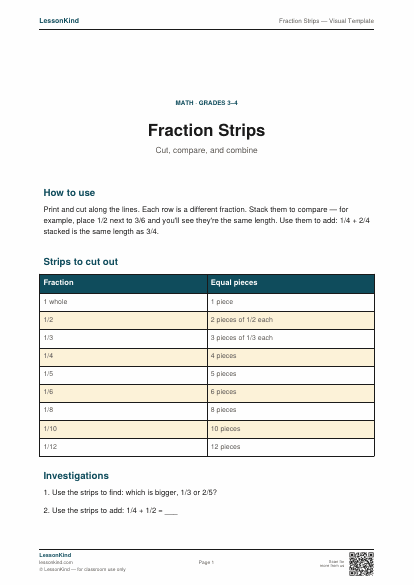
Fraction Strips — Visual Template
Printable fraction strips for halves, thirds, quarters, fifths, sixths, eighths, tenths and twelfths.
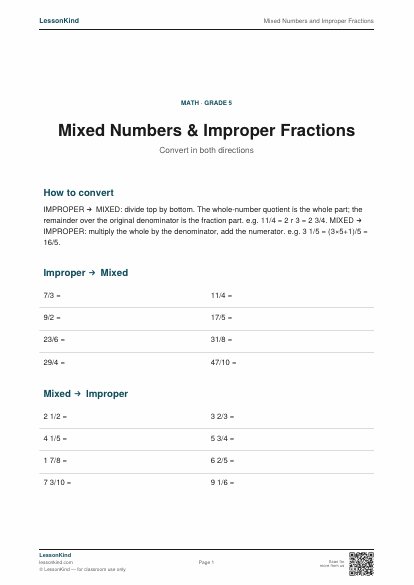
Mixed Numbers and Improper Fractions
Convert between improper fractions and mixed numbers. 20 practice problems.
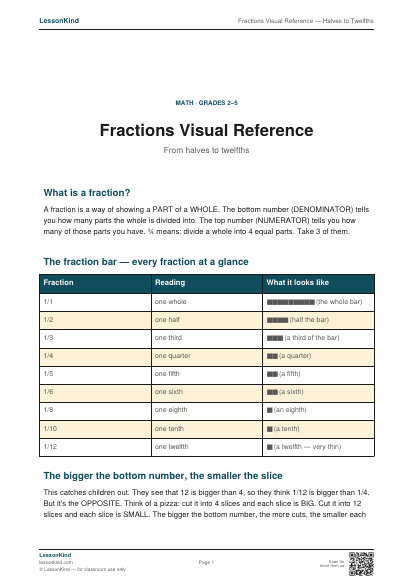
Fractions Visual Reference — Halves to Twelfths
A visual fractions reference showing halves, thirds, quarters, fifths and so on as bars and pies. Equivalent fractions made visible.
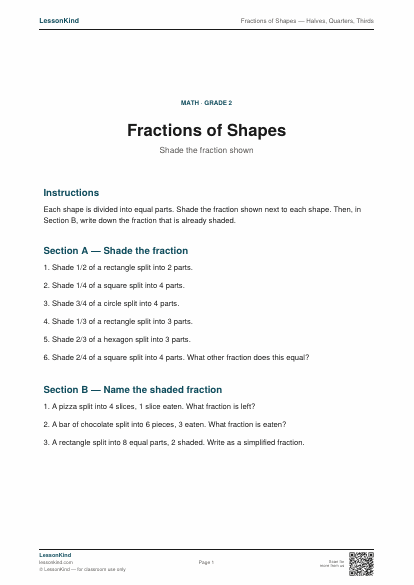
Fractions of Shapes — Halves, Quarters, Thirds
Identify and shade fractions of shapes. Includes halves, quarters and thirds.
Going deeper
Books on fractions teaching
Books we'd recommend on the topics raised in this article.
Practitioner
Convenience links to Amazon. As an Amazon Associate we earn from qualifying purchases at no extra cost to you. Read our affiliate disclosure.
Keep reading
Teaching strategy
Differentiating Math Without Burning Out
You don't need three separate lesson plans every day. Here's how to differentiate math meaningfully without doubling your prep.
6 min read
Math
When a Child Says 'I'm Bad at Math'
Almost every adult who hates math can name the year it started. By age eight, many children have already decided they're 'not a math person'. Here's how that happens and how to push back.
7 min read
Math
Maths Anxiety in Primary Children
By Year 3, some children have already decided maths isn't for them. By Year 6, it's hard to shift. Maths anxiety is real, measurable, and largely preventable — but it requires understanding what actually causes it, which is rarely what parents assume.
8 min read