Math · 7 min read
When a Child Says 'I'm Bad at Math'
How math anxiety takes hold by Year 3 — and what teachers and parents can do about it
Published 2026-08-06
A girl in my Year 3 class once told me, completely matter-of-factly, "I'm bad at math. My mum was bad at math too." She was eight years old. She had at least 10 more years of school math ahead of her. And she had already filed herself into a category that would shape her entire relationship with the subject.
I asked her how she knew she was bad at math. She thought about it for a moment. "Because it's hard," she said.
This is one of the most underrated problems in primary education. By the time children reach Year 3 or Year 4, a significant proportion have already decided they're "not a math person" — and the data on math anxiety suggests this self-image is remarkably sticky into adulthood. Studies on math anxiety estimate that around 25% of university students experience moderate to high levels of math anxiety, much of it traceable back to specific moments in primary or early secondary school.
How it takes hold
Math anxiety doesn't usually arrive in one big traumatic moment. It builds in small ways, often invisible to teachers.
The child who can't quite remember their seven-times-table when they're put on the spot, and reads "you're bad at math" in the silence after.
The child whose strategy for two-digit addition is slightly different from the one the teacher has just demonstrated, and who concludes that "different" means "wrong".
The child who is asked to come up to the board, freezes, and decides — with the unforgiving logic of an eight-year-old — that this means math is not for them.
The child whose parent says, lightly, at the dinner table: "I was never any good at math either. Don't worry about it." The child hears: math ability is something you have or don't, and we don't.
These individual moments would be nothing if they happened once. Repeated, they become a self-image. And once a self-image about ability hardens, it actively prevents learning. A child who believes they can't do math will not engage with hard math problems, because failing at them confirms what they already believe. They become risk-averse, give up early, and avoid challenge — not because they lack ability, but because their self-image is now too fragile to risk.
What the research says
Carol Dweck's work on growth mindset has been popularised, simplified, and sometimes badly applied in schools. But the underlying finding is robust: children who believe ability is fixed perform worse in challenging tasks than children who believe ability can grow with effort. This effect is strongest in math, where children are especially likely to attribute success or failure to "natural ability".
Jo Boaler's research at Stanford on math anxiety adds another layer: speed-based math practice — flashcards, timed tests, "race to the answer" games — appears to be a major driver of anxiety in primary children. The children who are slow but accurate develop the same correct understanding as the children who are fast, but they internalize the message that they're "bad at math" because they couldn't compete on speed.
This is a counterintuitive finding because timed practice has a long tradition in primary math, and there's some genuine evidence that fluency with number facts matters. The current consensus is roughly: fluency matters, but it's better built through low-stakes repeated practice over weeks than through high-stakes timed tests in front of peers.
What teachers can do
Six things, in rough order of impact.
**Praise effort and strategy, not speed or ability.** Not "Wow, you got that fast — you're so clever!" but "I like that you tried two different ways to solve it." Not "Math just clicks for you" but "I noticed you didn't give up when it got hard." This sounds like a small linguistic shift but it changes which part of themselves the child is rewarded for.
**Make struggle public and normal.** When you yourself get stuck on a problem, narrate it. "Hmm, this is tricky. Let me think. I'm going to try drawing it." The most damaging belief about math is that it should come easily. The antidote is teachers who model that it doesn't, even for them.
**Reduce timed tests, especially public ones.** If you must do mental math practice, do it as a quiet personal challenge — children racing themselves, not each other. Save timed assessment for genuine assessment moments, not weekly performance theater.
**Watch your phrases.** "Some children just find this hard" puts a child in a category. "This question is challenging — let's slow down" puts the difficulty in the question. Same lesson, two very different self-images formed.
**Prize different methods.** When a child solves a problem differently from how you taught it, don't say "but I didn't show you that way." Say "interesting — show me what you did." Children who think there's only one right method to a problem are children who shut down the moment they don't remember the method.
**Don't shield them from challenge.** The temptation with anxious math children is to give them easier work. This makes things worse. They need to experience genuine challenge AND succeed at it, with appropriate support, to repair the belief that hard math = my failure. Scaffold them up to grade-level work. Don't shrink the work down to where they already are.
What parents can do
If you're a parent reading this — and especially if you yourself have a fraught relationship with math — the single most important thing you can do is never say "I was bad at math too." Even said sympathetically, it transmits the belief that math ability is genetic.
Try instead: "Math takes practice. I had to work hard at it too." Or: "I never quite finished learning this — let's try it together." Or, if you genuinely don't know the answer: "I'm not sure. Let's look it up." Children who see their parents engaging with math, getting stuck, looking up answers, and trying again learn that math is something you DO, not something you ARE.
The other big intervention parents can make: number talks at the dinner table. "If we're 4 of us and we order 3 pizzas with 8 slices each, how many slices each?" Make math part of normal life, casually, without high stakes. The kitchen and the supermarket are better math classrooms than most schools.
A note on diagnosis
A small subset of children — perhaps 3–6% by some estimates — have dyscalculia, a specific learning difference that affects number sense in ways analogous to dyslexia. Dyscalculia is real, persistent, and not the same as math anxiety. If a child shows striking, persistent difficulty with the most basic number concepts (struggling to subitize small quantities, regularly miscounting small sets, failing to develop one-to-one correspondence) that's worth flagging for a specialist assessment.
But the great majority of children who declare themselves "bad at math" don't have dyscalculia. They have a story they've been telling themselves, often with our help. We can take it back from them — gently, persistently, over years.
The story we want them telling
The girl in my Year 3 class is now at university studying engineering. I'd like to claim credit for that. I can't — she had brilliant teachers after me, and parents who eventually changed how they talked about math. The story she tells now isn't "I was bad at math, but I figured it out." It's "I used to think I was bad at math, until someone showed me I wasn't."
That's the story we want all our children telling.
Free bundle for this topic
KS2 Maths Pack
10 favourite maths resources — times tables, fact families, mental maths, fractions.
Practical resources for this
Take this further
Printable, classroom-ready resources for the topics in this article.
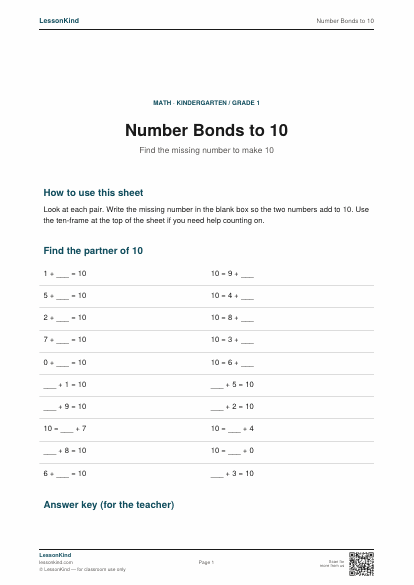
Number Bonds to 10
20 number-bond questions with a ten-frame visual support panel. Ideal for early addition fluency.
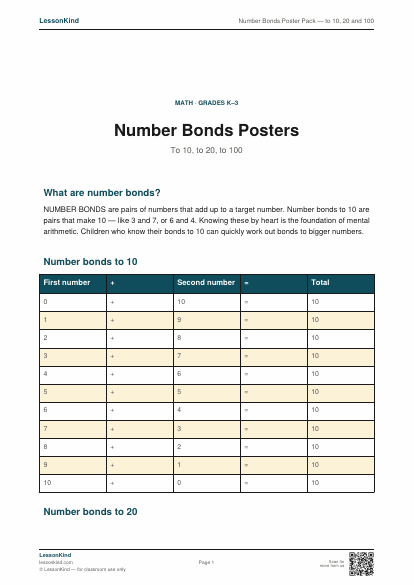
Number Bonds Poster Pack — to 10, 20 and 100
Three classroom posters showing all the number bonds to 10, to 20, and to 100. Visual, clear and ready to display.
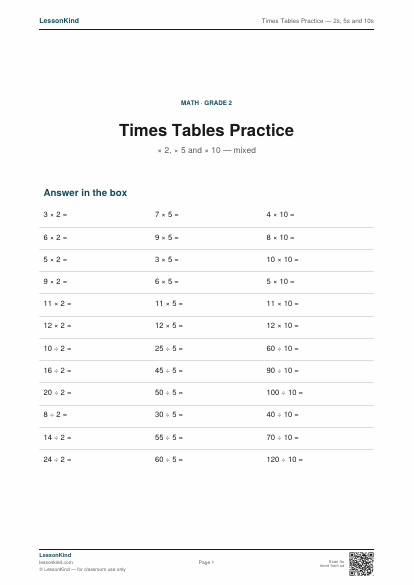
Times Tables Practice — 2s, 5s and 10s
Mixed-up times tables practice with 36 questions. Builds rapid recall of the 2, 5 and 10 tables.
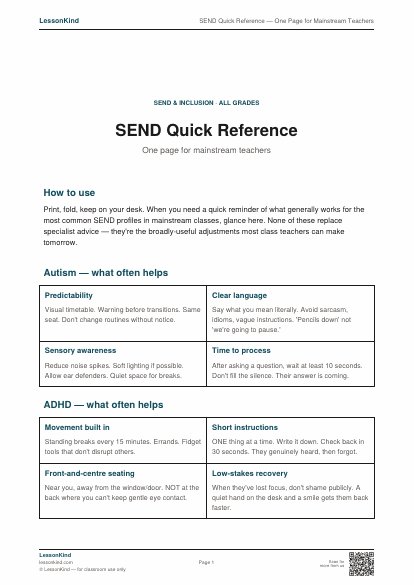
SEND Quick Reference — One Page for Mainstream Teachers
A one-page reference summarising the most useful adjustments for the four most common SEND profiles — autism, ADHD, dyslexia, anxiety. Print and stick on your desk.
Going deeper
Books on maths attitude and identity
Books for parents and teachers about how children develop their relationship with maths.
For teachers and parents
Convenience links to Amazon. As an Amazon Associate we earn from qualifying purchases at no extra cost to you. Read our affiliate disclosure.
Keep reading
Teaching strategy
Differentiating Math Without Burning Out
You don't need three separate lesson plans every day. Here's how to differentiate math meaningfully without doubling your prep.
6 min read
Teaching strategy
Ability Grouping in Primary: What the Evidence Actually Shows
Most primary classrooms still group children by 'ability' for maths and English. The evidence on this is unusually clear — and unusually ignored. Here's what the research says, why schools keep doing it anyway, and what good mixed-attainment teaching actually looks like.
9 min read
Teaching strategy
Ability Grouping in Primary: What the Evidence Shows
The debate about ability grouping is often ideological. The evidence is more nuanced and more actionable than either side usually acknowledges.
6 min read