Math · 6 min read
The trouble with maths 'tricks'
Shortcuts feel helpful in the moment and cost children years of understanding.
Published 2026-11-25
Maths tricks are everywhere in primary schools. They're well-meant. They feel like teaching. They produce immediate, visible success — the child who couldn't do fractions yesterday can now do them today. Job done.
Except job not done. The child can apparently do fractions but doesn't understand fractions. And in two years' time, when fractions are wrapped inside a problem about ratios, percentages or probability, that lack of understanding catches up with them. Hard.
What I mean by a 'trick'
A trick is any technique that produces the right answer without requiring (or building) understanding of why it works. Some classics:
- **KFC for fractions** ('Keep, Flip, Change' for dividing fractions) - **The butterfly method** for adding fractions with different denominators - **'When you see "of" in a question, multiply'** - **'Just add a zero'** for multiplying by 10 - **'Move the decimal point'** for multiplying or dividing by 10/100/1000 - **BIDMAS / BODMAS / PEMDAS** for order of operations - **'Cross-multiply'** for solving fraction equations - **The grid method** for long multiplication, taught as a sequence of steps without explaining the place value - **'Borrow one from the next column'** for subtraction without showing what's actually being borrowed
Each of these works. Each will produce a tick on the day you teach it. And each, taught without underlying understanding, will fall apart when the child meets a problem that doesn't fit the trick.
Why tricks fail
The 'add a zero' trick is the cleanest example. Tell a Year 3 child '7 × 10 is just 7 with a zero on the end.' They can now do 7 × 10. Brilliant.
But the trick lies. 7.4 × 10 is not 7.40. It's 74. The 'zero' isn't being added — the digits are being moved up a place value column. The trick gave them a procedure that works for whole numbers and silently fails for decimals. When the child gets to Year 5 and meets 0.6 × 10 or 4.7 × 100, they confidently add zeros, get the wrong answer, and feel betrayed by maths.
Or take 'when you see "of", multiply.' This works for 'a quarter of 12' (= 12 × 1/4 = 3). It works for '20% of 60' (= 60 × 0.2 = 12). It feels like a magic key. But the trick teaches the child to look for keywords rather than understand the question. Faced with 'what is the difference between three quarters of a metre and 60 cm?', the trick provides no help — there's no 'of' to multiply with. The child trained on keyword-spotting is now lost in a problem they should be able to do.
Tricks crowd out understanding
The deeper damage is what tricks DON'T teach.
When you tell a child 'KFC' for dividing fractions, they have a procedure. What they don't have is any sense of WHY dividing by a fraction makes the answer bigger, or what dividing by a fraction MEANS. Both of those things are conceptually important for everything that comes after — ratios, proportional reasoning, algebra, calculus.
The child who learns KFC has an answer. The child who learns 'how many quarters fit into 3' has a foundation. Years from now, the second child will recognise dividing by a fraction in a new context (like inverse proportion). The first child will be stuck unless they happen to spot that this is a 'KFC question'.
The opportunity cost of the trick is the understanding that didn't get built.
When tricks are okay
I'm not saying scrap every shortcut. Some are genuinely fine.
**Tricks are okay** when they're a final-stage efficiency, taught AFTER the underlying concept is secure. Once a child genuinely understands why we move digits in place value, telling them 'so a quick way to multiply by 10 is to shift each digit one column left' is fine. The trick now sits on top of understanding, not in place of it.
**Tricks are okay** for adults. Most of us use shortcuts every day in everyday maths — they're efficient, and we built them on top of understanding (we hope). The problem is offering them BEFORE the understanding exists.
**Tricks are okay** as scaffolding for children with significant maths difficulties, where building from first principles is a multi-year project and short-term success is also important for confidence. But even here, mark them as scaffolds — to be moved off, not relied on forever.
What to do instead
Most of teaching maths well comes down to one principle: build understanding first, efficiency second.
For each topic, ask yourself: what should the child be able to EXPLAIN, not just do? For dividing fractions, the explanation is something like 'I'm finding how many of these little bits fit into this bigger amount.' For order of operations, it's 'multiplication and division group together because they're really the same operation.' For multiplying by 10, it's 'each digit moves one place left because the value of each column is 10 times the column to its right.'
Then teach to that explanation. Use diagrams, manipulatives, real-world contexts. Let children get it wrong in interesting ways and have those mistakes drive the class discussion.
Once the understanding is there — fluency comes naturally. The 'tricks' become observations the children themselves make. 'Hey, when you multiply by 10, each digit just moves up.' Yes. Now they can use that as a shortcut, because they own the understanding underneath it.
The harder question
If tricks are so problematic, why do we use them?
Honestly — because they make teachers feel successful in the short term. A child who couldn't do something can suddenly do it. We pat ourselves on the back. Job done. Move on.
But job isn't done. We've outsourced the understanding to a procedure. The child WILL meet the problem this trick can't solve. And when they do, two years later, in a different teacher's classroom, the cost falls on them, not on us.
So when you next reach for a trick, pause and ask: 'Is this an efficiency on top of understanding, or am I papering over the understanding?' If it's the latter, the harder, slower, more honest path — actually teach the concept — is the one that pays off.
It just takes longer to see the payoff. And teachers, understandably, like to see results fast.
Free bundle for this topic
KS2 Maths Pack
10 favourite maths resources — times tables, fact families, mental maths, fractions.
Practical resources for this
Take this further
Printable, classroom-ready resources for the topics in this article.
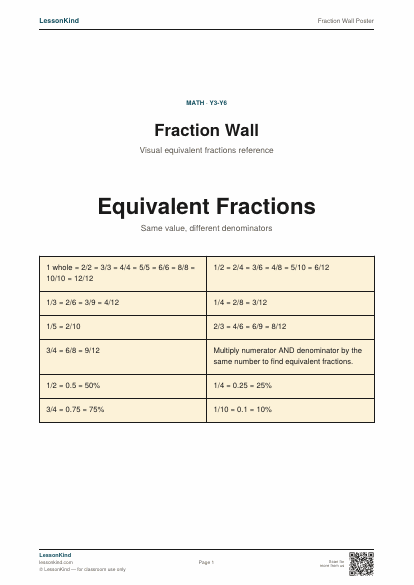
Fraction Wall Poster
Visual fraction wall showing equivalences from wholes to twelfths. The fastest way for KS2 children to grasp equivalent fractions.
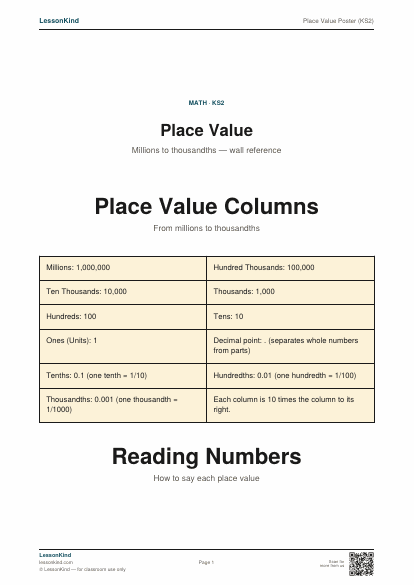
Place Value Poster (KS2)
Wall poster showing place value from millions through to thousandths. Reference for every KS2 maths lesson involving large numbers, decimals or rounding.
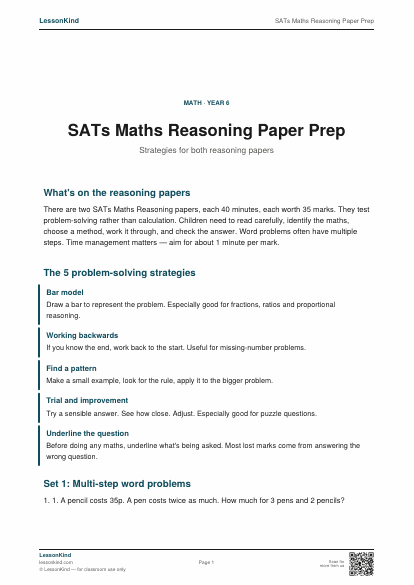
SATs Maths Reasoning Paper Prep
Strategies and practice for the two SATs Maths Reasoning papers — bar models, multi-step problems, time, money, ratio, and the question types that catch most children out.
Going deeper
On teaching maths conceptually
Books we'd recommend on the topics raised in this article.
Building mathematical understanding
- T Transforming Primary Mathematics: Understanding Classroom Tasks, Tools and Talk — Mike Askew
-
K
Knowing and Teaching Elementary Mathematics — Liping Ma
Cross-cultural classic on what teachers' subject knowledge matters - F Fundamental Constructs in Mathematics Education — John Mason, Sue Johnston-Wilder
- M Maths and the Primary Curriculum — Hilary Povey
Convenience links to Amazon. As an Amazon Associate we earn from qualifying purchases at no extra cost to you. Read our affiliate disclosure.
Keep reading
Math
Why kids hate maths (and what actually changes their mind)
When children say 'I hate maths,' they're rarely talking about numbers. They're talking about a feeling — confusion, embarrassment, the sense of being slow. The good news: that feeling is fixable, and the fix isn't more rote practice.
7 min read
Math
How to teach times tables that actually stick
Times tables are the foundation of every other maths skill, but the way most schools teach them — Friday tests, marathon practice sessions — is what cognitive science would tell you NOT to do. Here's what works.
8 min read