EYFS & early years · 5 min read
What Are Schemas? Understanding Children's Learning Patterns in EYFS
The repetitive behaviours that drive early childhood learning — and why you should lean into them
Published 2026-05-25
A child who spends 40 minutes transporting items from one corner of the room to another is not wasting time. A child who wraps every object they can find in fabric, paper, or clothing is not being disruptive. A child who insists on spinning, rotating, or turning everything they encounter may be developing one of the most fundamental spatial reasoning concepts in early mathematics.
These are schemas — repeated patterns of behaviour and thinking that children use to make sense of the world.
What schemas are
Chris Athey's research at the Froebel Institute in the 1970s identified schemas as a central mechanism of early childhood learning. Based on Piaget's work but applied practically to EYFS, Athey found that children explore specific patterns of action repeatedly — through different materials, contexts, and media — until they have fully assimilated the concept.
A child in a 'trajectory' schema fires objects, throws things, runs fast, rolls balls, swings on swings, and draws straight lines — all exploring the same fundamental concept: the path of a moving object. This same exploration lays foundations for forces, velocity, and projectile motion.
Common schemas to recognise
**Transporting** — moving objects from one place to another. Using bags, boxes, pushchairs, diggers. Exploring the relationship between containers and their contents.
**Enclosing/containing** — placing things inside other things; drawing lines around objects; building fences and walls around small world figures; climbing into and under things.
**Rotation** — spinning, turning, rolling; fascination with wheels, cogs, and roundabouts; drawing circles and spirals. Directly related to early understanding of rotation in maths and science.
**Connecting** — joining things together: Lego, train tracks, string, tape. Also disconnecting. Exploring relationships between separate elements.
**Trajectory** — moving in straight lines, at angles; dropping, throwing, rolling, running fast. Physically exploring the path of objects and bodies in space.
**Enveloping** — covering and wrapping: covering themselves with fabric, wrapping toys, painting over everything, building dens to hide in.
**Transforming** — changing the state of materials: mixing, crushing, melting, adding water to sand, cooking. Early chemistry and materials science.
What to do with this knowledge
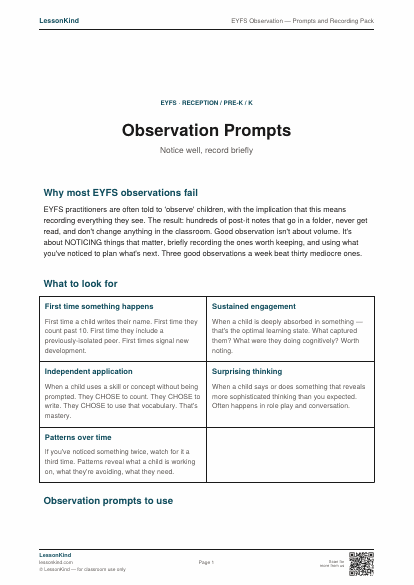
Observe first. When you notice a child returning repeatedly to the same type of activity, you are probably seeing a schema. Note the pattern: what are they always doing, across different contexts and materials?
Provide for it. A child in a trajectory schema needs: gutters, ramps, balls of different sizes, running space, throwing targets. Trying to redirect them to table activities will produce frustration and miss the learning.
Extend it. Find books, stories, songs, and activities that connect to the schema. A transporting schema can be extended into the story of the wheelbarrow at a farm, into counting (how many can you carry at once?), into design (what makes a good carrier?).
Free bundle for this topic
EYFS Essentials Pack
8 essentials for Reception and Kindergarten — provision, observation tools and activity cards.
Practical resources for this
Take this further
Printable, classroom-ready resources for the topics in this article.
Going deeper
Books on schemas and early childhood learning
Books we'd recommend on the topics raised in this article.
For practitioners
Convenience links to Amazon. As an Amazon Associate we earn from qualifying purchases at no extra cost to you. Read our affiliate disclosure.
Keep reading
EYFS & early years
How to Set Up Continuous Provision: A Beginner's Guide
Continuous provision — the system of self-directed learning activities that children access independently — is central to good EYFS practice. Here's how to set it up, what to put in each area, and how to make it work.
7 min read
EYFS & early years
Why Early Maths Experiences Matter More Than You Think
Mathematical understanding at age 5 is one of the strongest predictors of outcomes at 16 — stronger than reading. Here's what the research says about early maths, and what it means for EYFS practitioners.
6 min read