Parent communication · 5 min read
Understanding Your Child's Primary School Report
What the levels, comments, and grades actually mean — and what to do if you're concerned
Published 2026-05-18
Primary school reports in England vary widely between schools. There is no national format — schools choose their own, which is why reports can be confusing to interpret. Here's what to look for.
Common grading systems
**Emerging / Expected / Exceeding (EEE)**: used in many schools, particularly in KS1 and EYFS. Emerging means working towards the expected standard. Expected means meeting the standard for that year group. Exceeding means working beyond it.
**1-4 scale**: some schools use 1 (below expected), 2 (approaching expected), 3 (expected), 4 (above expected).
**Attainment targets**: some secondary-style reports list specific attainment targets ('Working Below', 'Working Towards', 'Working At', 'Working Above').
**Number grades**: some schools use raw numbers or percentages from internal assessments.
Whatever the system, the most important thing to look for is whether your child is meeting the expected standard for their year group, and whether their progress is described as positive.
What to look for in the written comments
Good report comments are specific, honest, and forward-looking. Be cautious about reports where all children seem to receive identical positive phrases — some schools do use templates that obscure real information.
Look for: specific strengths mentioned (not just 'works hard'), specific areas for development, and a forward-looking target ('next year she will focus on...').
Be alert to softened language that might be signalling concern: 'can sometimes find concentration challenging' and 'has made progress but still developing' are phrases that might deserve a follow-up conversation.
What to do if you're concerned
If the report suggests your child is below expected in any area, don't panic — but do act. Request a meeting with the class teacher as soon as possible. The most useful question to ask is: 'What specifically can we do at home to support this?' A good teacher will have a concrete answer.
If your child is on the SEN register, the report should include reference to their SMART targets and progress against them. If it doesn't, ask for a separate meeting to discuss SEND provision.
A note on attendance
Most reports now include an attendance figure. The national expected standard is 96% or above. 90% attendance means 19 full days missed per year — equivalent to four school weeks. Research consistently shows attendance as one of the strongest predictors of academic outcomes. If your child's attendance is below 95%, it's worth having a conversation with the school about barriers.
Practical resources for this
Take this further
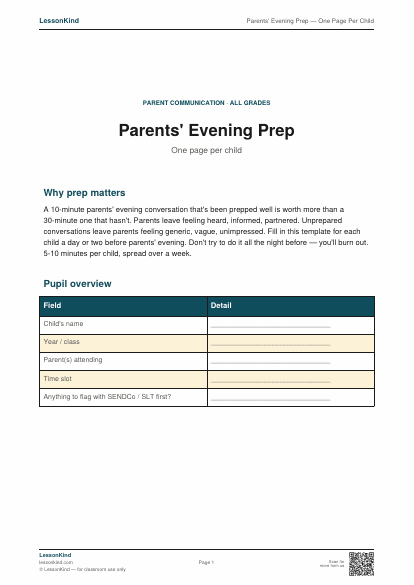
Printable, classroom-ready resources for the topics in this article.
Going deeper
Books for parents navigating primary school
Books we'd recommend on the topics raised in this article.
For parents
Convenience links to Amazon. As an Amazon Associate we earn from qualifying purchases at no extra cost to you. Read our affiliate disclosure.
Keep reading
Parent communication
Year 6 SATs: A Complete Guide for Parents
The Year 6 SATs are the most talked-about assessments in primary school. This guide explains what they are, what they test, when they happen, and how parents can support their child without adding pressure.
8 min read
Parent communication
Talking to Parents About Difficult Things
Sooner or later, every elementary teacher has to tell a parent something they don't want to hear. Here's how to do it well.
6 min read