Teaching strategy · 5 min read
What Is a WAGOLL? Using Model Texts in Primary Writing
What A Good One Looks Like — and how to use it so it actually works
Published 2026-05-21
WAGOLL stands for What A Good One Looks Like. It is a term used in primary English to describe a high-quality example of the type of writing children are about to produce — typically shown before or during a writing unit as a model of what excellent work looks like.
WAGOLL vs model text
In practice, the terms are often used interchangeably, but there is a useful distinction:
A **model text** is a complete piece of writing produced specifically to demonstrate the features of a particular form. It may be written by the teacher, drawn from published material, or generated specifically for the unit. Its primary purpose is pedagogical — it is designed to be studied and imitated.
A **WAGOLL** can be any high-quality example — including published literature, previous pupils' work, or the teacher's own writing. It shows the standard being aimed for. It may or may not be specifically designed for teaching.
How to use a WAGOLL effectively
Simply showing pupils a good piece of writing and asking them to write something similar produces limited benefit. The research suggests that effective use of model texts involves:
**Immersion** — multiple readings, with different focuses each time. First read: what happens / what is it saying? Second read: what do you notice about the language? Third read: what structural features can you see?
**Explicit feature study** — annotating the text together. What specific techniques is the writer using? Why did they make that choice? What would change if they hadn't?
**Imitation** — writing a piece using the same structure but different content. This is how Pie Corbett's Talk for Writing approach works: children learn a text, internalize its structure, then 'innovate' on it. The imitation is a scaffold, not plagiarism.
**Moving to independence** — gradually reducing the reliance on the model until children are drawing on internalised features. The WAGOLL should produce independence, not permanent dependence.
Common misuses
'Copy the features of this WAGOLL' without any discussion of why those features work produces writing that has a fronted adverbial in the second sentence because the WAGOLL did, not because it's the right choice.
Using only teacher-generated WAGOLLs misses the opportunity to use high-quality published literature — which typically has much better prose than anything a teacher writes at speed.
Showing the WAGOLL too early can limit ambition. Some teachers show it after initial planning so that the model inspires rather than constrains.
Practical resources for this
Take this further
Printable, classroom-ready resources for the topics in this article.
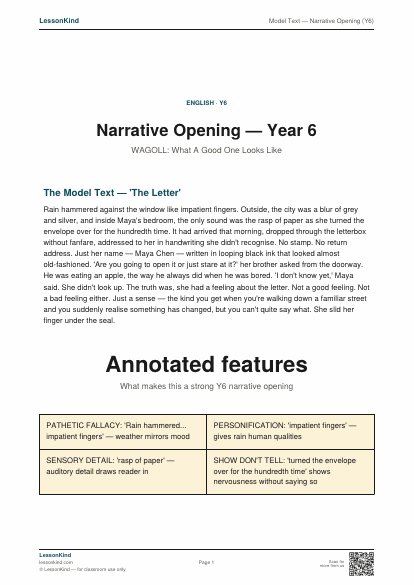
Model Text — Narrative Opening (Y6)
WAGOLL example of a Year 6 narrative opening — atmospheric, character-driven, with sophisticated sentence variety. Demonstrates show-don't-tell, dialogue, and 'pathetic fallacy' for SATs writing standards.
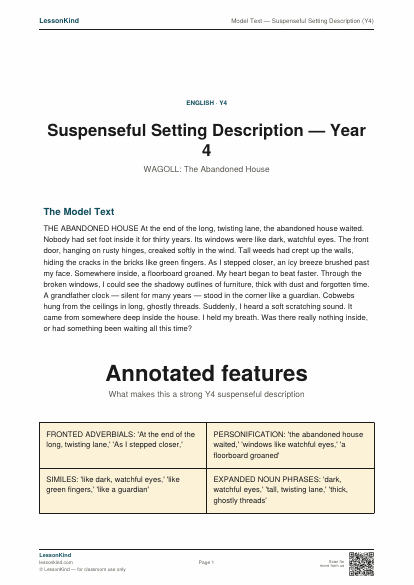
Model Text — Suspenseful Setting Description (Y4)
WAGOLL example of a Year 4 suspenseful setting description — The Abandoned House. Demonstrates atmospheric language, varied sentence openers, and personification for building tension.
Going deeper
Books on model texts and talk for writing
Books we'd recommend on the topics raised in this article.
For teachers
Convenience links to Amazon. As an Amazon Associate we earn from qualifying purchases at no extra cost to you. Read our affiliate disclosure.
Keep reading
Teaching strategy
How to Teach KS2 Writing: A Practical Guide
Writing is the most complex thing we ask primary children to do. This guide covers the key elements of effective KS2 writing teaching — modelling, immersion, drafting, and the difference between composition and transcription.
8 min read
Reading & literacy
How to Run Guided Reading in a Primary Classroom
Guided reading is one of the most time-intensive elements of primary English. Done well it is highly leveraged; done badly it produces worksheets. Here is what a well-run session looks like.
7 min read