EYFS & early years · 6 min read
What Reception Teachers Know That the Rest of the School Should
The principles of early years practice that work at every age
Published 2026-05-15
The best Reception teachers have a quality that's hard to name: they seem entirely unbothered by the gap between what they'd like children to do and what children actually do.
They don't take it personally when a child can't sit still. They don't seem surprised when a 5-year-old melts down because their coat peg is in the wrong place. They hold a philosophical acceptance of the developmental stage in front of them — and they work with it, not against it.
Development is not a behaviour choice
A 5-year-old who can't regulate emotions, can't sustain 20-minute attention, and can't sit cross-legged for more than 8 minutes is not being difficult. They're being 5.
Early years practitioners understand this structurally — they plan for it, scaffold around it, don't interpret it as defiance. The 7-year-old who still can't regulate under stress isn't a behaviour problem; they're a child whose development is proceeding at its own pace.
Play is the vehicle for learning
Children who learn through play develop stronger executive function, greater creativity, better language skills, and more positive attitudes towards learning. The child who spent the afternoon building a marble run in the construction area was doing physics, spatial reasoning, problem-solving, and collaboration simultaneously.
As children grow, the proportion of play decreases for practical reasons. But teachers who create genuine choice, agency, and project-based investigation access something the early years never fully loses: intrinsic motivation.
Relationship is the curriculum
Reception teachers know, in their bones, that the relationship between child and practitioner IS the learning environment. If a child doesn't feel genuinely safe, they cannot learn effectively.
This doesn't stop being true in Year 6. It becomes less visible because children become more able to mask and comply. But the child who trusts their teacher will take more risks, ask for help earlier, recover from failure faster.
The transition into Year 1
The move from Reception to Year 1 is one of the sharpest developmental discontinuities in English education. In Reception: continuous provision, child-led learning, low-stakes environment. In Year 1: a timetable, whole-class teaching, formal phonics. In the same September.
The children who struggle most are not the least able — they're the ones whose nervous systems needed the play-based environment to continue longer. The more Year 1 reflects EYFS principles in its first half-term, the smoother that transition.
Free bundle for this topic
EYFS Essentials Pack
8 essentials for Reception and Kindergarten — provision, observation tools and activity cards.
Practical resources for this
Take this further
Printable, classroom-ready resources for the topics in this article.
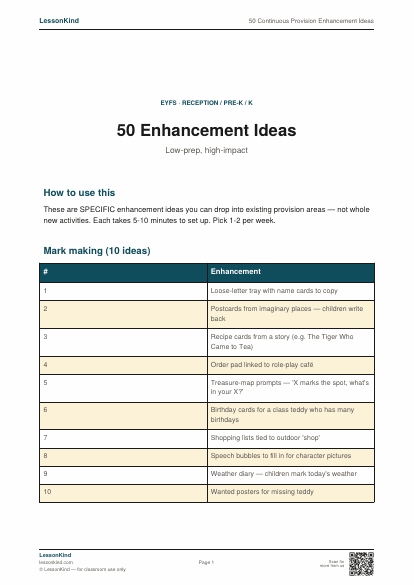
50 Continuous Provision Enhancement Ideas
50 specific, low-prep enhancements for the main provision areas — by area, by season, by skill. Useful for the Sunday-night moment when you're staring at the planning sheet.
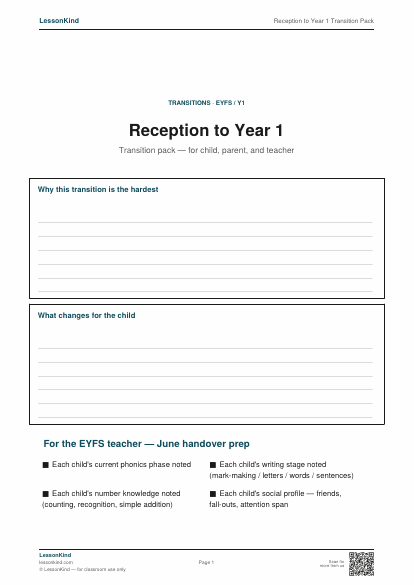
Reception to Year 1 Transition Pack
The single biggest transition in primary — from play-based EYFS to a more structured Year 1 classroom. Activities, parent letter, classroom routines, and EYFS-to-KS1 staff handover sheet for the gentlest possible move.
Going deeper
Books on EYFS practice and early years pedagogy
Books we'd recommend on the topics raised in this article.
For teachers
Convenience links to Amazon. As an Amazon Associate we earn from qualifying purchases at no extra cost to you. Read our affiliate disclosure.