Teacher wellbeing · 7 min read
Why September Feels So Hard (And Why That's Normal)
The annual cycle no one warns new teachers about — and what to do about it
Published 2026-08-08
There is a graph that lives in the back of every primary teacher's head, even if they couldn't draw it. It tracks how you feel across the year. It starts hopeful in late August. It rises briefly in the first week as you meet your new class. Then it drops. It drops again. It bottoms out in mid-November, somewhere in the long dark stretch between half term and Christmas. It rises sharply at Christmas and again at Easter and is essentially flat for July.
The shape of this graph is so consistent across teachers that it's almost a law of nature. And yet new teachers go through it for the first time genuinely thinking something is wrong with them.
This article is for them. And for the experienced teachers who keep forgetting that the graph is a feature, not a bug.
What actually happens in September
If you ask a teacher in late August how they feel, they'll often say "I'm dreading it but also excited". The mix is real. The new class. The fresh start. The classroom display you stayed up until midnight putting up. The clean exercise books.
Then the children walk in.
September is about the gap between the class you imagined and the class you actually have. The class you imagined was a single, manageable group. The actual class is 28 individual humans with 28 individual personalities, friendships, traumas, learning needs, family circumstances and energy levels, all of them watching you to see what kind of teacher you're going to be. They are not bad. They are just real.
The first two weeks of September burn through more nervous energy than any other period in the year. You're learning their names, their handwriting, their parents, their dietary needs, their reading levels, their friendship dynamics, their triggers. You're also doing this while teaching, marking, parents' evenings, induction meetings, and pretending you remember anyone's name.
By the end of September you are exhausted in a way you weren't expecting to be exhausted, and the year feels suddenly endless.
This is normal. Everyone feels it. Even the head teacher.
October: the surprise dip
Most new teachers think September was the hard bit and October will be the recovery. October is, in fact, often worse.
By October: - The honeymoon is over and the children are testing limits - You've seen enough work to realise the gap between where they are and where they need to be by July - The days are getting shorter and the playground is getting wet - Half-term is in sight and your reserves are empty - Parents' evening is approaching, which means you have to articulate, for every child, what they need to work on
The dip in October is a real, measurable thing. Stress hormones rise. Sleep gets worse. Sundays become "Sunday scaries" — that low, anxious feeling that arrives around 5 p.m. and lingers until Monday morning.
The good news: half-term in late October is the single most healing week of the year for most teachers. Even an unproductive week of doing very little brings you back.
November: the low point
If September is "the surprise" and October is "the dip", November is often "the bottom".
The week after October half-term is, in my experience, the hardest week in the calendar for primary teachers. The clocks have changed. It's dark when you arrive at school and dark when you leave. The children come back from half-term feral. The classroom is freezing in some rooms and like a sauna in others. There's nothing on the horizon except Christmas, which feels both very near and impossibly far.
This is the period when teachers most often wonder if they should leave teaching. The wondering is real. The leaving usually isn't, because by mid-December things change.
The Christmas turn
Something happens in early to mid-December that is hard to explain rationally. The children become slightly less feral, in spite of the sugar. There are nativity rehearsals and class parties and whole-school singing assemblies. The school becomes warmer. There's a feeling of arriving at the end of a long stretch.
By Christmas you will have forgotten, briefly, that November ever happened. You will be exhausted in a different way — full, somehow, not depleted. You will sleep for sixteen hours on Christmas Eve and feel reborn.
This is the natural rhythm. It will repeat next year.
What to do about it
Knowing the shape of the year is itself one of the most useful things you can know. New teachers who think September is unique to them, or that October's struggles indicate they've made the wrong career choice, often spiral. Experienced teachers who recognise the pattern push through.
A few specific things that help.
**Plan your November survival in October.** Don't wait until you're already at the bottom. Book the dentist, the haircut, the night out, the cinema trip — all of them — for October. Have them already in the diary so November doesn't have to make any decisions, just turn up.
**Do less in September.** This is counterintuitive but right. September wants to be productive. The classroom display, the planning, the marking, the school trips, the parent emails — all of it expanding to fill any free moment. Resist. Save energy for October and November.
**Don't compare your November to other people's social media.** Other teachers' Instagram feeds are not the truth. They are the highlight reel. The teacher posting beautiful display photos at 8pm on a Wednesday is not winning at life — they are also coping by curating an image of themselves they wish they were.
**Sundays are not for school.** This sounds easy and is the hardest thing in the article. Try to get all of Sunday afternoon and evening back. Plan during the week or on Saturday morning if you must, but reclaim Sundays as off limits. Your nervous system needs the boundary even if your work allegedly doesn't.
**Friends who aren't teachers.** A surprising number of teachers find their entire social circle is teachers, which means their entire social conversation is teaching. This is suffocating in November. One non-teaching friendship — a friend from before, a hobby, a neighbour — saves you.
**Notice the small wins.** A child who said hello when they wouldn't have done a month ago. A piece of writing that wasn't there before. A quiet moment of focused work. The job is not the report card; it is the daily quiet wins, and noticing them protects you.
What schools should do
If you're reading this and you're a head teacher, deputy or anyone with influence: the November dip is predictable. Structure for it.
A staff lunch in November (with food provided, ideally something warm). A no-meeting week. An admin amnesty — one fewer report this term. Genuine warmth from senior leadership: "I know this is the hard stretch. We see you. We appreciate you."
The schools that hold their teachers together through November are the schools that don't lose teachers in February.
You are not failing
Whatever else you take from this article, take this: if you're reading it in October or November and feeling like you've made a terrible mistake — you haven't. You're inside the predictable hard stretch. It will lift. The graph will bend back upwards. The children, who are also exhausted, will become slightly easier. Your reserves, given any rest at all, will rebuild faster than you think.
Teaching is genuinely one of the hardest jobs in the modern economy. The fact that anyone does it well, year after year, is something close to a miracle. If you're doing it at all, you're doing more than enough.
December is coming.
Free bundle for this topic
The Starter Pack
18 of our best free resources — a way to spend less time prepping and more time recovering.
Practical resources for this
Take this further
Printable, classroom-ready resources for the topics in this article.
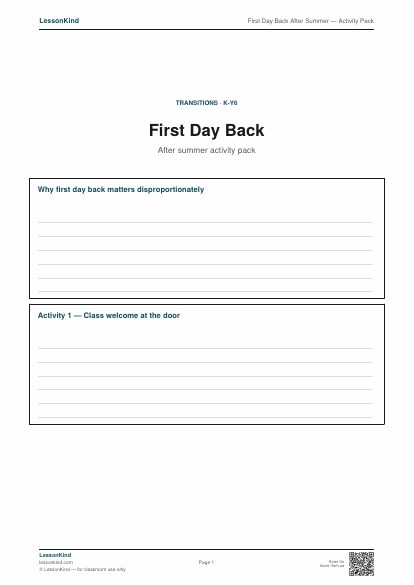
First Day Back After Summer — Activity Pack
Six activities for the first day back in September — designed to ease children in without overwhelming them, and give the new teacher useful information about their class. Low-stakes, structured, calming.
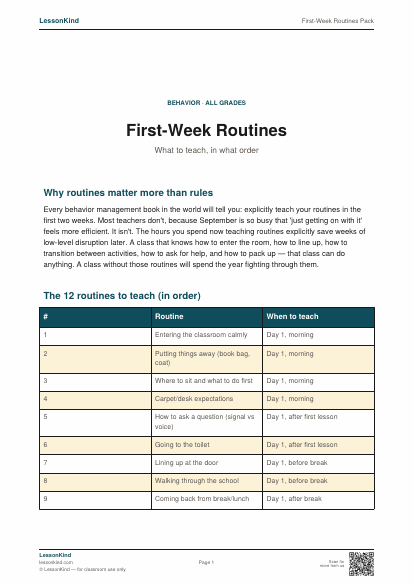
First-Week Routines Pack
The 12 routines you must establish in the first two weeks — entry, transitions, lining up, asking for help, finishing work, end of day. With explicit teaching scripts.
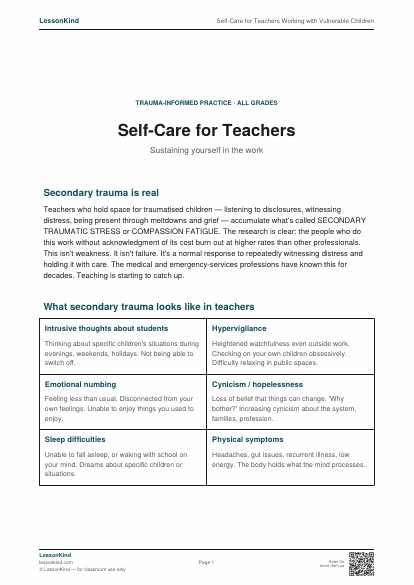
Self-Care for Teachers Working with Vulnerable Children
Teachers who work with traumatised children carry secondary trauma whether they realise it or not. What it looks like, what helps, and how to sustain yourself in the work.
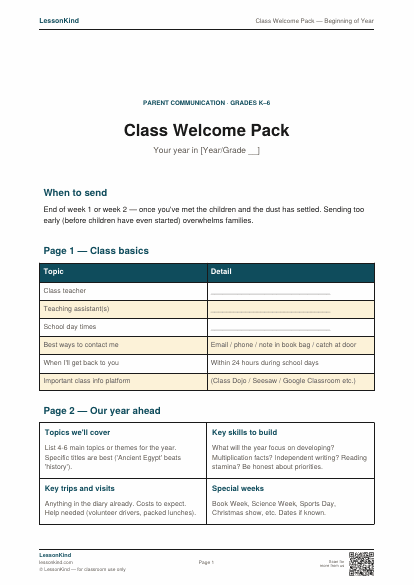
Class Welcome Pack — Beginning of Year
A 4-page pack to send home in the first week — covers the year ahead, communication, expectations, and how to support learning at home.
Going deeper
Books on teacher wellbeing
For when September is winning.
For tired teachers
Convenience links to Amazon. As an Amazon Associate we earn from qualifying purchases at no extra cost to you. Read our affiliate disclosure.
Keep reading
First-year teaching
Five Mistakes I Made as a New Elementary Teacher
If I could go back and shake my first-year teacher self by the shoulders, here's what I'd say.
7 min read
Classroom culture
The Most Important Week of the Year
Most teachers think the first week is for getting to know the children. The teachers whose classrooms run beautifully use it for something quite different.
6 min read
Behavior & classroom management
The First Two Weeks: The Behavior Foundation You Can't Build Later
Most teachers know the first two weeks matter. Few know how MUCH they matter, or what to do with them. The behavior of your class in June is largely determined by what you do — or fail to do — in September.
8 min read
Teaching strategy
The Handover Most Schools Skip
Every July, the children move up a year. The data tracking system shows reading levels and maths attainment. The handover meeting (if it happens) lasts twenty minutes. And the new teacher spends most of the autumn term re-learning what the previous teacher already knew.
8 min read