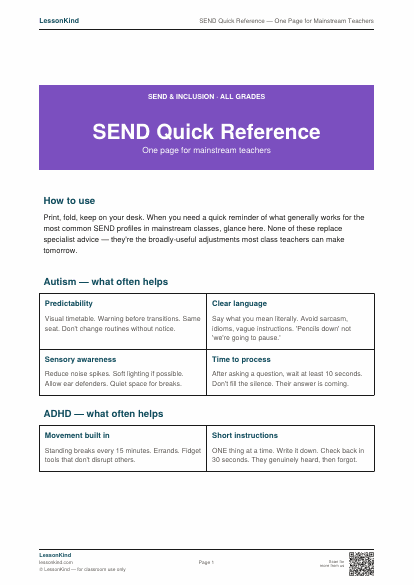
SEND Quick Reference — One Page for Mainstream Teachers
A one-page reference summarising the most useful adjustments for the four most common SEND profiles — autism, ADHD, dyslexia, anxiety. Print and stick on your desk.
Preview
Page count: 7. Print-ready PDF — letter / A4 friendly. Click image to see all pages.
Learning objective
Provide an at-a-glance reference of common SEND adjustments for mainstream class teachers.
About this resource
- Subject: SEND & Inclusion
- Type: Checklist
- Grade levels: Kindergarten (ages 4-6, ≈ Reception / Y1), Grade 1 (ages 6-7, ≈ Year 2), Grade 2 (ages 7-8, ≈ Year 3), Grade 3 (ages 8-9, ≈ Year 4), Grade 4 (ages 9-10, ≈ Year 5), Grade 5 (ages 10-11, ≈ Year 6), Grade 6 (ages 11-12, ≈ Year 7)
- Pages: 7
- Date added: 2026-08-22
- Credit: Qualified primary teacher
SEND in the mainstream — recommended reading
Convenience links if you'd like to look any of these up. We've recommended these books in the resource above.
Foundational
- T The Perfect SENCO — Natalie Packer
- T Trauma-Informed Behaviour Management — Jules Daulby
- T The SENCo Handbook — Anita Devi
Disclosure: Links above go to Amazon. LessonKind may earn a small commission if you buy via these links — at no extra cost to you. We only link to books and items we already recommend in our resources. We are not paid by Amazon to recommend specific titles.
Part of these collections
Curated bundles where this resource appears alongside related ones.
Read more about this
Articles that go deeper on the topic this resource covers.
Teaching strategy · 6 min read
Differentiating Math Without Burning Out
You don't need three separate lesson plans every day. Here's how to differentiate math meaningfully without doubling your prep.
Teaching strategy · 7 min read
The Myth of Learning Styles — and What to Do Instead
Learning-styles theory has been one of the most popular ideas in education and one of the most thoroughly debunked. Here's why — and what genuinely helps children learn.
Math · 7 min read
When a Child Says 'I'm Bad at Math'
Almost every adult who hates math can name the year it started. By age eight, many children have already decided they're 'not a math person'. Here's how that happens and how to push back.
Reading & literacy · 9 min read
What to Do When a Year 4 Child Still Can't Read
It happens in every primary school: a child arrives in Year 4 with reading two or three years behind. Here's what's likely going on, and what you can actually do about it.
EAL & inclusion · 9 min read
Understanding the Autism Spectrum in Primary School
Most teachers will have at least one autistic child in their class. Most teacher training spends maybe an hour on autism. This article fills in the gap: what the spectrum actually looks like, what helps, and the things teachers commonly get wrong.
EAL & inclusion · 8 min read
ADHD Isn't a Lack of Attention — and Why That Matters
The label is the worst part of the diagnosis. ADHD is not 'attention deficit' — it's an attention regulation difference, and that distinction changes almost everything about how schools should respond.
Teaching strategy · 9 min read
Ability Grouping in Primary: What the Evidence Actually Shows
Most primary classrooms still group children by 'ability' for maths and English. The evidence on this is unusually clear — and unusually ignored. Here's what the research says, why schools keep doing it anyway, and what good mixed-attainment teaching actually looks like.
Reading & literacy · 8 min read
When to Worry About a Five-Year-Old Who's Not Reading Yet
Reception and Year 1 parents worry constantly about their child's reading. Most of the worry isn't warranted. Some of it is. Here's how to tell the difference — and what to do about both.
Behavior & classroom management · 7 min read
When to Worry About Your Child's Handwriting
Most concerns about handwriting at primary age are about pace, not problem. But some patterns are worth taking seriously — and the pencil grip thing is more interesting than most parents realise. Here's how to tell the difference.
Math · 8 min read
Maths Anxiety in Primary Children
By Year 3, some children have already decided maths isn't for them. By Year 6, it's hard to shift. Maths anxiety is real, measurable, and largely preventable — but it requires understanding what actually causes it, which is rarely what parents assume.
EAL & inclusion · 9 min read
How SENDCos Actually Run Their Cases
SENDCo is one of the most demanding roles in primary, done by people on a fraction of a day's release. This is what the role actually looks like from the inside — the cycles, the decisions, the difficult conversations, and the rhythms that separate the SENDCos who burn out from the ones who last.
You might also like
Selected based on subject, grade, and type — with a free option always included.
SEND Classroom Adjustments — Universal Design Checklist
A walk-through audit of adjustments that benefit children with SEND but help everyone else too. Audit your classroom in 15 minutes.
Autism-Friendly Classroom Checklist
A practical audit of the things that make a classroom genuinely welcoming for autistic children — sensory, communication, predictability, social.
SEND Sensory Toolkit — What Teachers Actually Buy
The sensory tools that primary teachers actually buy and find useful — fidgets, ear defenders, wobble cushions, weighted lap pads, chew necklaces, time timers, calming spray. With honest notes on what works, what doesn't, and the difference between 'nice-to-have' and 'genuinely helpful'.
Sensory Strategies — A Practical Toolkit
Practical sensory strategies for the four common patterns — sensory seekers, sensory avoiders, mixed and unpredictable. With low-cost classroom kit ideas.
ADHD Strategies for the Mainstream Classroom
What ADHD actually looks like in primary school (it's not 'lack of focus'), and the practical strategies that consistently help in mainstream classrooms.
Emotional Regulation — A Toolkit for Primary Classrooms
How to teach and support emotional regulation in primary classrooms — including why 'use your words' so often fails, and what to do instead.