Math · 7 min read
Why kids 'forget' maths overnight (and what's actually happening)
It's not really forgetting. It's that they never really had it.
Published 2026-11-26
Every primary teacher has had this experience. You teach long division on Monday. The class gets it. They can do it. You finish the lesson feeling great.
Tuesday, you start with a quick recap. Half the class looks at you blankly. The other half remember the procedure but get muddled on the details. By Friday, when you give a written assessment, the success rate has crashed.
It's tempting to call this 'forgetting.' But the cognitive science term is more accurate, and more useful: the gap between PERFORMANCE and LEARNING.
Performance is not learning
When a child gets a question right at the end of a lesson, what you've measured is their performance in that moment. It does not necessarily mean they have learned the underlying concept.
Performance and learning are different things. Performance is what a child can do RIGHT NOW. Learning is what a child can still do TWO WEEKS LATER, in a different context, possibly under stress.
If a child can do long division at the end of the lesson but not on Friday, they didn't learn long division. They performed it. Those are different events.
This isn't a moral failure on the child's part — it's how memory works. Information that's just been taught sits in working memory and short-term memory. Most of it never makes it into long-term memory unless something specific happens to push it there. That something is called retrieval, and it has to be deliberate.
What actually pushes information to long-term memory
Three things, all of them well-evidenced by research:
**Retrieval (active recall).** Trying to remember something STRENGTHENS the memory of that thing. This sounds obvious but contradicts how most people study (re-reading notes, copying out tables). The act of pulling information OUT — answering a question without help — is what consolidates the memory. Looking AT the answer is far weaker.
**Spacing.** Memory consolidates when information is revisited at increasing intervals. Five minutes after the lesson, then the next day, then four days later, then a week, then a fortnight. This is the 'spaced retrieval' that the cognitive science literature keeps banging on about. It's annoying because it doesn't feel like teaching — but it's what actually moves things to long-term memory.
**Interleaving.** Mixing different topics together is harder in the moment than blocking them — but it produces stronger long-term recall. A child who does 30 long-division questions in a row doesn't really learn long division; they learn how to repeat one procedure. The same child doing 10 long-division mixed with 10 fractions and 10 area questions has a harder lesson but learns more durably.
These three are the boring engine of learning. They don't make for an exciting lesson observation. But they are the difference between performance (which fades) and learning (which sticks).
Why this looks like forgetting
When a child can do something on Monday and not Tuesday, what's happened isn't that the memory has been deleted. It's that the memory was never strong in the first place. Monday's success was a moment of high performance — the information was active in working memory, the teacher's scaffolding was visible, the previous example was minutes ago. By Tuesday, all of that had decayed, and the underlying memory wasn't strong enough to stand on its own.
This explains an annoying classroom phenomenon. The child who 'gets it' in the lesson but 'can't do it' in the homework hasn't suddenly become stupid. They just had supports during the lesson — your worked example on the board, the previous question's answer still in their head, the gentle scaffolding of your teaching voice — that aren't there at home. Strip away the supports, and the underlying memory wasn't enough.
The reframe for planning
If you accept that performance ≠ learning, your planning changes.
A lesson that ends with high success but no follow-up has produced no learning. A lesson that ends with moderate success but with planned spaced retrieval over the next three weeks has produced learning. The first feels better. The second works better.
This means your weekly maths plan should look something like: new content, then a planned schedule of retrieval. Not 'we did fractions on Tuesday so we tick that off and move on.' More like 'we did fractions on Tuesday — they get a fluency starter on fractions on Friday, again the following Wednesday, again two weeks later, then again at the end of the half term.'
Most schools' maths plans don't do this systematically. The curriculum plan usually says 'fractions: Week 3.' It doesn't say 'fractions retrieval: weeks 4, 6, 8, 10.' That's the missing piece.
What 'retrieval practice' looks like in primary
It doesn't have to be fancy.
- A 90-second 'do it now' starter that includes 2 questions from last week, 2 from last term, and 1 from today's topic. - A weekly 'flashback Friday' with 6 mixed questions covering everything from the term so far. - A half-termly low-stakes mixed assessment that covers everything covered, not just the most recent topic. - Short multiple-choice quizzes (3 questions, in your back pocket, fillable from any topic at any time).
The key features: low stakes (no big scores recorded), mixed topics (not just the current unit), self-marked or quick-marked (you don't want to drown in marking), and frequent (multiple times per week).
This is essentially what your daily-5 times-tables practice is doing — applied to all of maths, not just multiplication.
Why we don't do this
If retrieval, spacing and interleaving are so well-evidenced, why don't more teachers do them? Two reasons.
One: they don't feel like teaching. They feel like testing. And testing has a bad name in primary, so we shy away from doing it more. But the evidence is clear: low-stakes retrieval is one of the most powerful TEACHING tools we have. Calling it 'practice' or 'flashback' rather than 'test' helps.
Two: they expose problems. A retrieval starter on last term's fractions might reveal that 60% of the class haven't really retained it. That feels like a failure of the original teaching. It is — but it's a failure that ALREADY HAPPENED. The retrieval starter is just showing it. Better to find out now than to discover it in a SATs paper. The retrieval is the reset chance.
The takeaway
When children 'forget' maths overnight, they didn't forget. They never properly learned it in the first place — the lesson produced performance, not learning. The fix is boring and works: deliberately revisit, deliberately mix up, deliberately make children retrieve from memory rather than copy from a model. Do this every week, in small bursts, on every topic.
It's a bigger shift than it sounds. But it's the difference between teaching that fades and teaching that sticks.
Free bundle for this topic
KS2 Maths Pack
10 favourite maths resources — times tables, fact families, mental maths, fractions.
Practical resources for this
Take this further
Printable, classroom-ready resources for the topics in this article.
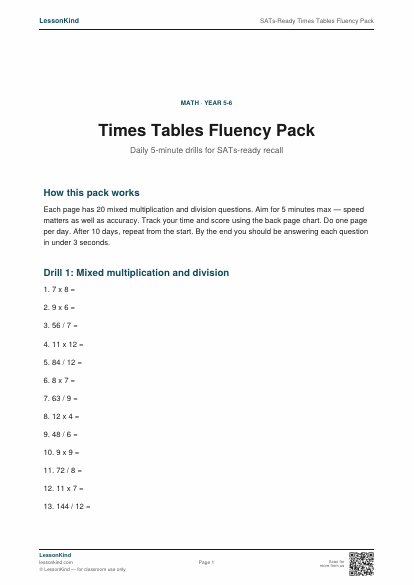
SATs-Ready Times Tables Fluency Pack
Daily 5-minute fluency drills covering all multiplication and related division facts to 12x12 — the foundation for SATs Arithmetic speed.
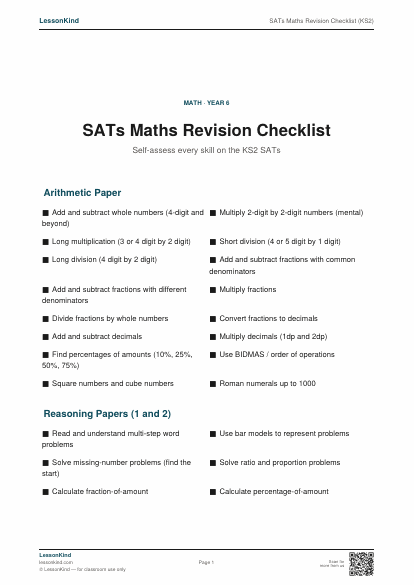
SATs Maths Revision Checklist (KS2)
A printable self-assessment checklist of every maths skill on the KS2 SATs Arithmetic and Reasoning papers. Y6 children tick off what they're confident with and what needs more practice.
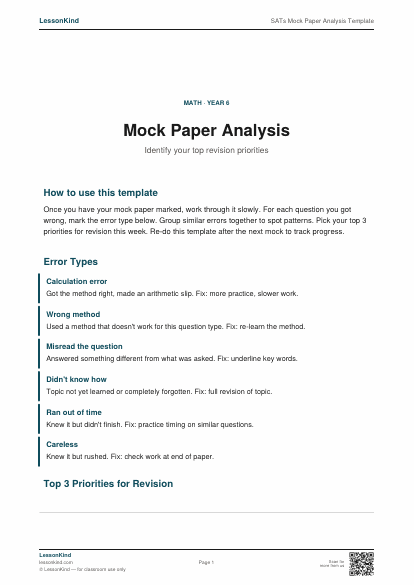
SATs Mock Paper Analysis Template
After every mock paper, children use this template to analyse what went wrong and identify their top 3 revision priorities. Works for both maths and English papers.
Going deeper
On retrieval, spacing and durable learning
Books we'd recommend on the topics raised in this article.
The cognitive science
- M Make It Stick: The Science of Successful Learning — Peter C. Brown, Henry L. Roediger, Mark A. McDaniel
-
W
Why Don't Students Like School? — Daniel T. Willingham
Cognitive scientist on the gap between performance and learning - R Rosenshine's Principles in Action — Tom Sherrington
- R Retrieval Practice: Research and Resources for Every Classroom — Kate Jones
Convenience links to Amazon. As an Amazon Associate we earn from qualifying purchases at no extra cost to you. Read our affiliate disclosure.
Keep reading
Teaching strategy
The Quiet Power of Low-Stakes Quizzing
Frequent low-stakes quizzes might be the single highest-impact, lowest-effort change you can make to your teaching this year.
6 min read
Math
How to teach times tables that actually stick
Times tables are the foundation of every other maths skill, but the way most schools teach them — Friday tests, marathon practice sessions — is what cognitive science would tell you NOT to do. Here's what works.
8 min read