Behavior & classroom management · 8 min read
Why Your Year 6 Child Is Suddenly Anxious About Secondary School
And the surprising thing that helps most — which isn't what schools usually say
Published 2026-10-20
A scene most parents of older primary children will recognise. February of Year 6: child cheerful, confident, talking happily about which secondary school they'll go to. April: child increasingly quiet, anxious, suddenly tearful about something that's still five months away. June: full meltdown over the SECONDARY-SCHOOL UNIFORM photo session. By the time September arrives, the child who'd been excited about secondary in February is sometimes a wreck.
This pattern is so common that primary teachers, secondary teachers, and parenting professionals see it every year. It is also poorly understood by everyone involved, including (often) the children themselves.
This article is about why Year 6 anxiety about secondary school spikes in spring and summer, why the standard responses sometimes backfire, and what actually helps.
What's happening
The simple version: secondary school becomes real.
For most of primary, secondary school is an abstract idea. The child knows they'll go eventually but it's distant. They have older siblings, cousins, family friends who go, but it's not THEIR experience yet. From the child's perspective, secondary is something that happens to people much older than them.
In Year 5 and the start of Year 6, this changes slightly. There's some talk about secondary, some visits perhaps, some application paperwork. Still distant, still abstract.
What shifts in spring is concrete reality. The application is decided. They know which school. They've visited. They've met some teachers. Other children's school choices are public. Uniform fittings. Reading lists. Form documents. Friend groups starting to fragment along secondary lines.
Suddenly secondary isn't abstract. It's a real building, with real new people, real new teachers, real new uniform, real new bus route, real new everything. And a calendar that says it starts in 5 months. Then 4. Then 3.
For many children, this is when their imagination starts running. And ten-year-old imagination, in the absence of real information, fills with worst-case scenarios.
What they're actually worried about
Most secondary-school anxiety in Year 6 is NOT about the things adults think it's about.
Adults think children are worried about: - Academic pressure - Schoolwork being harder - Tests and assessments - Uniform and behaviour rules
What children are usually actually worried about: - Friendships breaking up — who will I sit with at lunch? - Getting lost in a huge building - Older students being scary - Being the youngest after being the oldest in primary - Looking 'wrong' in some specific way (haircut, uniform, speech) - Public toilets / changing for PE - Not knowing how the social rules work - Forgetting things and getting in trouble - Bullying - Rumours they've heard about a specific teacher or experience
These worries are often present in some combination, varying child to child. They are also, mostly, not academic. They're SOCIAL and ENVIRONMENTAL.
This matters because the standard adult response to secondary anxiety — 'don't worry, the work is similar to what you do now' — completely misses what the child is actually anxious about. The work isn't the issue. Lunchtime is the issue.
Why standard reassurance often makes it worse
A few patterns that don't help, despite seeming kind.
**'You'll be fine.'** Closes the conversation. The child often experiences this as 'you don't want to hear this.' They stop sharing. The anxiety continues but goes underground.
**'It's not as scary as you think.'** Treating the worry as a misperception is dismissive. The child's fears feel real to them. Saying 'they're not really there' invalidates without solving anything.
**'I know you'll make new friends.'** They might. They might not. Promising things you can't promise — about friendships, about a smooth transition, about a particular outcome — sets up a betrayal.
**Visits and information days.** Often helpful in concept, but can ESCALATE anxiety in practice — the child sees the size of the building, the height of the older students, the volume of the corridors. Some children come back from open evenings more worried, not less.
**Repeated upbeat conversations.** 'Won't it be exciting!' 'You'll have so much fun!' Sometimes lands. Sometimes the child reads adult forced-cheer as evidence that they SHOULD be excited and aren't, which adds shame on top of anxiety.
**Comparison to siblings.** 'When [older sibling] went, they were fine.' Different child, different fears. Often unhelpful.
**Telling them they should focus on the positives.** Children who feel anxious can't easily 'focus on the positives.' This is roughly equivalent to telling someone with vertigo to 'focus on not falling.'
The deeper issue with these is that they all aim to MAKE THE WORRY GO AWAY. They treat the worry as the problem.
What actually helps
The worry isn't actually the problem. The lack of EQUIPMENT FOR HANDLING THE WORRY is the problem. Children with strong coping resources can have a worry and still function. Children without those resources have the worry and freeze.
A few things that genuinely help build the equipment:
**Listen properly.** When they share a worry, don't fix it. Don't reassure. Just hear it. 'That makes sense, that would worry me too.' 'Tell me more about that.' Let the worry be heard. Children often feel less anxious after being heard than after being reassured — counterintuitively but consistently.
**Validate without reinforcing.** 'It IS scary going to a new school. It IS bigger. There ARE older students. Those things are real. AND I think you're capable of handling them.' Accept the reality. Add capacity.
**Normalise the worry.** 'Most people who go to secondary feel nervous before they start. It's not a sign something is wrong with you. It's a sign you're paying attention.' Normalising reduces shame.
**Get specific information.** General reassurance doesn't help. Specific information often does. 'Yes, the school has 1,500 students. The Y7s are kept mostly together for the first half-term. Here's the layout map. Here's the bus route. Here's where the toilets are.'
**Find one connection.** Knowing one person at the new school often calms a lot of anxiety. A friend going. A friend-of-a-friend. An older child. A teacher already met. Even a name to look out for.
**Practise the route.** Walk to the school, repeatedly, at different times. Take the bus a few times in summer. Make the journey familiar BEFORE the first day.
**Buy the uniform early.** Wear it around the house. Practise tying the tie. Get it laundered. Reduces the 'first morning in unfamiliar uniform' shock.
**Identify what can be controlled.** Most anxiety includes a sense of powerlessness. Identifying things they CAN control — packing their bag the night before, knowing the route, having a contingency plan — reduces the powerless feeling.
**Plan for the hard moments.** 'If you can't find lunch friends in the first week, what could you do?' 'If you get lost between classes, what would you do?' 'If a teacher seems scary, what's the plan?' Pre-thought-through responses reduce the chance of freezing in the moment.
**Talk about your own transitions.** Honest stories from your own school days. Ones with hard moments and how you got through. Children find these reassuring without finding them dismissive.
**Reduce summer demands.** Summer holidays can become loaded with anticipation. Keep the rhythm normal. Plan calm activities. Don't let secondary become the only topic.
**Avoid building it up.** 'Last summer before secondary!' Some children find this exciting. Others find it sad and pressuring. Read your child.
The role of primary school
Good primary schools recognise that Year 6 transition anxiety is a thing and respond accordingly.
Patterns that help:
- Multiple visits to secondary in summer term, gradually - Buddy systems with older children at the secondary school - Year 6 transition lessons exploring worries explicitly - Sample timetables, sample lunches, sample lessons - Connection between primary teachers and secondary form tutors - Detailed handover notes from primary to secondary
Patterns that don't:
- Treating secondary as a threat ('they won't accept that in secondary!') - Building up secondary's strictness, length, or difficulty - Encouraging Year 6 children to 'grow up' suddenly - Comparing primary unfavourably to secondary - Letting Year 6 become a coasting year where standards drop
If you're a parent and your school does the helpful things, lucky you. If they don't, you can supplement.
The role of secondary school
Some secondaries handle Year 7 transition really well. Some don't.
Markers of a good secondary transition:
- Multiple summer visits / induction days - Buddy systems with Year 8 students - Form tutor as primary point of contact - Quiet first weeks with reduced expectations - Visible map / signage / orientation support - Pastoral lead easily reachable - Friendly tone during the first weeks (not 'cracking down on standards')
Markers of a struggle:
- Single induction day, no follow-up - 'Sink or swim' attitude in first week - High demands from day one - No clear pastoral pathway - Teachers using fear as engagement strategy
If your secondary doesn't seem to be doing the right things, you can advocate. Talk to the form tutor. Email the head of Year 7. Request specific support if your child is struggling. Don't wait for things to deteriorate.
A note on neurodivergent children
Children with autism, ADHD, anxiety disorders, or other neurodivergent profiles often find secondary transition harder. The reasons are predictable:
- Loss of consistent adults (multiple teachers vs one) - Loss of consistent classroom (moving rooms throughout the day) - Sensory overload (bigger building, more people, more noise) - Social demands stepping up (peer dynamics in adolescence) - Executive function demands (timetables, equipment, multiple homeworks)
For these children, transition support should be more substantial:
- Specific transition meeting between primary, secondary, parents - EHCP/SEN support plan updated for new setting - Identified key adult at secondary - Sensory-aware classroom placement - Reduced timetable initially if needed - Quiet space accessible - Pre-arranged way to ask for help
If your child has known SEN, push for these conversations early — January or February, not July. The longer the runway, the smoother the landing.
A final word
Year 6 anxiety about secondary is normal, common, and largely manageable with the right support. It's also more about social and environmental fears than academic ones, and it responds better to specific information and practice than to general reassurance.
If your child is anxious about September, don't try to make the anxiety go away. Try to build their capacity to handle it. Validate the fears. Get specific information. Practise the journey. Identify the people and places that will help. Make a plan for the hard moments.
By the time September arrives, they'll still be nervous. That's fine. Nervousness is normal. What you've built — the listening, the information, the practice, the plans — is what they take with them through the secondary gates.
The first week is hard for almost every Year 7. By half-term, most have settled enough to start having normal lives at secondary. By Christmas, most are fine. The transition is, for the vast majority, surmountable.
Your job in the months before isn't to make them un-anxious. It's to give them the tools they need so the anxiety doesn't decide what they can do. That's a more achievable, and more useful, goal.
Free bundle for this topic
Cover Day Survival Pack
9 resources for any cover day, including behavior strategies and morning meeting scripts.
Practical resources for this
Take this further
Printable, classroom-ready resources for the topics in this article.
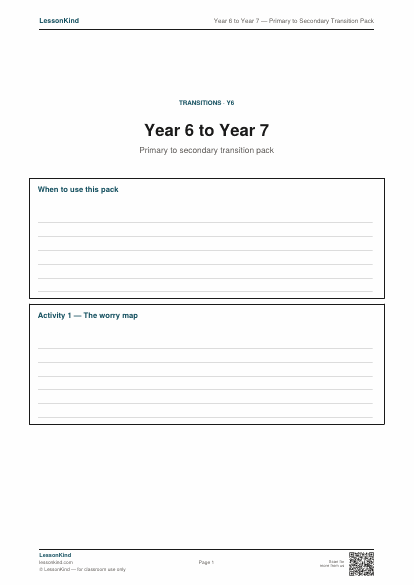
Year 6 to Year 7 — Primary to Secondary Transition Pack
A practical pack for the biggest transition of all — Year 6 to secondary school. Worry-mapping activities, a 'questions you can ask' sheet, parent letter, and the practical things that get forgotten until August.
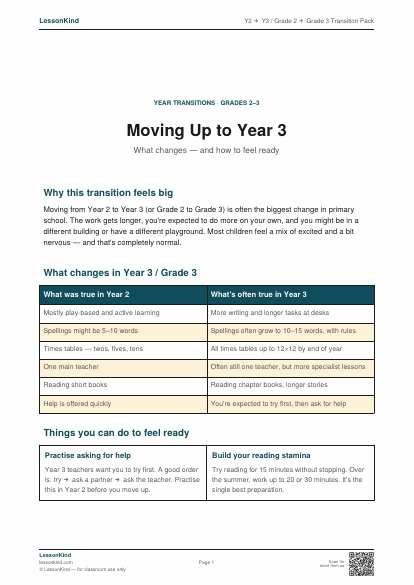
Y2 → Y3 / Grade 2 → Grade 3 Transition Pack
The biggest jump in primary — KS1 to KS2 in the UK, lower to upper elementary in the US. Covers the changes children can expect and how to feel ready.
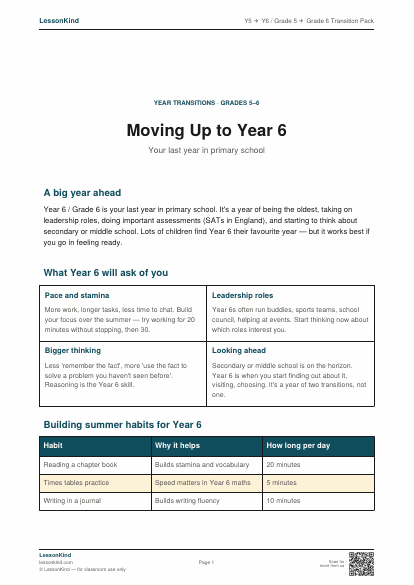
Y5 → Y6 / Grade 5 → Grade 6 Transition Pack
The final year of primary — preparing for the year of SATs (UK) or graduation (US/CA), leadership roles, and looking ahead to secondary/middle school.
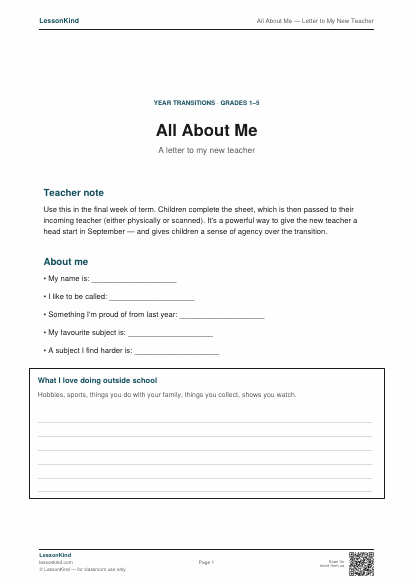
All About Me — Letter to My New Teacher
A printable sheet children fill in for their incoming teacher — interests, strengths, things they find hard, and what helps them learn.
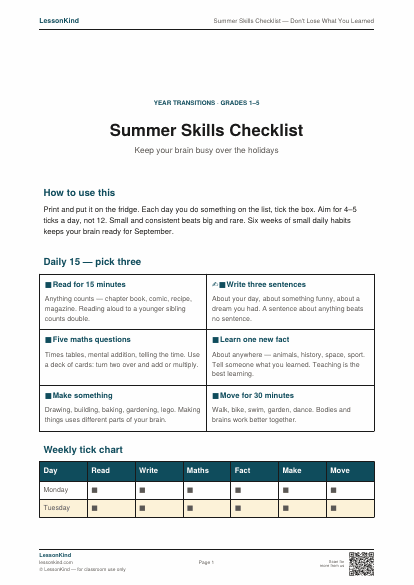
Summer Skills Checklist — Don't Lose What You Learned
A printable summer checklist of small daily habits that prevent the 'summer slide' — 5–15 minutes a day of reading, writing and number work.
Y6 Reading List — Books for the Year of Secondary Transition
Books for Y6 children — the year before secondary, where reading taste matters most and reading is the strongest predictor of secondary attainment. Calibrated for the Y6 cohort specifically — friendship, identity, change, growing up.
Going deeper
Books for the secondary transition
Books to read in the final term of Y6 — for the worried child, and for the parents.
For Y6 children
Convenience links to Amazon. As an Amazon Associate we earn from qualifying purchases at no extra cost to you. Read our affiliate disclosure.
Keep reading
Behavior & classroom management
Anxiety in Primary Children: What's Normal and What's Not
Most primary-aged children worry. Some of them worry in ways that affect their lives. The line between these is the most consequential thing for parents to get right — and the most often blurred by anxiety culture going in both directions.
9 min read
Behavior & classroom management
Friendship Problems in Year 4: When to Step In, When to Wait
Year 4 is the age where friendships get politically complicated. Drama, exclusion, falling-out, falling-back-in. Most of it isn't bullying. Most of it doesn't need adult intervention. Some of it does. How to tell the difference, and what to do when your child comes home in tears.
8 min read
Behavior & classroom management
What Trauma-Informed Teaching Actually Means in Year 4
'Trauma-informed' has become a school slogan, sometimes deployed by leadership without actually changing anything. This article is about what genuinely changes when the framework is taken seriously — and what doesn't.
9 min read