Behavior & classroom management · 8 min read
Friendship Problems in Year 4: When to Step In, When to Wait
The most common reason for tears at the school gate from age 8 to 10 — and why the obvious adult response often makes things worse
Published 2026-10-21
A specific phone call most parents of 8-to-10-year-olds will recognise. Pickup time. Your child gets in the car or you meet them at the gate. They're upset. Eventually it comes out: '[Specific friend] has decided not to be friends with me.' Or: 'They left me out at break.' Or: 'I sat at the wrong table at lunch and now [specific group] won't talk to me.'
In adult terms, the events sound trivial. In Year 4 terms, they're seismic. Your child is genuinely heartbroken. You feel a strong pull to fix it — to call the school, to call the other parent, to make the situation better.
Sometimes that's the right response. Often it's not. Misjudging which is which is one of the most common parenting errors at this age, and one with real consequences for the child's social development.
This article is about the friendship politics of upper KS2 (roughly ages 8-10), why they intensify, what's developmentally normal, and when adult intervention helps versus when it makes things worse.
Why friendships get harder around Year 4
For most of early primary, friendships are simple. 'Are we friends?' 'Yes.' 'Do you want to play?' 'Yes.' The complexity is low. Children play with whoever is willing.
By Year 3, then more so by Year 4, this changes. A few developmental shifts converge.
**Social hierarchy awareness.** Children become aware that there are 'popular' children, 'cool' groups, perceived rankings. This awareness is mostly imagined — Year 4 hierarchies are largely social construction — but it feels real to the children.
**Best-friend culture.** The exclusive 'best friend' becomes a thing. Children rank friends. They have a 'first best friend' and a 'second best friend.' Mutual best-friendship feels enormously important. Mismatches (you think they're your best friend, they think someone else is) are devastating.
**Group formation.** Friendships consolidate into groups — usually 3-6 children. Membership is real. Outsiders are real. Politics within groups (who's in, who's slightly out) become the daily dynamic.
**Theory of mind matures.** Children become more able to think about what others think of them. Sometimes this is great — they become more empathetic. Sometimes it's painful — they become hyperaware of slights, perceived slights, real slights.
**Independence from adults.** Children's friendship lives become less mediated by adults. The teacher isn't there at every break. Parents aren't on every playdate. Children manage social complexity themselves, mostly without trained skills.
**Communication outside school.** WhatsApp groups, social media (officially or unofficially), phone messages. The drama doesn't end at 3:30 anymore — it follows them home and continues until bedtime.
The combined effect: friendship becomes the most cognitively and emotionally demanding part of a Year 4 child's day. Sometimes more demanding than the academic work. They are doing politics they don't yet have the tools for, in environments their parents can't see, with stakes that feel existential.
What's normal — and what isn't
A lot of Year 4 friendship drama is developmentally normal. It feels enormous to the child but is also part of how they learn social skills.
NORMAL patterns:
**Falling out and making up.** Same friends, multiple times a week. Argument over something tiny. Sulk. Come back. This is how children learn conflict resolution.
**Shifting alliances.** A child who was best friends with X last term is best friends with Y this term. Then with Z. Children are trying out connections.
**Group politics.** Who's in, who's out, who said what. Most of it minor. Most of it self-correcting within days or weeks.
**Some exclusion.** Not every child gets invited to every party. Best friends sometimes prefer each other's company. Children sometimes pair off and leave others out at break.
**Drama around minor events.** 'She didn't sit next to me.' 'He didn't pick me first.' Big feelings about small things.
**Loneliness, sometimes.** Most children experience some lonely moments at this age. A friend off school. A break where it didn't quite work out. A weekend with no playdate.
These are normal. They are also painful. The child's pain is real. The pain itself doesn't mean adult intervention is needed.
NOT NORMAL patterns:
**Sustained exclusion targeting one child.** A specific child being systematically left out, week after week, by an established group.
**Repeated cruelty from the same source.** A particular peer (or peers) consistently saying or doing harmful things.
**Online harassment.** Cyber-bullying via WhatsApp groups, social media, gaming platforms.
**Physical aggression beyond the occasional pushing.** Hitting, kicking, deliberate physical hurt.
**Threats or intimidation.** 'Don't talk to me or I'll tell everyone X.' Threats that produce fear.
**Pattern of social engineering.** A child or group orchestrating others to ostracise someone. Often with messages, social media, and explicit instructions ('don't sit with X this week').
**Significant impact on the child's wellbeing.** Not wanting to come to school. Crying daily. Not eating. Not sleeping. Withdrawing from previously-loved activities.
These aren't normal. They're closer to bullying. They warrant adult intervention.
The line between the two isn't always clear. The signal that you're crossing from normal to not-normal is usually IMPACT and PERSISTENCE. Painful one-off events are usually normal. Sustained targeted patterns over weeks aren't.
Why over-intervening backfires
The most common parenting mistake in Year 4 friendship drama is intervening too fast and too hard. The reasons it backfires:
**It removes practice.** Children learn to handle social difficulty by handling it. Each falling-out, each tricky moment, each conflict is a chance to develop skills. If parents step in immediately, the child doesn't get the practice.
**It can make things worse socially.** A child whose mum has called the other mum, or called the school, becomes 'the one whose parent gets involved.' Other Year 4 children read this. Sometimes it leads to social cost greater than the original problem.
**It can entrench the issue.** When parents call schools about minor friendship issues, schools sometimes respond with friendship interventions that highlight the problem to everyone in class. The conflict that would have resolved naturally is instead made formal and public.
**It gives adult-level meaning to childhood-level events.** A 9-year-old saying 'I don't want to be your friend anymore' said in anger may be forgotten by the next morning. An adult treating it as a serious rupture imports adult understanding of relationship loss into something the children would have moved past.
**It doesn't build the child's coping.** Children need to develop the capacity to feel social pain, recover, try again, find new connections. If parents protect them from every painful moment, the recovery muscle doesn't develop.
This is uncomfortable. As a parent, watching your child cry over a friendship is awful. The instinct is to fix it. Resisting that instinct, when the situation is normal Year 4 drama, is part of the harder work of parenting older children.
When to step in
Some patterns warrant intervention. When you decide one of these is happening, intervene calmly and proportionately.
**Sustained targeting.** If your child is being consistently excluded or targeted by the same individual or group for weeks, this isn't passing drama. School involvement is appropriate.
**Bullying behaviour.** Threats, repeated cruelty, physical harm, online harassment. Schools have policies for this. Use them.
**Significant impact on wellbeing.** If your child is regularly distressed, not sleeping, not eating, not wanting to go to school, the situation has tipped beyond what they can handle alone.
**Concerning specific incidents.** A particularly bad incident — physical harm, public humiliation, racist or other identity-based abuse — warrants action even if it's a one-off.
**Patterns the child can't see.** Sometimes children don't recognise harmful dynamics — gaslighting, manipulative friendships, controlling peers. As an adult, you may see what they don't.
**No movement after weeks.** If your child has been distressed about a specific friendship situation for several weeks, with no resolution and no fading, the situation isn't self-correcting. It needs intervention.
What intervention looks like:
**Talk to the school first.** Class teacher, then SENDCo or pastoral lead if needed. Specific facts. What you've observed. What your child has shared. Ask what they've noticed. Ask what they suggest.
**Don't call other parents directly (usually).** Going around the school often escalates situations. Sometimes the other parent isn't aware of their child's role; sometimes they are and disagree with you. Either way, school-mediated conversation usually works better.
**Be specific in what you're asking.** Not 'sort it out' but 'we'd appreciate seating apart for a fortnight' or 'could you watch what happens at lunch break and feed back?' Specific is actionable.
**Continue to support your child at home.** Don't use the school's involvement as the only response. Continue listening. Continue building their resilience.
**Watch and follow up.** A week later, check in with the school. Two weeks later, check in. Don't assume one conversation has fixed it.
What helps your child without intervention
Even when you're not stepping in directly, there are things you can do at home.
**Listen properly.** Without trying to fix. 'That sounds really tough. Tell me more.' Children often process social pain by talking it out. Your job is to be the safe place to talk.
**Validate the feelings.** 'It hurts when a friend does that.' Don't minimise ('it'll be fine tomorrow') even if you think it will.
**Help them think it through.** 'What do you think she meant by that?' 'What might be going on for him?' Helping them think about others' perspectives is a useful skill, learned through practice.
**Plan small responses.** 'What might you try tomorrow?' Let them generate ideas. Offer a few. Don't dictate.
**Make sure home has other connections.** Cousins. Other-school friends. Family friends. The wider social world means a difficult patch at school isn't their entire life.
**Build self-worth outside friendships.** A child whose identity is entirely in 'who is my friend right now' is fragile. A child who knows they are creative, or sporty, or kind, or funny, or interesting, has more to fall back on.
**Limit the dramatic devices.** WhatsApp at this age is often a problem multiplier. The drama that would have ended at 3:30 continues until bedtime. Where possible, reduce or eliminate access to group chats. This is unpopular with the children. It's almost always right.
**Don't gossip about it with other parents in front of your child.** It elevates the importance. Models a way of dealing with social drama that isn't healthy.
**Tell your own stories.** Honest stories from your own primary years. Difficult friendships, ones that resolved, ones that didn't. Children draw enormous comfort from knowing this is a normal human experience.
The longer view
Most Year 4 friendship problems don't last. By Year 5 or 6, the child has different friends, different group dynamics, different concerns. The intense drama of the moment becomes a distant memory.
A few children, however, develop more sustained friendship difficulties. If your child:
- Has consistently struggled to make and keep friends across multiple years - Often feels lonely at school - Has difficulty reading social cues - Misinterprets neutral interactions as hostile - Or other patterns suggestive of underlying social communication difficulties
it may be worth investigating further. Some children with autism, ADHD, anxiety disorders, or social communication difficulties find Year 4 friendship politics particularly hard. The challenges are predictable and the support available is real. Don't write off persistent struggles as 'just the child not being good with people.'
For most children, though, Year 4 is the year of friendship turbulence followed by gradual settling. Your role is to be the steady, listening adult who provides perspective, comfort, and support without taking over.
A final word
Friendship problems at this age are painful for parents because they are painful for children — and you can see your child hurting and not be able to fix it. The hardest part of parenting older children is often this: your child has experiences you can't control, in spaces you can't see, with people you can't influence directly. You can't make their friends be kind. You can't sit with them at lunch.
What you can do is be the steady person they come home to. The one who listens without dismissing. The one who validates without amplifying. The one who provides perspective. The one who notices when something has crossed from normal drama into not-normal harm.
The skill is calibration — knowing when to wait, knowing when to act. It's earned through experience. You'll get some of it wrong. So will every parent who's ever raised a 9-year-old.
What matters most is that your child knows: when friendship hurts, home is the place where someone listens, takes them seriously, and helps them think it through. That's the foundation. The rest gets built on top of it.
Free bundle for this topic
Cover Day Survival Pack
9 resources for any cover day, including behavior strategies and morning meeting scripts.
Practical resources for this
Take this further
Printable, classroom-ready resources for the topics in this article.
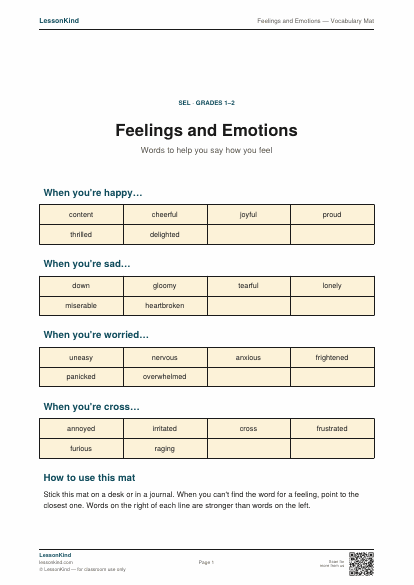
Feelings and Emotions — Vocabulary Mat
Twenty emotion words grouped by intensity. Helps children name and talk about feelings.
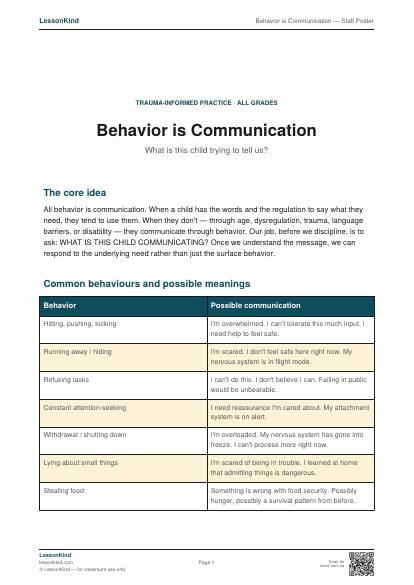
Behavior is Communication — Staff Poster
A staff-room poster reframing common 'difficult' behaviours as communications. The shift in lens is often the most powerful intervention there is.
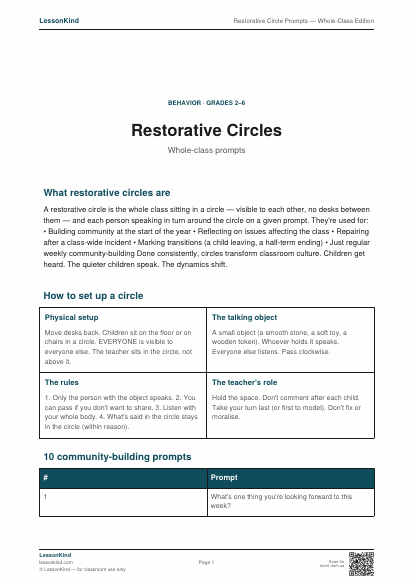
Restorative Circle Prompts — Whole-Class Edition
Whole-class restorative circle prompts for community-building and after class-wide incidents. 30 prompts across 4 categories, plus how to set up and run the circle.
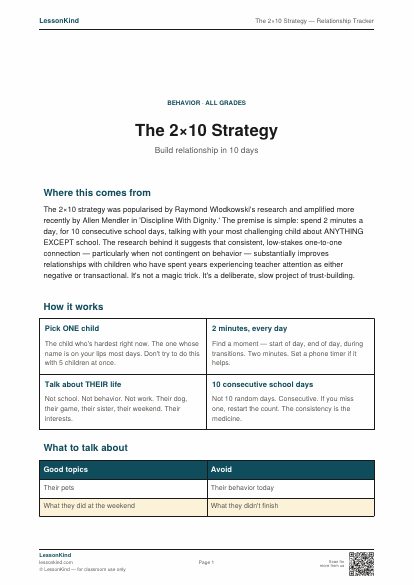
The 2×10 Strategy — Relationship Tracker
An evidence-informed approach to building relationship with the most challenging child in your class — 2 minutes a day, 10 days, talking only about non-school topics. With a tracking sheet.
Going deeper
Books on childhood friendships
Books on the rocky friendships of Y4-Y5, where social complexity ramps up.
For parents
Picture books for the children themselves
Convenience links to Amazon. As an Amazon Associate we earn from qualifying purchases at no extra cost to you. Read our affiliate disclosure.
Keep reading
Behavior & classroom management
Anxiety in Primary Children: What's Normal and What's Not
Most primary-aged children worry. Some of them worry in ways that affect their lives. The line between these is the most consequential thing for parents to get right — and the most often blurred by anxiety culture going in both directions.
9 min read
Behavior & classroom management
School Refusal: What's Actually Going On
School refusal has risen sharply post-pandemic. The standard responses — punishment, fines, force — usually make things worse. Here's what's actually happening, what works, and what families can do when they realise their child genuinely cannot get through the school gates.
9 min read
Behavior & classroom management
What Trauma-Informed Teaching Actually Means in Year 4
'Trauma-informed' has become a school slogan, sometimes deployed by leadership without actually changing anything. This article is about what genuinely changes when the framework is taken seriously — and what doesn't.
9 min read