Behavior & classroom management · 9 min read
What Trauma-Informed Teaching Actually Means in Year 4
Beyond the slogans — what changes in a real classroom when you start seeing children through this lens
Published 2026-09-30
Some phrases get adopted by school leadership before anyone really knows what they mean. "Growth mindset" was one. "Restorative practice" is another. "Trauma-informed" is the most recent.
The result is that you can now hear school leaders confidently announce that their school is "trauma-informed" while the day-to-day teaching has not visibly changed at all. Detentions still get given for visible disruption. Children who freeze in lessons are still told to "look at me when I'm talking to you." Public charts still move children's pegs. The behavior policy still rewards conformity and punishes deviation.
Trauma-informed practice, where it's real, looks different. This article is about what genuinely changes — and what doesn't — when a teacher and a school take it seriously.
What it isn't
A few common misunderstandings, before we get to what it is.
**It's not abandoning expectations.** This is the first and most consequential misunderstanding. Children with trauma backgrounds need MORE structure than other children, not less. The chaos in their lives outside school makes school's predictability MORE important, not optional. A trauma-informed classroom has clear expectations, clear consequences, and clear routines. What it doesn't have is shame.
**It's not 'no consequences'.** A child who has hurt another child still has to address what they did. The repair process matters. The work is in HOW the consequence happens — preserving relationship, framing repair as restoration, not punishment. The accountability is there. The shame isn't.
**It's not amateur therapy.** We're teachers, not therapists. We don't 'work through' a child's trauma in the classroom. We don't bring up their history in lessons. We don't probe for disclosures. What we do is make the classroom safe enough for trauma not to dominate, so the child can learn — and so professionals who CAN help with the trauma have somewhere to start from.
**It's not soft.** This bears repeating. Trauma-informed teaching is harder than punitive teaching. It requires more self-regulation from the adult, more patience, more thinking, more deliberate restraint. The teachers who do it well aren't the most gentle ones. They're the most disciplined.
**It's not for some children.** Many schools deploy 'trauma-informed' selectively for the children identified as vulnerable. This misses the point. Universal trauma-informed practice — applied to ALL children — works because (a) you don't always know which children have trauma backgrounds, (b) other children benefit too, and (c) the differential creates exactly the visible, shaming, 'special treatment' that undermines vulnerable children's belonging.
What changes — daily
A trauma-informed Year 4 classroom looks like a regular Year 4 classroom on the surface. The differences are small and, in aggregate, transformative.
**Greetings at the door.** The teacher stands at the door each morning and greets every child by name. Eye contact. A specific comment if possible — 'how was football?' 'I love your new haircut.' Five seconds per child. Done deliberately. This isn't decoration; it's the cheapest, most effective intervention in trauma-informed practice. It signals to a vulnerable nervous system: I see you, you matter, you're welcome here.
**Visible timetable.** What's happening today is visible. What's happening tomorrow is mentioned. Changes to routine are flagged in advance. The future is predictable enough that the nervous system doesn't have to scan for surprises.
**Calm voice.** Whatever volume the classroom is at, the teacher's voice is at the lower end of it. Not shouting over noise; getting attention by going quieter. Consistent across days. Consistent under pressure. The teacher's voice does not match the energy of disrupted children — it provides a different frequency to attune to.
**Movement built in.** Brain breaks. Stretches between lessons. Permission to stand at desks. Wobble cushions. Errands. Bodies moved purposefully. For dysregulated children, sitting still is not a learning condition — it's a punishment.
**Quiet redirects, not public corrections.** When a child is off-task or disrupting, the redirect happens privately or with minimal attention. A hand on the desk. A short whisper. A look. The aim is to bring the child back to the work, not to shame them in front of peers.
**Repair after ruptures.** When the teacher loses their cool — and they will, sometimes — they apologise. Quickly. Specifically. 'I was sharp earlier. I'm sorry.' This isn't weakness. It's the most powerful teaching about how relationships work that some children will see all year.
**Consequences that repair, not punish.** When something needs to be addressed — a child who hurt another, a child who damaged something — the response involves making it right. Cleaning. Apologising. Replacing. The aim is not to make the child feel bad; it's to teach them that mistakes are repairable.
What changes — over the year
Some changes don't show up in any single day. They emerge over time.
**The 'difficult' children get easier.** Not because they've been broken. Because their nervous systems, after months of consistent calm, predictable warmth, and absence of shame, slowly retrain. The freeze responses get shorter. The aggression decreases. The hyper-vigilance softens. Children who would have been suspended in November are doing fine by April. This isn't always linear — there are setbacks — but the trajectory is clear.
**The 'safe person' relationship deepens.** Some children need a particular adult to be reliable for months before they trust it. By February, the child you thought was beyond reach is showing up at your door at break, just to be near you. By June, they've blossomed into someone you didn't recognise in September.
**Other children become kinder.** Children watch how the teacher treats the most difficult child. If they see public shaming, they learn that's how to treat people who struggle. If they see calm patience, they learn that's how. The whole class culture shifts based on how the most-challenging member is held.
**Parents engage differently.** Parents who've been told their child is the problem at every previous school respond differently when they encounter a teacher who doesn't blame them. Defenses come down. Information flows. The home-school partnership becomes real. This often takes a term to develop — but once it does, it's transformative.
**Your own teaching becomes more deliberate.** You become aware of your voice, your pace, your body language, your tone. The discipline of co-regulation makes you a more present teacher generally. Even children without trauma benefit from a teacher who has worked on themselves.
What's hard about it
A few honest costs.
**It's tiring.** Holding calm under pressure, repairing ruptures, regulating yourself when the child is escalating — all of this requires more from you than 'shouting and writing names on the board' does. Trauma-informed practice is not the easy path; it's the path that costs the teacher more.
**It can feel slow.** The work is gradual. Children who have spent years building survival adaptations don't drop them in a month. There are weeks where it feels like nothing's working. The trajectory is months, not days.
**It's lonely if your school doesn't get it.** A teacher trying to do trauma-informed work in a punitive school is in a difficult position. Their classroom can feel different to other classrooms. They can be seen as 'soft' or 'making excuses.' Senior leadership decisions can undermine their work. This is the hardest position to be in — quiet trauma-informed practice in an unaligned school.
**It can compound your own trauma.** Hearing children's stories, sitting with their distress, repeatedly co-regulating dysregulated nervous systems — all of this leaves residue in YOUR system. Secondary trauma is real. Without supervision and self-care, the very teachers who do this work best burn out fastest.
**It doesn't always work in time.** Some children's situations are beyond what one teacher in one classroom can address. The work helps; it isn't always enough. Holding this — that you can do it brilliantly and still have children who need more than you can provide — is part of the job.
What it requires from school leaders
Teachers can do trauma-informed work in their own classrooms regardless of the school's stance. But the impact compounds when school leadership is genuinely aligned. A few things leaders need to do for it to land:
**Adopt it as the default, not as an intervention for some.** Universal application makes the difference. If trauma-informed practice is only for 'identified' children, it becomes special treatment, which undermines belonging.
**Train all staff, including non-teaching staff.** Lunchtime supervisors, office staff, supply teachers, governors. The whole adult environment matters. A child can have a brilliant teacher and still be undone by a punitive lunchtime supervisor.
**Review behavior policy.** Many behavior policies are built on shame and exclusion. Public peg-moving charts. Detention systems. Reward systems that depend on visible compliance. These are difficult to reconcile with trauma-informed practice. The policy itself often needs work.
**Provide reflective supervision.** Teachers doing this work need somewhere to debrief. Not management meetings — actual reflective supervision with someone trained. Many schools provide this for SENCOs and DSLs but not for class teachers. They should.
**Defend the work against false metrics.** Trauma-informed practice may produce slower visible improvement and longer-term gains. Schools obsessed with this term's data sometimes undermine it. Leaders need to hold the longer view.
**Acknowledge the cost on staff.** Teachers carrying these children's stories pay a price. Acknowledging it, naming it, providing concrete support — therapy, time, conversation — is part of the work, not optional.
A final word
Trauma-informed practice, where it's real, is one of the most genuinely transformative shifts in primary education in the last twenty years. It's also been adopted, watered down, and weaponised in ways that obscure what it actually is.
If you're a teacher reading this and your school uses the language but not the practice, you can still do this work in your classroom. The kids in front of you will benefit. Some of them, decades from now, will remember a year of being treated with this kind of care and date their healing from it.
That's the work. It's small, daily, deliberate, and unglamorous. It looks like a regular Year 4 classroom from the outside. From inside, it's something different — a place where children whose nervous systems have learned to expect harm slowly learn to expect something else. That re-learning is what changes lives.
Free bundle for this topic
Cover Day Survival Pack
9 resources for any cover day, including behavior strategies and morning meeting scripts.
Practical resources for this
Take this further
Printable, classroom-ready resources for the topics in this article.
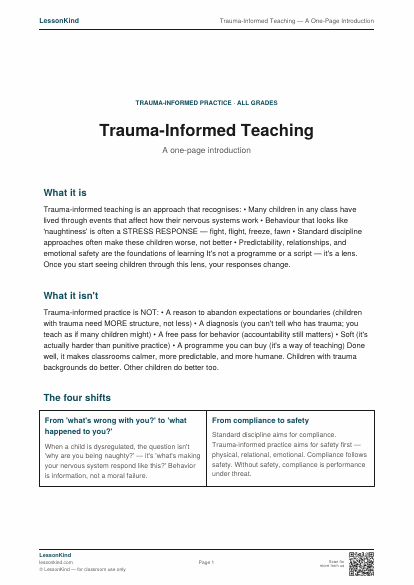
Trauma-Informed Teaching — A One-Page Introduction
What trauma-informed teaching actually is, what it isn't, and the four shifts that make a classroom safer for children with trauma backgrounds. Useful as a CPD opener.
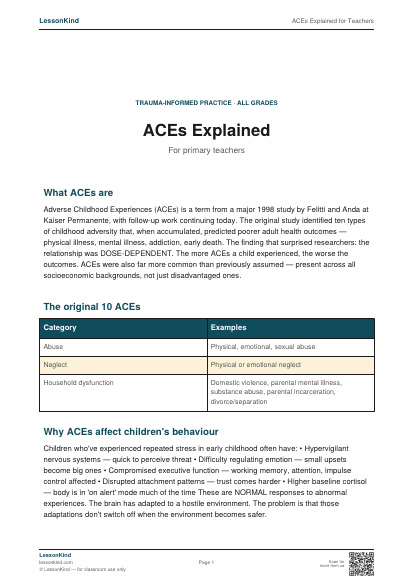
ACEs Explained for Teachers
Adverse Childhood Experiences — what they are, how they affect children's brains and behaviour, and what teachers can actually do. Based on the original Felitti and Anda research and subsequent decades of follow-up.
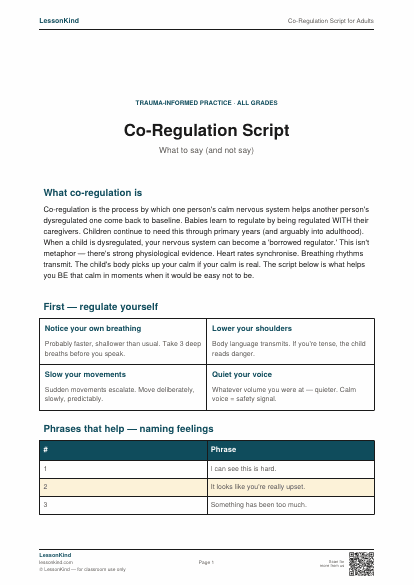
Co-Regulation Script for Adults
What to actually say (and not say) when a child is dysregulated. Phrase by phrase, based on the principles of co-regulation. Useful for the staff briefing.
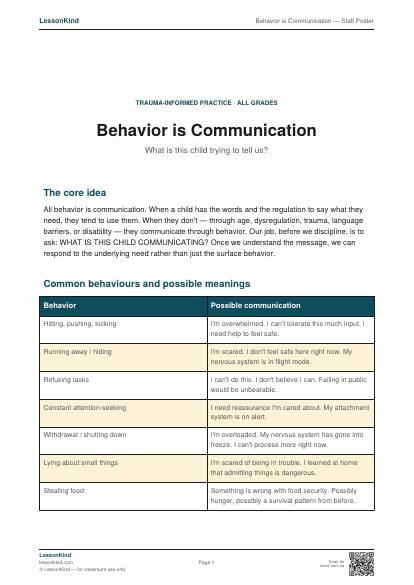
Behavior is Communication — Staff Poster
A staff-room poster reframing common 'difficult' behaviours as communications. The shift in lens is often the most powerful intervention there is.
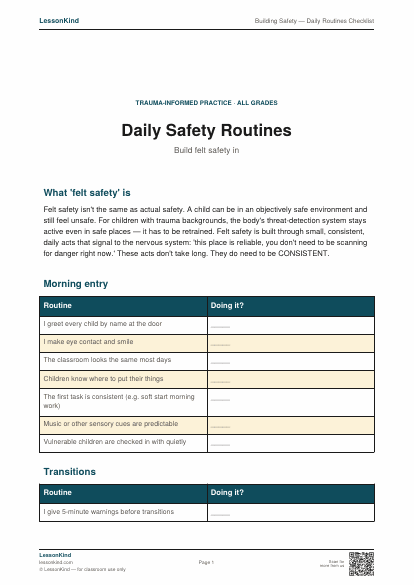
Building Safety — Daily Routines Checklist
The small daily routines that build felt safety for children with trauma backgrounds — entry rituals, transitions, exits. Audit your day.
Going deeper
Trauma-informed practice — recommended reading
The texts that have shaped UK trauma-informed school practice.
Foundational
Practical school-based
Convenience links to Amazon. As an Amazon Associate we earn from qualifying purchases at no extra cost to you. Read our affiliate disclosure.
Keep reading
Behavior & classroom management
When a Child's Behaviour Is Communication
Most adult responses to children's behaviour assume the behaviour IS the message. The trauma-informed reframe is simpler and more demanding: the behaviour is a SIGNAL of something underneath. The shift in response that follows is enormous.
8 min read
Behavior & classroom management
Anxiety in Primary Children: What's Normal and What's Not
Most primary-aged children worry. Some of them worry in ways that affect their lives. The line between these is the most consequential thing for parents to get right — and the most often blurred by anxiety culture going in both directions.
9 min read
Behavior & classroom management
School Refusal: What's Actually Going On
School refusal has risen sharply post-pandemic. The standard responses — punishment, fines, force — usually make things worse. Here's what's actually happening, what works, and what families can do when they realise their child genuinely cannot get through the school gates.
9 min read