EAL & inclusion · 6 min read
A New EAL Pupil's First Week: What Actually Helps
Moving beyond the welcome leaflet — practical, human actions for the first five days
Published 2026-05-15
A new pupil who speaks little or no English joins your class on Monday. You have a bilingual dictionary, possibly a welcome booklet, and 29 other children waiting for a lesson to begin.
Before they arrive (if you have notice)
**Get the name right.** Mispronouncing someone's name from day one signals a lack of care. Saying it correctly signals the opposite.
**Identify a buddy.** A calm, kind child who can show the newcomer physical things — the toilet, the dinner queue, where coats go — without words.
**Set up a visual timetable.** Even a simple pictorial schedule helps an EAL child predict what's coming. Predictability reduces anxiety enormously.
The first morning
**Greet them personally at the door.** Have someone there before they enter the classroom.
**Don't put them on the spot.** The 'stand up and tell the class about yourself' welcome is well-intentioned and often agonising. A silent introduction is kinder.
**Give them something to do immediately.** A colouring task, a simple worksheet — something they can attempt without language. The worst thing is to sit a child with nothing while a lesson they don't understand proceeds around them.
Managing the classroom around them
Don't over-explain. Key words, physical demonstration, and visual support are more effective than slow loud English.
Don't expect silence to mean non-understanding. The 'silent period' can last weeks or months. A child who says nothing is absorbing, not absent.
Don't force verbal responses before the child is ready. Written, drawn, or physically demonstrated responses reduce performance anxiety.
Don't let the child be isolated. Structured pair tasks — sorting, matching, pointing — create interaction without requiring language production.
What research says about EAL acquisition
Children typically develop Basic Interpersonal Communication Skills (BICS — playground language) within 1–2 years. Cognitive Academic Language Proficiency (CALP — academic language for school work) takes 5–7 years.
A child who appears fluent in English after two years may still be significantly behind peers in the academic language of subjects. Treating conversational fluency as academic readiness is one of the most common and consequential mistakes made with EAL pupils.
The measure of a successful first week
By Friday, the child should know: their teacher's name, the routine of the day, where the toilet is, what lunchtime looks like, the name of at least one peer, and that this place was ready for them.
Free bundle for this topic
SEND Inclusion Toolkit
7 essential SEND resources covering autism, ADHD, dyslexia and emotional regulation.
Practical resources for this
Take this further
Printable, classroom-ready resources for the topics in this article.
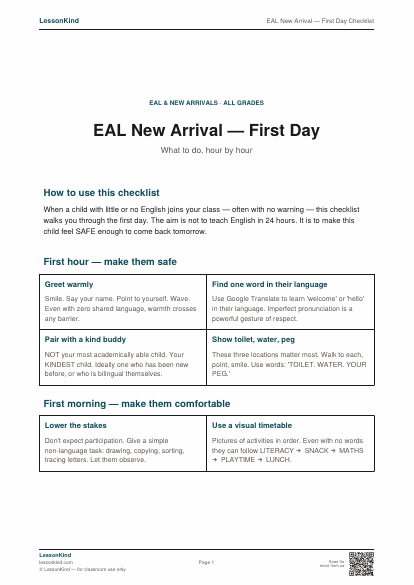
EAL New Arrival — First Day Checklist
What to do in the first hour, first morning and first afternoon when a child with no English joins your class. Practical, kind, ready to print.
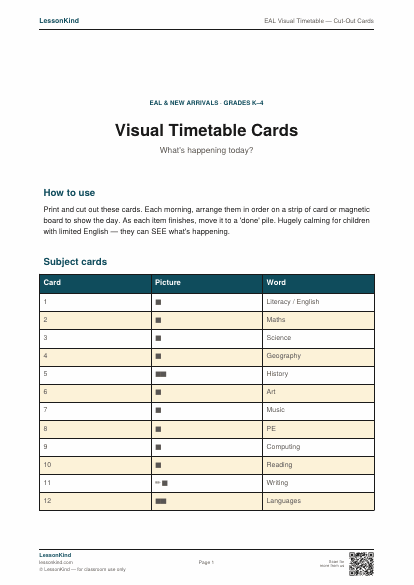
EAL Visual Timetable — Cut-Out Cards
Picture cards for every subject and routine in a typical school day. Arrange in order to show 'what's happening today' to a child who can't yet read.
Going deeper
Books on supporting EAL pupils
Books we'd recommend on the topics raised in this article.
For teachers
Bilingual dictionaries and word tools
Convenience links to Amazon. As an Amazon Associate we earn from qualifying purchases at no extra cost to you. Read our affiliate disclosure.
Keep reading
EAL & inclusion
Teaching a Child Who Doesn't Speak Any English Yet
When a new arrival is sat at the back of your class with no English and no warning, here's what to do in the first hour, the first week and the first term.
9 min read
EAL & inclusion
The Silent Period — Why Your EAL Child Isn't Speaking
When a new EAL arrival barely speaks for weeks, teachers worry. The silent period is well-documented in the research, almost universal, and often a sign of cognitive work happening below the surface.
6 min read
EAL & inclusion
Five Myths About Bilingual Children (And What the Research Actually Says)
Five widely-held beliefs about bilingual children that turn out to be wrong, with the research that should replace them. Useful for teachers, parents and school leaders.
7 min read