
About this resource
A framework for the conversation no teacher wants to have — concerns about a child, pushback from parents, raising a sensitive issue. With phrases that work and phrases to avoid.
What's included
- Print-ready PDF — A4 and US Letter compatible
- No sign-up required — download instantly
- Free to use in your classroom
More like this
More Parent Communication & School Letters resources

First Day Welcome Letter — Template
A warm, useful welcome letter for the first day — sets the tone, gives practical info, invites questions. Used in late August / early September.

Class Welcome Pack — Beginning of Year
A 4-page pack to send home in the first week — covers the year ahead, communication, expectations, and how to support learning at home.

Mid-Year New Starter — Welcome Letter
A welcome letter for a child joining your class mid-year — settling info, key contacts, what to expect in the first weeks. Often forgotten in the chaos of mid-year arrivals.
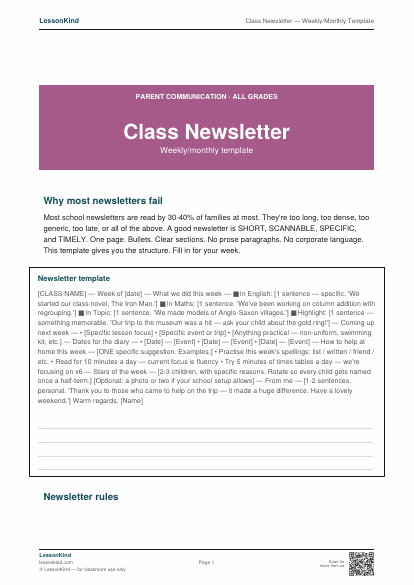
Class Newsletter — Weekly/Monthly Template
A simple, scannable class newsletter template — what we did, what's coming up, important dates, how to help. Designed to actually get read.

Weekly Summary Email — Quick Format
A 5-line summary email teachers can send Friday afternoon — for schools without a formal newsletter system, or for teachers who don't want the overhead.

Friday Round-Up — End-of-Week Class Summary
A printable Friday round-up sheet children can take home — what they did this week, what's next, and conversation starters for parents.
As an Amazon Associate and affiliate partner, LessonKind earns from qualifying purchases and referrals at no extra cost to you. Full disclosure →
Working from home or on school Wi-Fi? NordVPN keeps your devices and lesson resources secure.