Parent communication · 5 min read
The Parent Who Disagrees With You
How to handle the conversation when a parent doesn't accept your assessment
Published 2026-11-06
At some point in every primary teacher's career, a parent will tell you you're wrong about their child. Not in a casual way — in an emotional, sometimes confrontational way, often during parents' evening or after a behaviour incident.
How you handle the next ten minutes determines whether the relationship recovers or breaks. The teachers who handle these well share a few specific moves.
Why it's so hard
Disagreements with parents activate something deeper than disagreements with colleagues. The parent is defending their child — it's a primal protective instinct. You're defending your professional judgment. Both feel non-negotiable.
It also tends to happen at the wrong time. Tuesday evening parents' evening, after a long day, with five other families waiting. Or in the playground, with other parents within earshot. The setting amplifies the stress.
The instinct is to defend yourself. To explain why you're right. To list the evidence. To get more articulate. None of this works.
What actually works
**1. Listen for what they're really saying.**
When a parent says "I don't think your assessment is right", they're rarely making a calm statistical claim. They're often saying:
- "I'm worried my child isn't OK and I don't know how to help." - "Other kids seem to be doing better and I feel inadequate." - "I had a hard time at school and I'm scared this is starting again." - "I want my child to be exceptional and you're suggesting they're not."
Almost no parent disagreement is purely about evidence. It's about anxiety, identity, history, fear. If you reply only to the surface argument, you're missing the actual conversation.
**2. Acknowledge before you respond.**
Before defending your assessment, acknowledge what they've said. Specifically.
"I hear you saying you don't recognise the child I described. That must be hard to hear about your daughter."
This isn't agreeing they're right. It's signalling that you heard them and you take them seriously. Once parents feel heard, they soften enough to actually listen.
If you skip this step and go straight to "but the evidence shows..." — they will stop listening, and the conversation goes nowhere.
**3. Be specific about what you've seen.**
Vague assessments are easy to dismiss. Specific observations aren't.
Don't say: "She struggles with reading." Say: "On Wednesday, when we were reading about volcanoes, she found the word 'eruption' tricky. She decoded it on the third attempt. Then she got 'magma' first time. That's the pattern I'm seeing — she can decode unfamiliar words, but it takes processing time. That's why she sometimes seems to be falling behind in fast-paced reading."
The first version is dismissable. The second isn't. Parents argue with summaries; they engage with observations.
**4. Hold your line, calmly.**
If you genuinely believe your assessment is correct, don't abandon it to make the conversation easier. That's a betrayal of the child.
What you can do is restate it without emotion. "I understand you see her differently at home. In school, what I'm seeing is X. Both can be true — children often present differently in different contexts. But the school version is what I have to work with for what we do here."
This holds the line without antagonising. You're not saying they're wrong. You're saying your professional judgment, based on what you see in school, stands.
**5. Offer a structured next step.**
Most parent disagreements resolve when there's a plan. Not "let's see how it goes" — a specific plan with a checkpoint.
"I'd like to do this: for the next four weeks, I'm going to track her progress on three specific things — fluency, comprehension, and stamina. We'll meet again in late October and look at the data together. If I'm wrong about her, the data will show it."
This achieves several things: - Shows you take their concern seriously - Gives them something concrete to look forward to - Doesn't require either of you to capitulate today - Sets up evidence-based resolution rather than opinion-based
Most parents accept this. Many come back at the four-week meeting having calmed down and ready to work with you.
What not to do
**Don't argue about who knows the child better.** You both know the child differently. School and home are different contexts. This argument can't be won — only escalated.
**Don't say "I have 30 children to think about".** True, but it lands as defensive. The parent is thinking about ONE child. Your "30" is irrelevant to them in that moment.
**Don't compare to other children.** Even implicitly. "Most Y3s can do this by now" is technically true and politically disastrous.
**Don't escalate to senior leadership too quickly.** Bringing in the head signals you've lost control of the relationship. Use this only if the parent is hostile or threatening — not just disagreeing.
**Don't end angry.** If the conversation isn't going well, propose a follow-up. "Let's pause this and meet next week with more time" is fine. Walking out angry is not.
The moment that often saves these conversations
Sometimes the conversation pivots when you say something close to:
"You know your child better than I ever will. I see her for six hours a day, you've raised her for nine years. What do you think she needs right now?"
This often reframes the whole conversation. The parent has been bracing for an argument. Suddenly they're being asked to lead. Many take a breath, think about it, and say something quite reasonable.
It's not weakness on your part — you're inviting them to be the expert on their child while you stay the expert on the classroom. Both are true.
When the parent is genuinely unreasonable
Sometimes — rarely — the parent is genuinely hostile, threatening, or impossible to reason with. In that case:
- End the meeting calmly: "I think we need a longer conversation with the headteacher present. I'll set that up." - Document everything: write up the conversation in factual notes that day - Inform your line manager / SLT - Don't meet alone again
Most "difficult parent" situations are not this. Most are emotional but workable. Reserve the formal escalation for the genuinely problematic 1-2% of conversations.
The professional truth
The teachers who handle parent disagreements best aren't the ones with the best evidence or the cleverest comebacks. They're the ones who can stay calm when they're being criticised, hear what the parent is actually saying, and hold their judgment without making it personal.
This is harder than it sounds. It gets easier with practice. By your fifth or sixth disagreement, you'll find you have a quiet sense of "this is going to be fine" even as the parent is shouting. That confidence is built one calm conversation at a time.
Practical resources for this
Take this further
Printable, classroom-ready resources for the topics in this article.
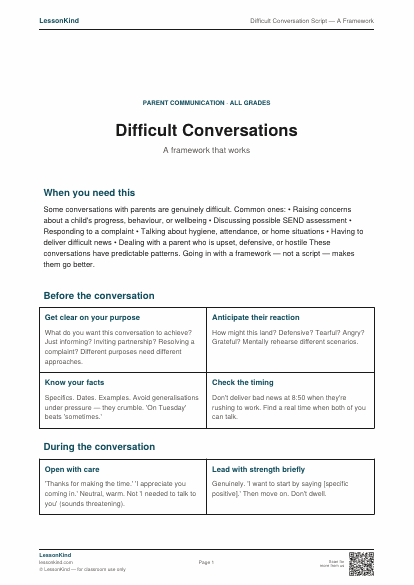
Difficult Conversation Script — A Framework
A framework for the conversation no teacher wants to have — concerns about a child, pushback from parents, raising a sensitive issue. With phrases that work and phrases to avoid.
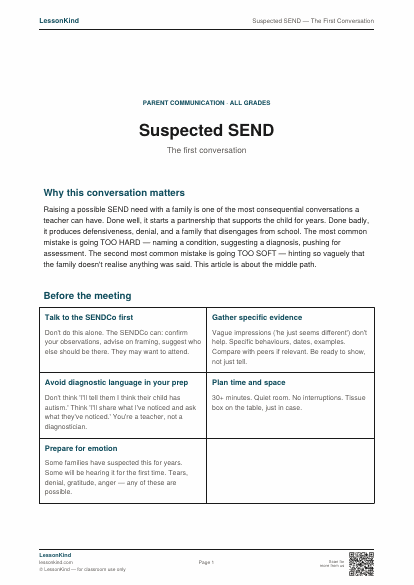
Suspected SEND — The First Conversation
How to raise the possibility of a SEND need with a family for the first time — without diagnosing, without panicking parents, and without backing off when you shouldn't.
Going deeper
Books on difficult conversations
Books we'd recommend on the topics raised in this article.
Practitioner
Convenience links to Amazon. As an Amazon Associate we earn from qualifying purchases at no extra cost to you. Read our affiliate disclosure.
Keep reading
First-year teaching
Your First Parents' Evening (And How Not to Dread It)
Parents' evening can feel like 30 high-stakes interviews with strangers. Here's the structure that works, and the phrases that get you out of awkward moments gracefully.
5 min read
Parent communication
Talking to Parents About Difficult Things
Sooner or later, every elementary teacher has to tell a parent something they don't want to hear. Here's how to do it well.
6 min read
Parent communication
The Difficult Parent Meeting — A Better Approach
Telling parents something they don't want to hear is one of the hardest skills in teaching. Most teachers learn it the hard way, by getting it wrong. There's a better path.
7 min read