SEND Sensory Toolkit — What Teachers Actually Buy
The sensory tools that primary teachers actually buy and find useful — fidgets, ear defenders, wobble cushions, weighted lap pads, chew necklaces, time timers, calming spray. With honest notes on what works, what doesn't, and the difference between 'nice-to-have' and 'genuinely helpful'.
Preview
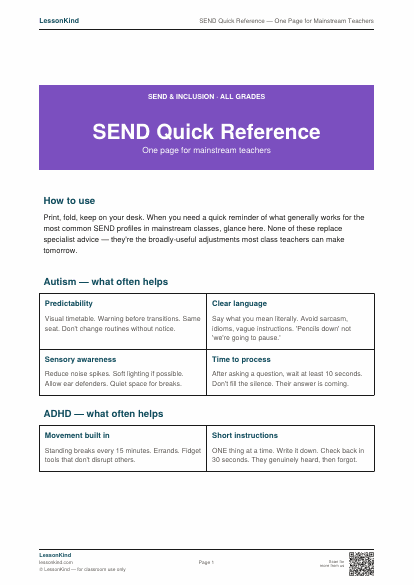
Page count: 4. Print-ready PDF — letter / A4 friendly. Click image to see all pages.
Learning objective
Provide teachers, SENDCos, and parents with an honest, calibrated guide to sensory tools — what's worth buying, what isn't, and how to use them well.
About this resource
- Subject: SEND & Inclusion
- Type: Fact File
- Grade levels: Pre-Kindergarten (ages 3-4, ≈ Nursery), Kindergarten (ages 4-6, ≈ Reception / Y1), Grade 1 (ages 6-7, ≈ Year 2), Grade 2 (ages 7-8, ≈ Year 3), Grade 3 (ages 8-9, ≈ Year 4), Grade 4 (ages 9-10, ≈ Year 5), Grade 5 (ages 10-11, ≈ Year 6), Grade 6 (ages 11-12, ≈ Year 7)
- Pages: 4
- Date added: 2026-11-11
- Credit: Qualified primary teacher
Sensory tools we actually recommend
Honest curation. Convenience links to Amazon. Schools often buy these via approved suppliers (TTS, YPO, ESPO) for VAT reasons — but for individual teachers and parents, Amazon is fine.
High-leverage — worth investing in
These earn their keep across years and across many children.
-
T
Time Timer 60 Minute Visual Timer — Time Timer
Visual countdown — invaluable for autism, ADHD, transition anxiety -
C
Children's Ear Defenders (Foldable) — Vanaheim
Noise-cancelling — for sensory overload and assemblies -
W
Wobble Cushion (Inflatable Disc) — Yogibo
Sensory seating — for children needing movement to focus -
W
Weighted Lap Pad (2.5kg) — Senseez
Calming proprioceptive input — for self-regulation
Fidget tools — useful, cheap, replace often
Fidgets are consumable — buy decent quality, expect to replace.
-
T
Tangle Junior Fidget Toys (Pack of 8) — Tom & Geo
Class set — quiet, durable -
T
Therapy Putty (Set of 4) — Speks
Quiet, calming, useful for hand strength too -
P
Pop-It Fidget Toys (Class Pack) — Various
Loved by children — but can become noisy distractor; manage carefully -
S
Sensory Snake Coil Bracelet — TickiT
Wearable, discreet, doesn't get lost
For the calm corner
Equipping a calm corner with a few well-chosen items.
-
M
Mindful Maze (Wooden Sensory Toy) — Hape
Calming hand activity -
S
Sensory Liquid Motion Bubbler — Soothing
Calming visual focus — use for self-regulation -
S
Soft Cushion Set (Pack of 2) — TickiT
Comfortable seating -
R
Ruby's Worry (Picture Book) — Tom Percival
Calm corner book — anxiety made visible -
T
The Color Monster (Picture Book) — Anna Llenas
Naming feelings to manage them
Specific need — chew, oral, movement
For specific sensory profiles. Match to child carefully.
-
C
Chewable Sensory Necklace — ARK Therapeutic
For oral-seekers — discreet, durable -
T
Trampette / Mini Trampoline — Kid Active
Movement break — proprioceptive input -
H
Hopper Ball (45cm) — Gonge
Movement break alternative
Disclosure: Links above go to Amazon. LessonKind may earn a small commission if you buy via these links — at no extra cost to you. We only link to books and items we already recommend in our resources. We are not paid by Amazon to recommend specific titles.
You might also like
Selected based on subject, grade, and type — with a free option always included.
Sensory Strategies — A Practical Toolkit
Practical sensory strategies for the four common patterns — sensory seekers, sensory avoiders, mixed and unpredictable. With low-cost classroom kit ideas.
ADHD Strategies for the Mainstream Classroom
What ADHD actually looks like in primary school (it's not 'lack of focus'), and the practical strategies that consistently help in mainstream classrooms.
Emotional Regulation — A Toolkit for Primary Classrooms
How to teach and support emotional regulation in primary classrooms — including why 'use your words' so often fails, and what to do instead.
Dyslexia-Friendly Classroom — A Practical Guide
What dyslexia is and isn't, the most useful classroom adjustments, and the things that genuinely help dyslexic children access mainstream learning.
SENDCo — Professional Reading List
Professional books every primary SENDCo should have on the shelf — covering autism, ADHD, dyslexia, trauma-informed practice, EHCP writing, and parent partnership. Calibrated for the SENDCo who has 15 minutes a week to read.
50 SEND Strategies — A Staff Meeting Handout
50 specific, named, takeaway-able strategies for supporting children with SEND in mainstream classrooms. Use as a CPD handout — discuss 5 a fortnight.