Emotional Regulation — A Toolkit for Primary Classrooms
How to teach and support emotional regulation in primary classrooms — including why 'use your words' so often fails, and what to do instead.
Preview
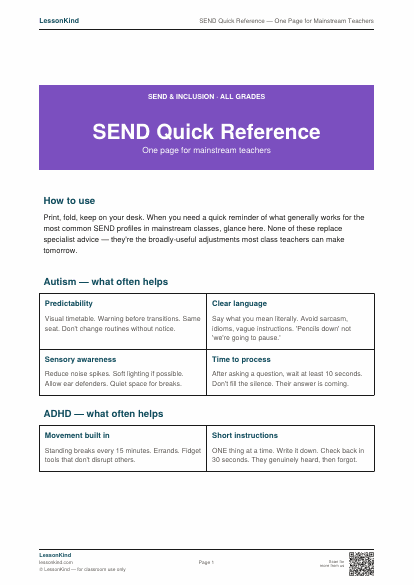
Page count: 7. Print-ready PDF — letter / A4 friendly. Click image to see all pages.
Learning objective
Build practical emotional regulation strategies into primary classroom practice.
About this resource
- Subject: SEND & Inclusion
- Type: Fact File
- Grade levels: Grade 1 (ages 6-7, ≈ Year 2), Grade 2 (ages 7-8, ≈ Year 3), Grade 3 (ages 8-9, ≈ Year 4), Grade 4 (ages 9-10, ≈ Year 5), Grade 5 (ages 10-11, ≈ Year 6), Grade 6 (ages 11-12, ≈ Year 7)
- Pages: 7
- Date added: 2026-08-28
- Credit: Qualified primary teacher
Emotional regulation — reading
Convenience links if you'd like to look any of these up. We've recommended these books in the resource above.
Practitioner
- T The Zones of Regulation — Leah Kuypers
- S Self-Reg: How to Help Your Child (and You) Break the Stress Cycle — Stuart Shanker
- A A Therapeutic Treasure Box for Working with Children — Karen Treisman
Disclosure: Links above go to Amazon. LessonKind may earn a small commission if you buy via these links — at no extra cost to you. We only link to books and items we already recommend in our resources. We are not paid by Amazon to recommend specific titles.
Part of these collections
Curated bundles where this resource appears alongside related ones.
Read more about this
Articles that go deeper on the topic this resource covers.
Behavior & classroom management · 8 min read
When the Kids Who Need You Most Are the Ones You Find Hardest
The marble jars and traffic lights work for the children who didn't really need them. Here's what actually moves the kids who keep blowing the system up.
EAL & inclusion · 8 min read
ADHD Isn't a Lack of Attention — and Why That Matters
The label is the worst part of the diagnosis. ADHD is not 'attention deficit' — it's an attention regulation difference, and that distinction changes almost everything about how schools should respond.
Behavior & classroom management · 9 min read
Anxiety in Primary Children: What's Normal and What's Not
Most primary-aged children worry. Some of them worry in ways that affect their lives. The line between these is the most consequential thing for parents to get right — and the most often blurred by anxiety culture going in both directions.
You might also like
Selected based on subject, grade, and type — with a free option always included.
SEND Sensory Toolkit — What Teachers Actually Buy
The sensory tools that primary teachers actually buy and find useful — fidgets, ear defenders, wobble cushions, weighted lap pads, chew necklaces, time timers, calming spray. With honest notes on what works, what doesn't, and the difference between 'nice-to-have' and 'genuinely helpful'.
Sensory Strategies — A Practical Toolkit
Practical sensory strategies for the four common patterns — sensory seekers, sensory avoiders, mixed and unpredictable. With low-cost classroom kit ideas.
ADHD Strategies for the Mainstream Classroom
What ADHD actually looks like in primary school (it's not 'lack of focus'), and the practical strategies that consistently help in mainstream classrooms.
Dyslexia-Friendly Classroom — A Practical Guide
What dyslexia is and isn't, the most useful classroom adjustments, and the things that genuinely help dyslexic children access mainstream learning.
SENDCo — Professional Reading List
Professional books every primary SENDCo should have on the shelf — covering autism, ADHD, dyslexia, trauma-informed practice, EHCP writing, and parent partnership. Calibrated for the SENDCo who has 15 minutes a week to read.
50 SEND Strategies — A Staff Meeting Handout
50 specific, named, takeaway-able strategies for supporting children with SEND in mainstream classrooms. Use as a CPD handout — discuss 5 a fortnight.