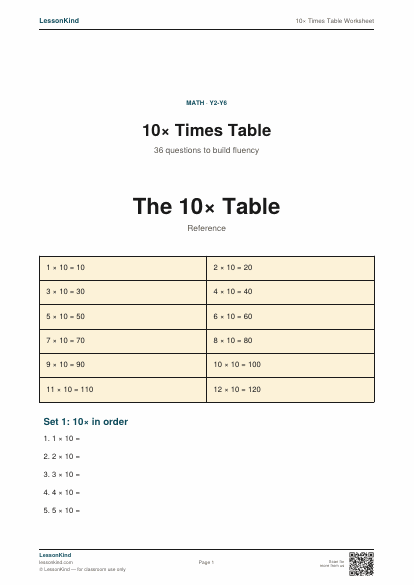
10× Times Table Worksheet
Ready-made printable practice for the 10× times table — 36 questions across multiplication, random-order, and related division facts. Print and go.
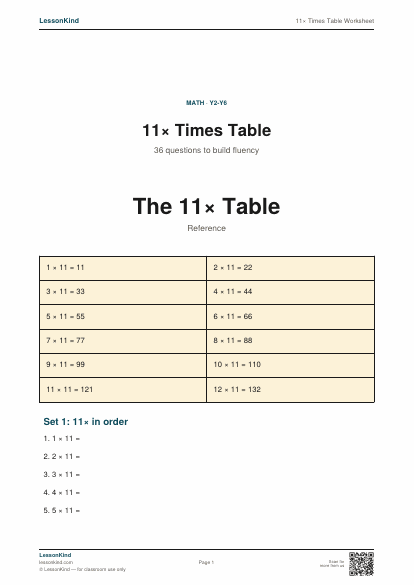
11× Times Table Worksheet
Ready-made printable practice for the 11× times table — 36 questions across multiplication, random-order, and related division facts. Print and go.
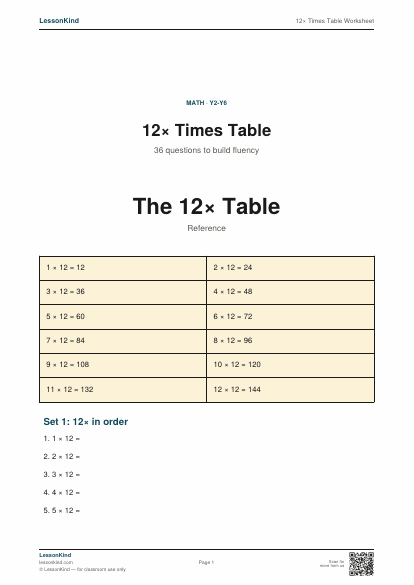
12× Times Table Worksheet
Ready-made printable practice for the 12× times table — 36 questions across multiplication, random-order, and related division facts. Print and go.
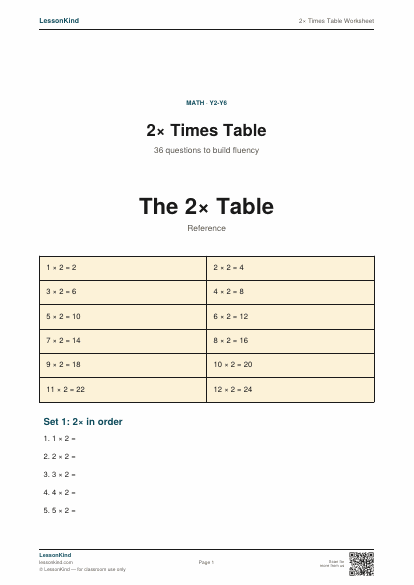
2× Times Table Worksheet
Ready-made printable practice for the 2× times table — 36 questions across multiplication, random-order, and related division facts. Print and go.
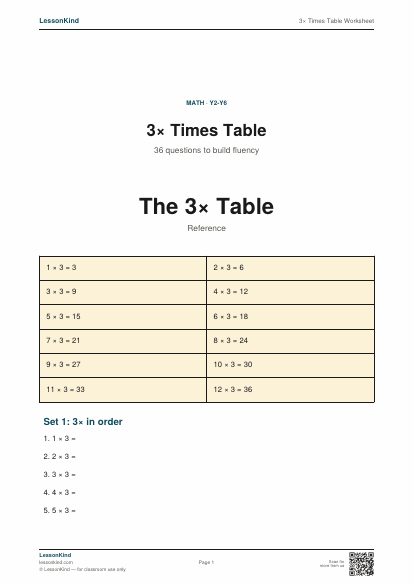
3× Times Table Worksheet
Ready-made printable practice for the 3× times table — 36 questions across multiplication, random-order, and related division facts. Print and go.
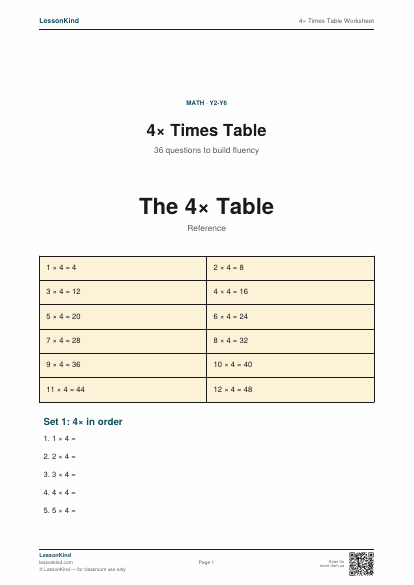
4× Times Table Worksheet
Ready-made printable practice for the 4× times table — 36 questions across multiplication, random-order, and related division facts. Print and go.
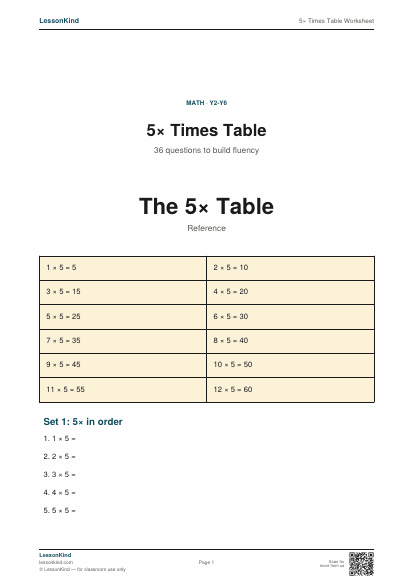
5× Times Table Worksheet
Ready-made printable practice for the 5× times table — 36 questions across multiplication, random-order, and related division facts. Print and go.
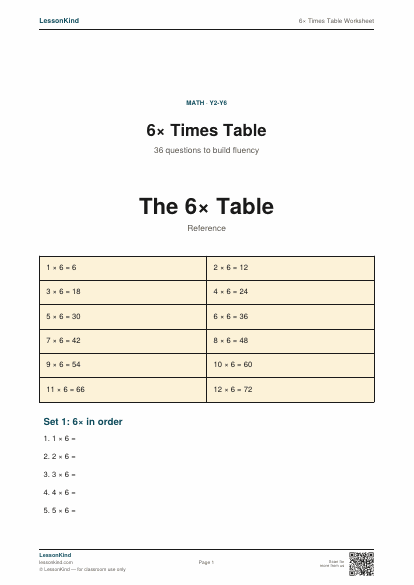
6× Times Table Worksheet
Ready-made printable practice for the 6× times table — 36 questions across multiplication, random-order, and related division facts. Print and go.
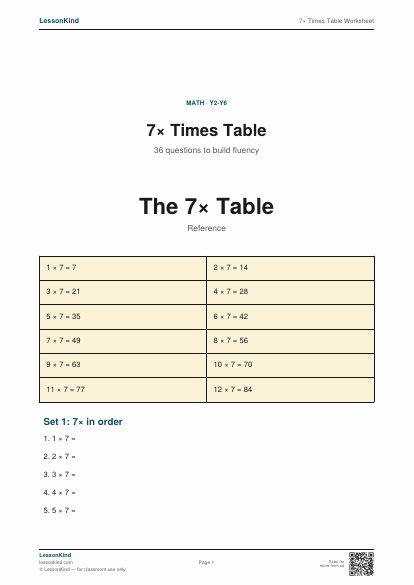
7× Times Table Worksheet
Ready-made printable practice for the 7× times table — 36 questions across multiplication, random-order, and related division facts. Print and go.
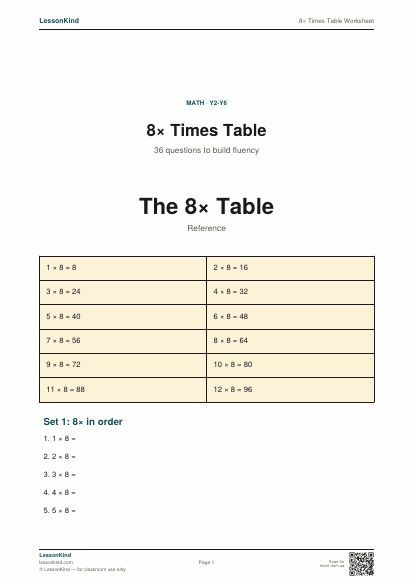
8× Times Table Worksheet
Ready-made printable practice for the 8× times table — 36 questions across multiplication, random-order, and related division facts. Print and go.
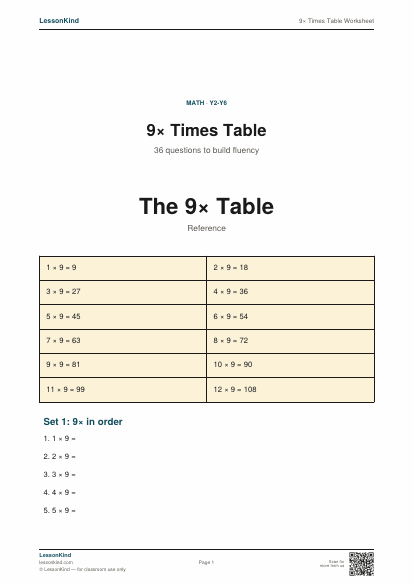
9× Times Table Worksheet
Ready-made printable practice for the 9× times table — 36 questions across multiplication, random-order, and related division facts. Print and go.
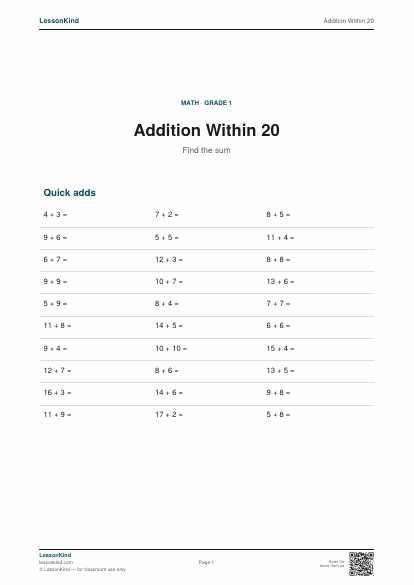
Addition Within 20
30 single-digit addition questions with sums up to 20. Mixed problem types for fluency.
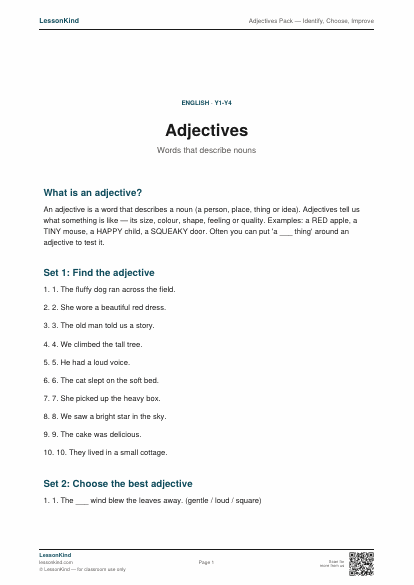
Adjectives Pack — Identify, Choose, Improve
Ready-made adjectives worksheet covering identification, choosing the best adjective, and using adjectives to improve writing. KS1 and lower KS2 friendly.
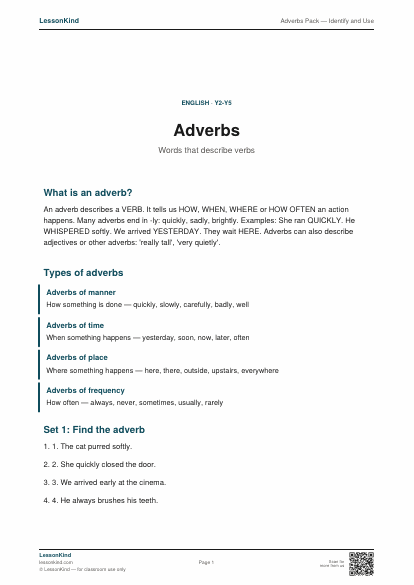
Adverbs Pack — Identify and Use
Ready-made adverbs worksheet covering manner, time, place and frequency adverbs. KS2 focused.
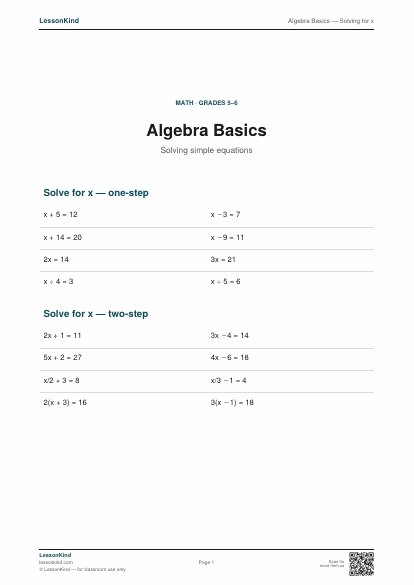
Algebra Basics — Solving for x
Introduction to simple equations. 20 questions building from one-step to two-step equations.
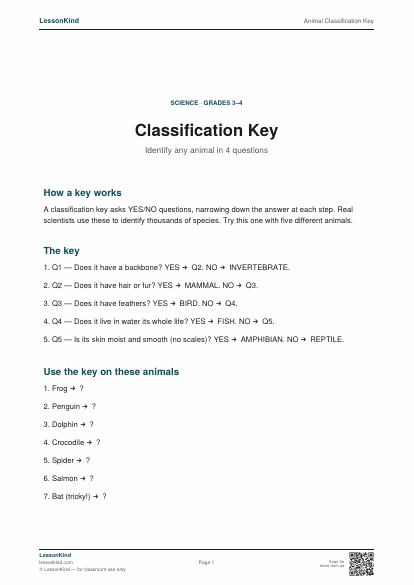
Animal Classification Key
Use a branching key to classify animals as mammal, bird, reptile, amphibian, fish or invertebrate.
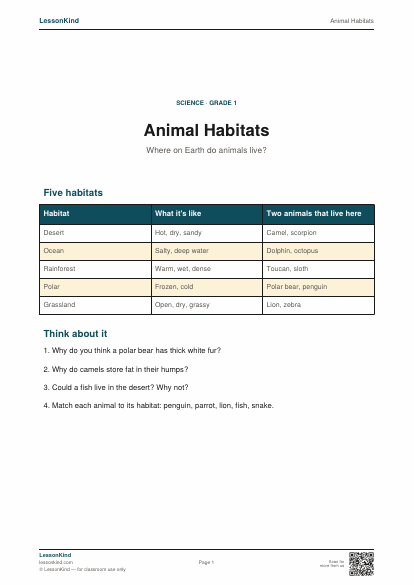
Animal Habitats
Match animals to their habitats — desert, ocean, rainforest, polar, grassland.
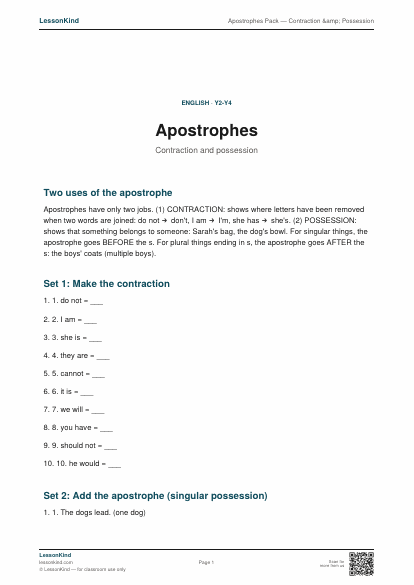
Apostrophes Pack — Contraction & Possession
Focused practice on the two uses of apostrophes — contractions (don't) and possession (Sarah's). Lower KS2 level.
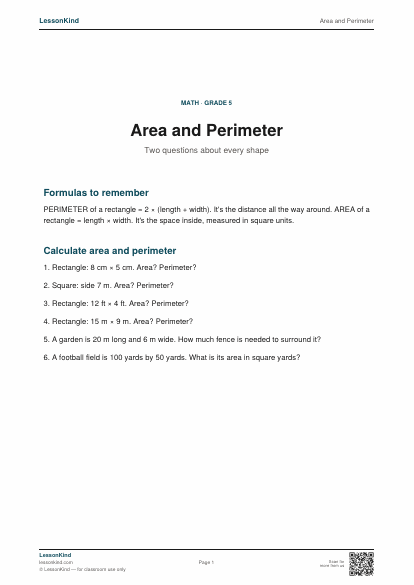
Area and Perimeter
Calculate area and perimeter of rectangles, then apply to compound shapes and word problems.
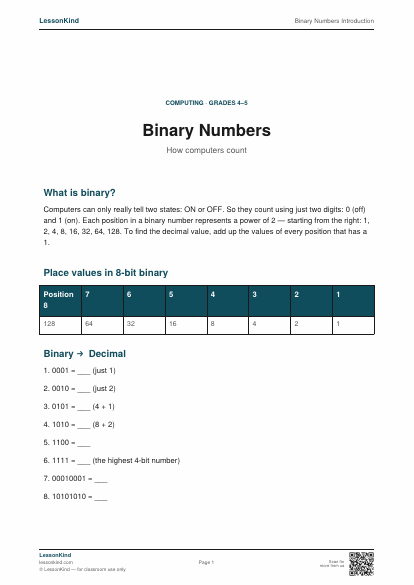
Binary Numbers Introduction
How computers count using only 0s and 1s. Convert between decimal and binary up to 8 bits.
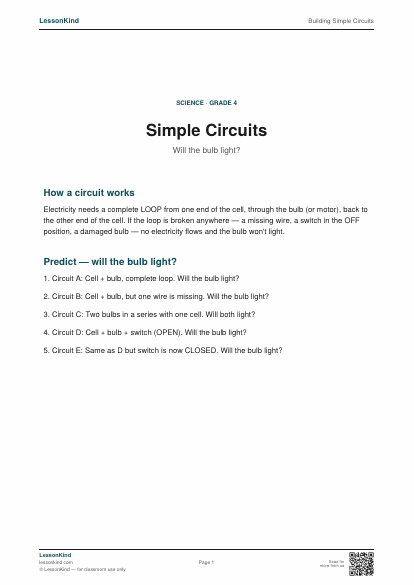
Building Simple Circuits
Diagram four simple circuits (working bulb, broken circuit, two bulbs, switch added) and predict outcomes.
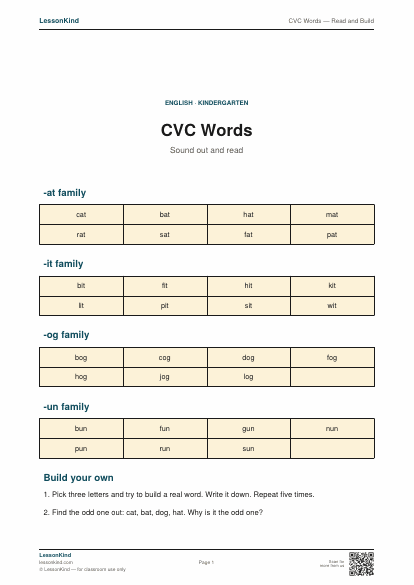
CVC Words — Read and Build
Read, sound out and build consonant-vowel-consonant words. Includes word families.
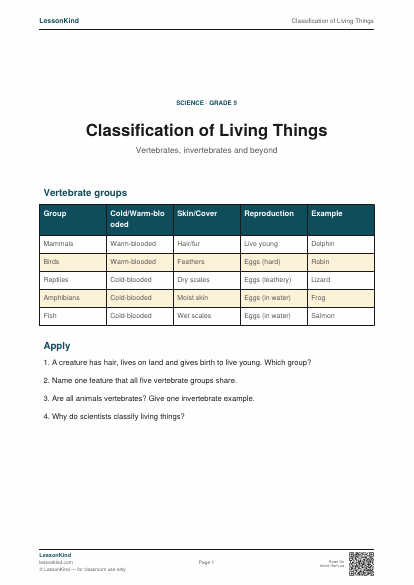
Classification of Living Things
Use a classification key to sort vertebrates and invertebrates.
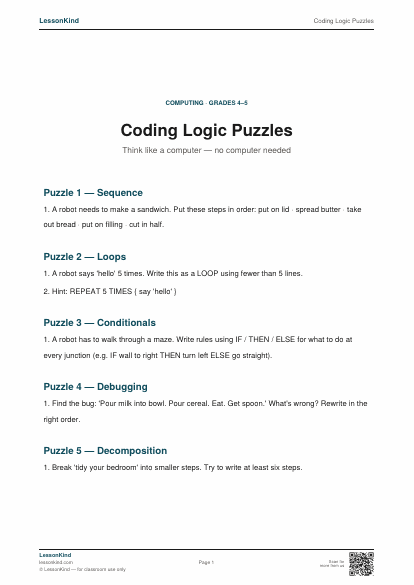
Coding Logic Puzzles
Five unplugged coding puzzles — sequence, loops, conditionals — no computer needed.
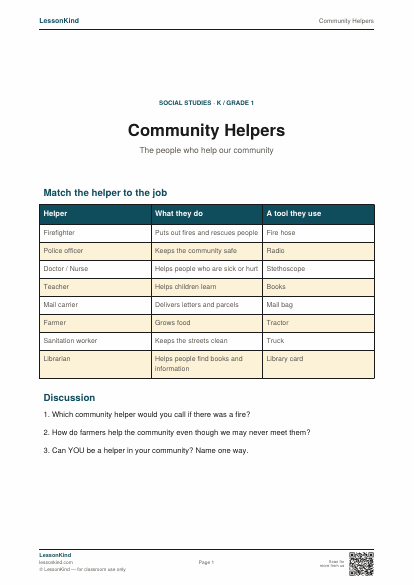
Community Helpers
Match each community helper to their tool, vehicle and what they do.
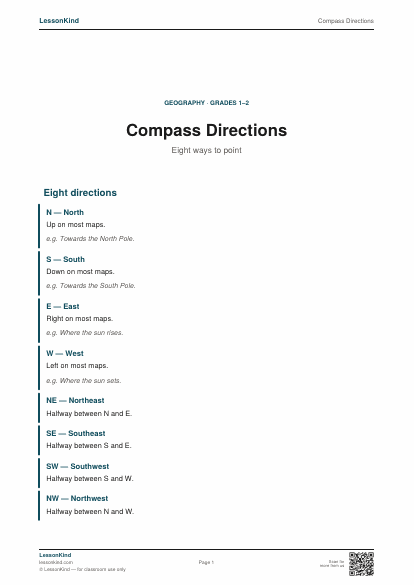
Compass Directions
Learn the four cardinal directions and four ordinals. Includes a treasure-map activity.
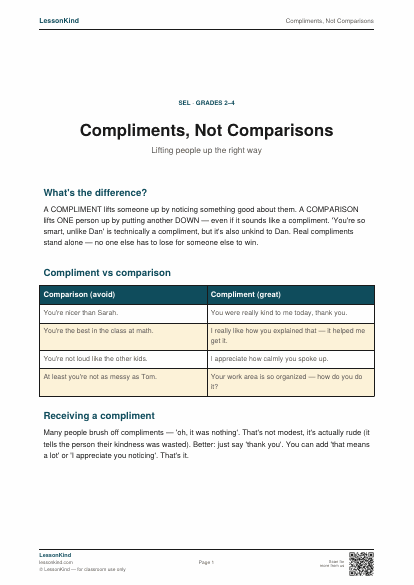
Compliments, Not Comparisons
How to give and receive compliments well — and why comparisons hurt even when they sound nice.
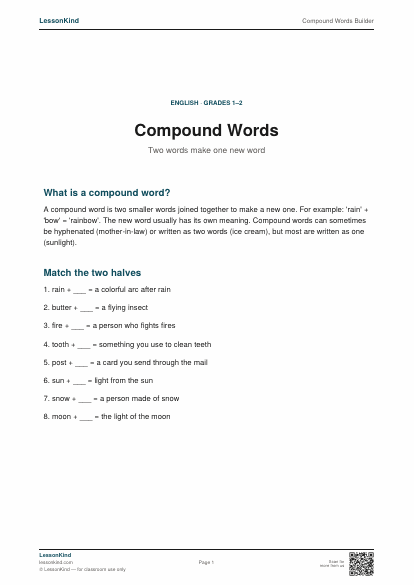
Compound Words Builder
Match two words to make a compound. Then build your own. Develops vocabulary and word play.
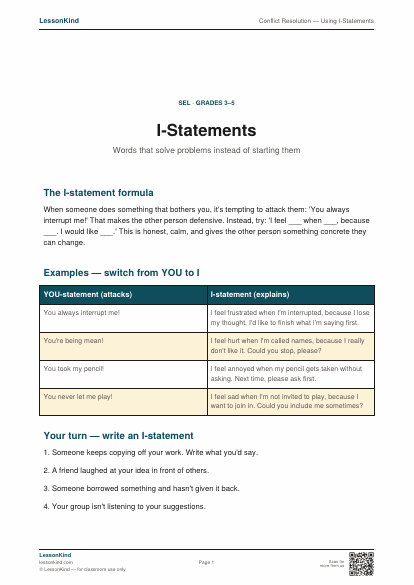
Conflict Resolution — Using I-Statements
Turn finger-pointing into clear communication with the I-statement formula.
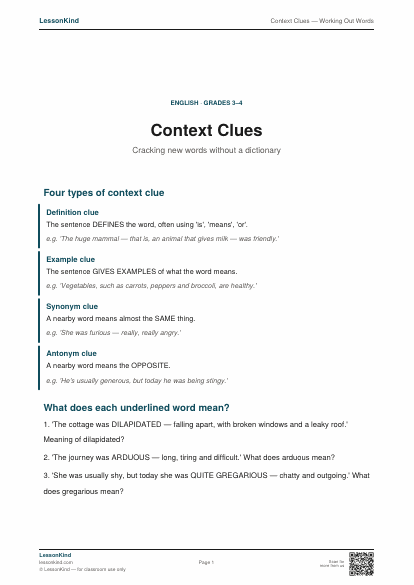
Context Clues — Working Out Words
Strategies for guessing the meaning of new words from the surrounding text. Six practice passages.
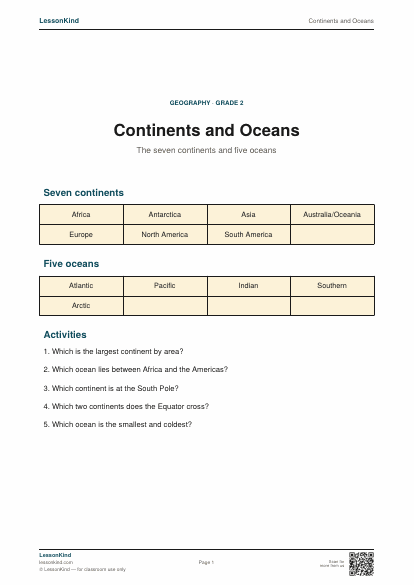
Continents and Oceans
Name and locate the seven continents and five oceans of the world.
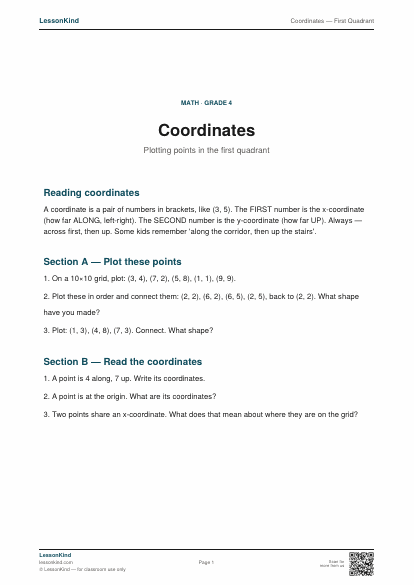
Coordinates — First Quadrant
Plot and read points in the first quadrant. Includes a 'connect the dots to make a shape' activity.
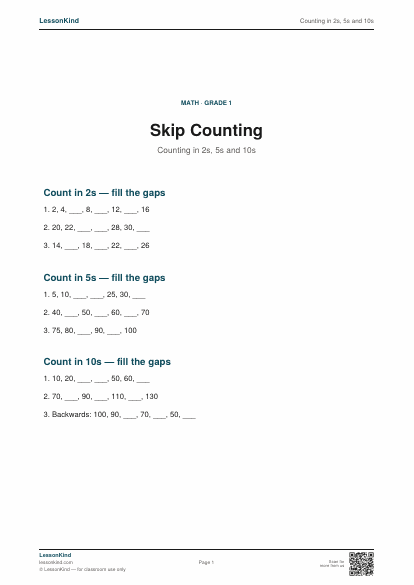
Counting in 2s, 5s and 10s
Number-line completion activity with three sequences. Includes counting backwards.
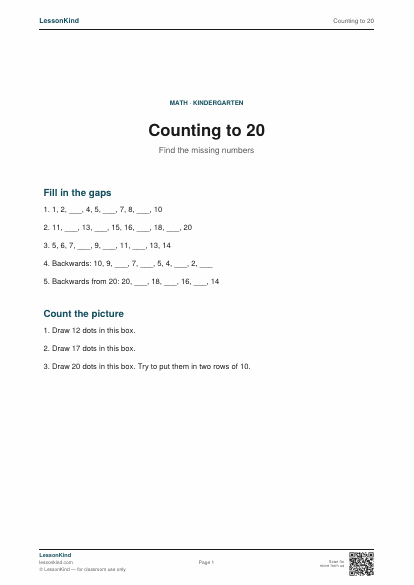
Counting to 20
Count, fill in missing numbers, and find the patterns. Builds confidence to 20.
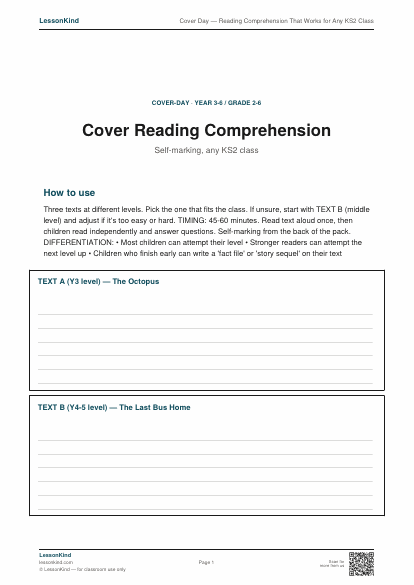
Cover Day — Reading Comprehension That Works for Any KS2 Class
Three short, age-flexible reading texts (animal facts, a short story, a non-fiction explanation) with comprehension questions. Pick the one that fits the class level. Self-marking — children check answers at the back.
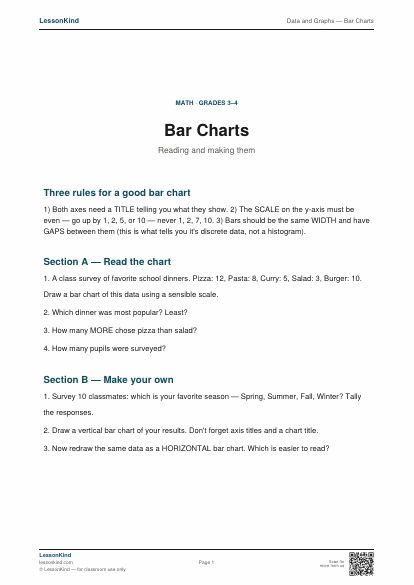
Data and Graphs — Bar Charts
Read, interpret and create bar charts. Vertical and horizontal, with three sample data sets.
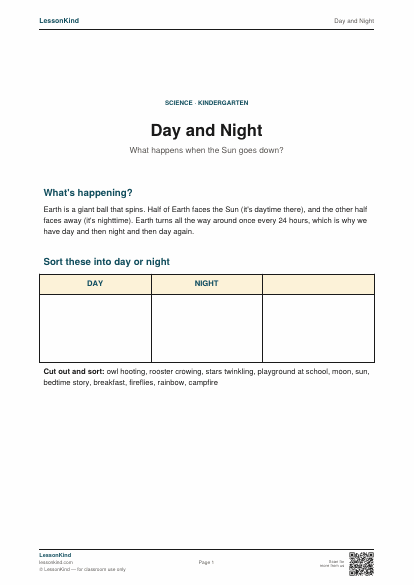
Day and Night
Sort activities into day and night. Introduces the Sun, Moon and Earth's rotation.
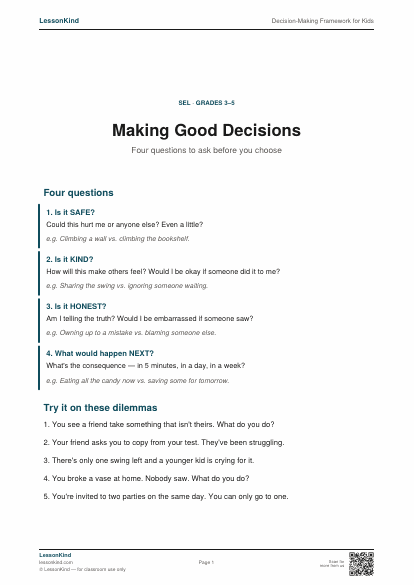
Decision-Making Framework for Kids
A simple 4-question framework children can use to make better choices when they're not sure what to do.
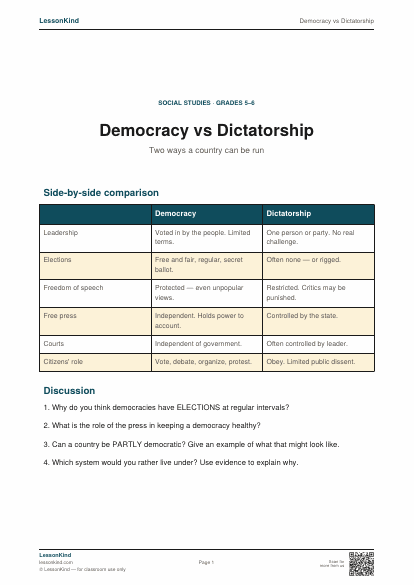
Democracy vs Dictatorship
Compare two systems of government across leadership, freedoms, elections and the law.
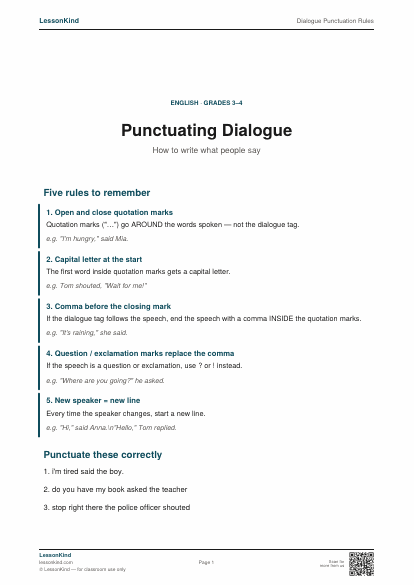
Dialogue Punctuation Rules
How to punctuate speech in stories. Comma placement, capitalization and the dialogue tag.
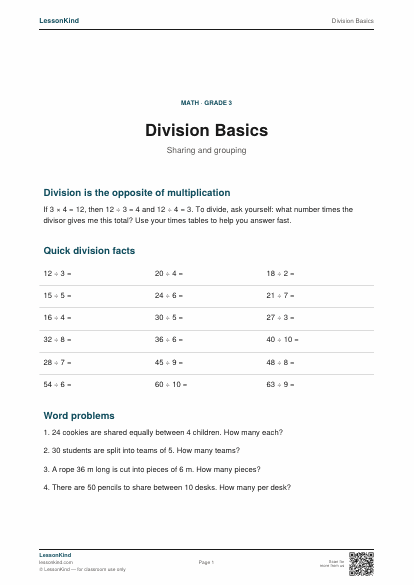
Division Basics
Introduction to division as sharing and grouping. Builds from arrays to facts.
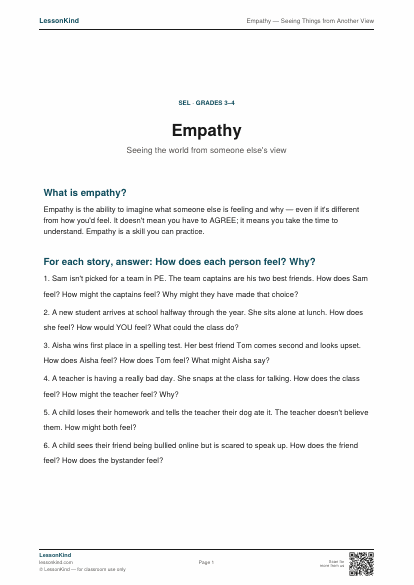
Empathy — Seeing Things from Another View
Six story scenarios ask students to consider how each character feels and why.
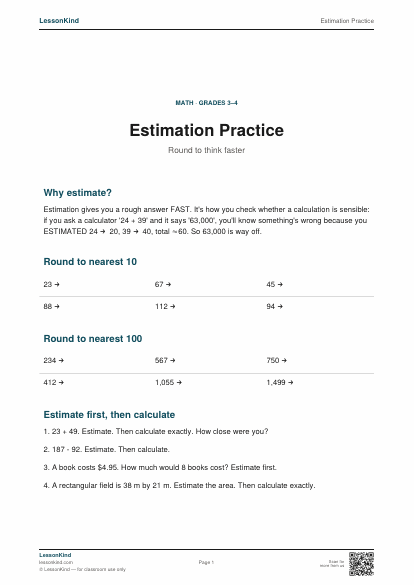
Estimation Practice
Practice rounding to the nearest 10, 100 and 1,000, then use estimation in real-world calculation problems.
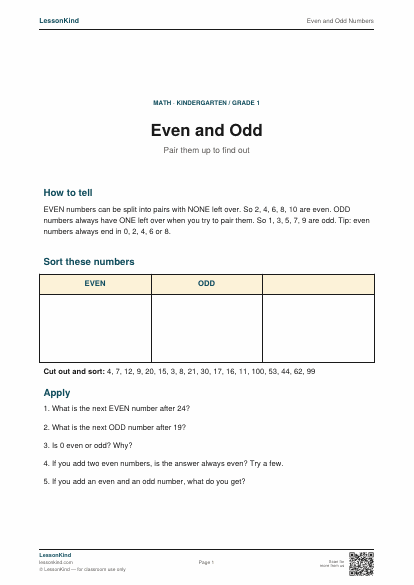
Even and Odd Numbers
Learn the difference between even and odd numbers. Sorting, coloring and pattern-spotting activities.
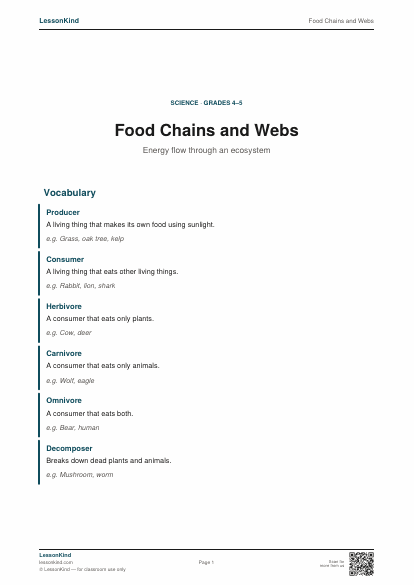
Food Chains and Webs
Build a food chain and a food web. Label producers, consumers and decomposers.
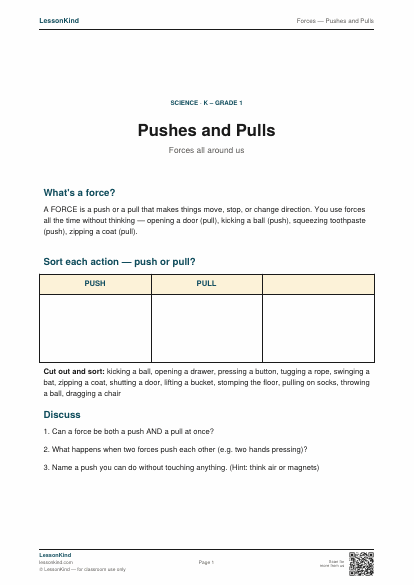
Forces — Pushes and Pulls
Identify pushes and pulls in everyday actions. Sort 12 actions and discuss what forces do.
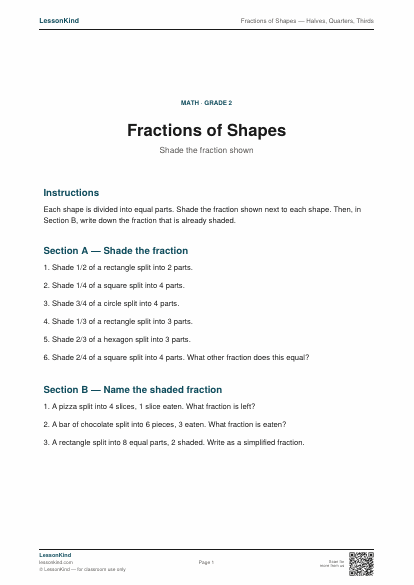
Fractions of Shapes — Halves, Quarters, Thirds
Identify and shade fractions of shapes. Includes halves, quarters and thirds.
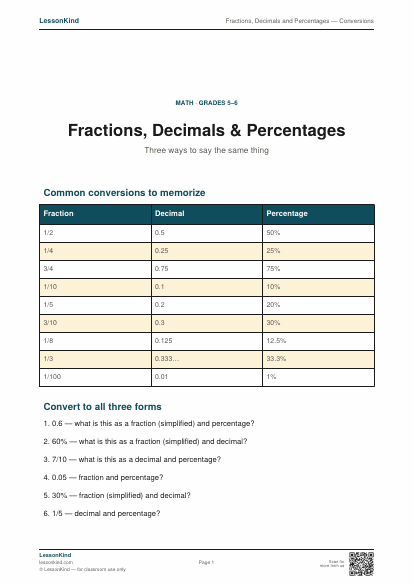
Fractions, Decimals and Percentages — Conversions
Convert between fractions, decimals and percentages. Tables, conversion practice and word problems.
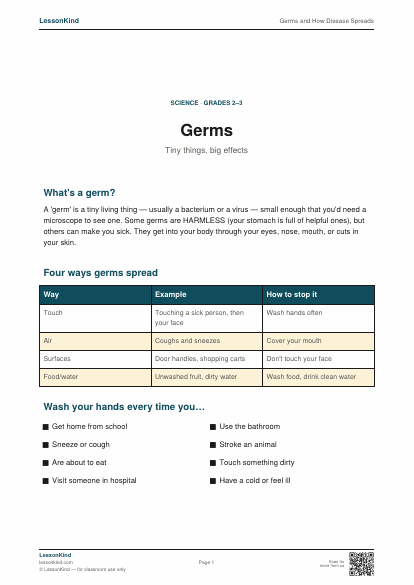
Germs and How Disease Spreads
Four ways germs spread, and how to stop them. Plus a quick-reference 'when to wash hands' checklist.
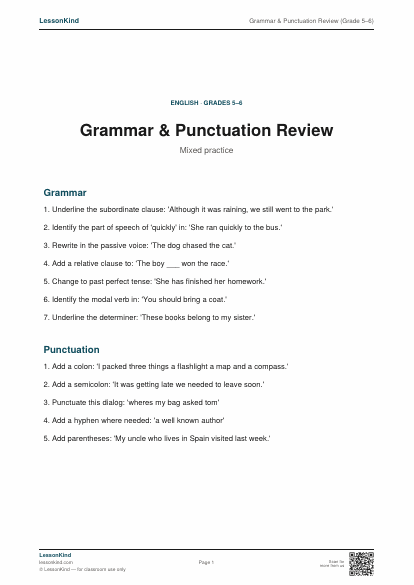
Grammar & Punctuation Review (Grade 5–6)
Mixed grammar and punctuation questions for upper-elementary review.
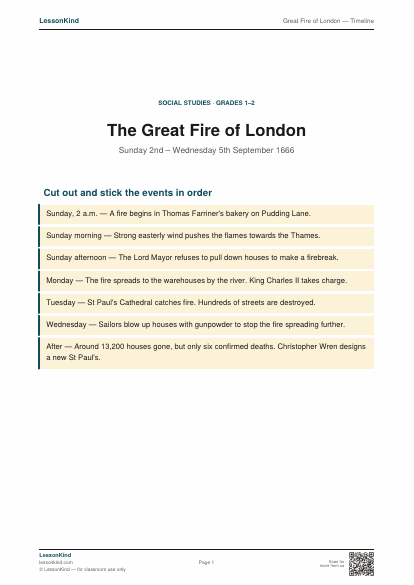
Great Fire of London — Timeline
Order key events from the Great Fire of London (1666) on a printable timeline.
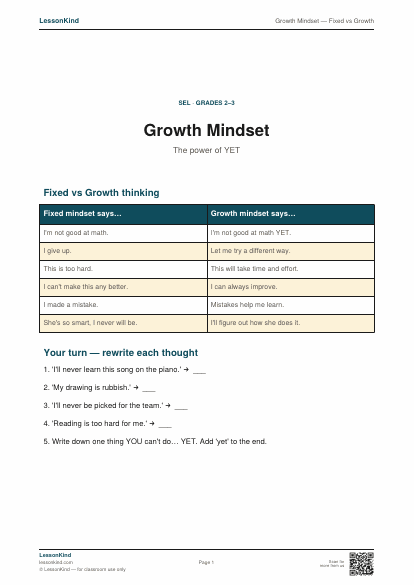
Growth Mindset — Fixed vs Growth
Compare fixed-mindset and growth-mindset thinking. Rewrite negative self-talk.
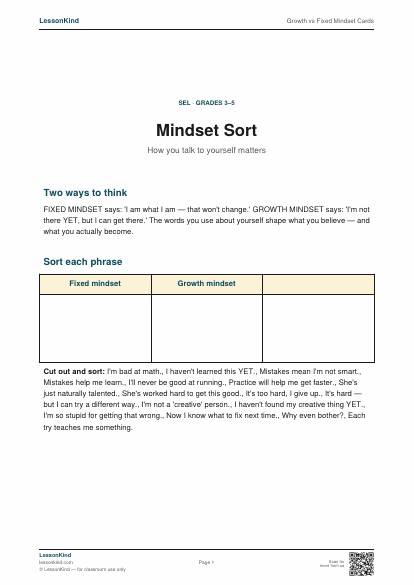
Growth vs Fixed Mindset Cards
16 phrases — sort into 'fixed mindset' vs 'growth mindset' — and rephrase the fixed ones.
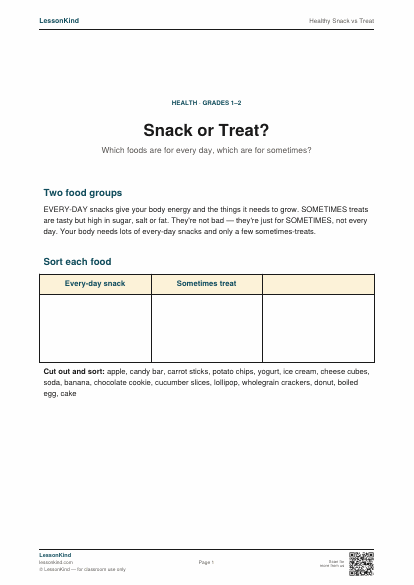
Healthy Snack vs Treat
Sort 16 foods into 'snack' (everyday) vs 'treat' (sometimes). Includes a make-your-own-balanced-snack activity.
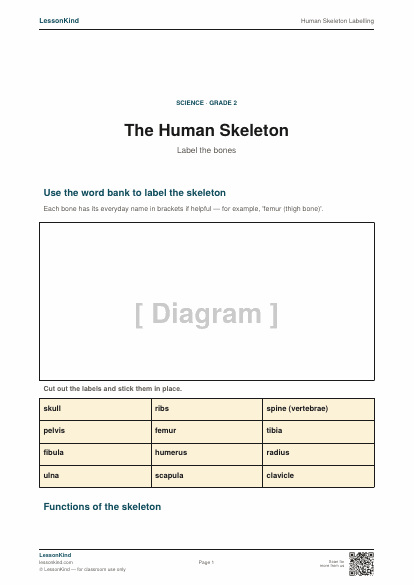
Human Skeleton Labelling
Label 12 key bones, then answer questions about their function.
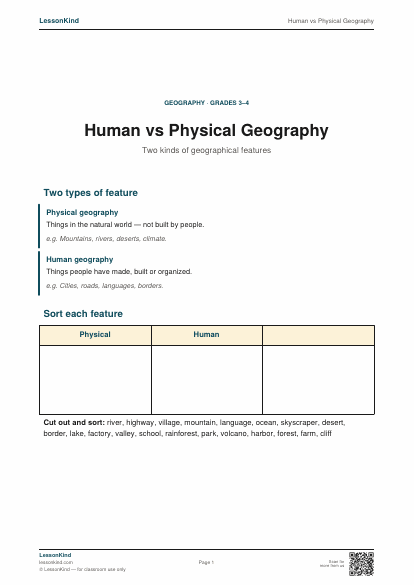
Human vs Physical Geography
Sort 20 features into human or physical geography categories. Includes definitions.
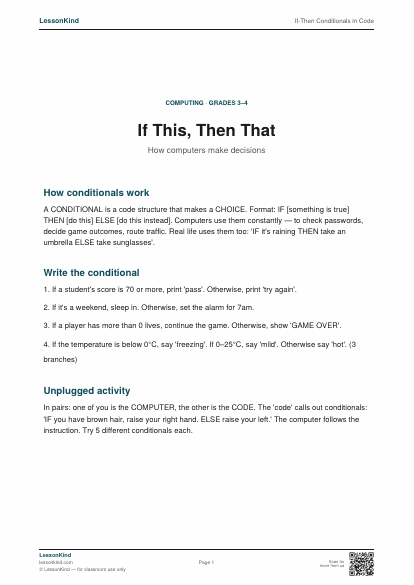
If-Then Conditionals in Code
How computers make decisions — IF something is true, THEN do this. With unplugged practice activities.
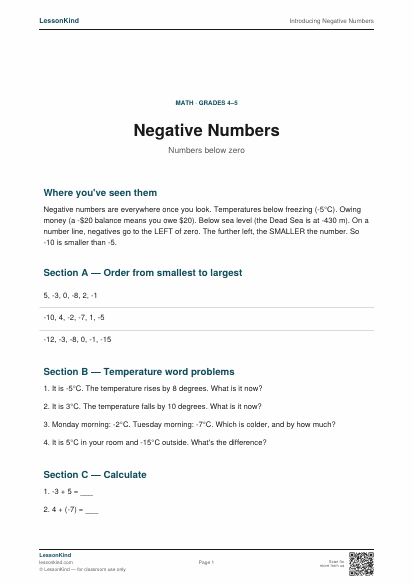
Introducing Negative Numbers
What numbers below zero mean — using temperature, money and a number line. 16 practice questions.
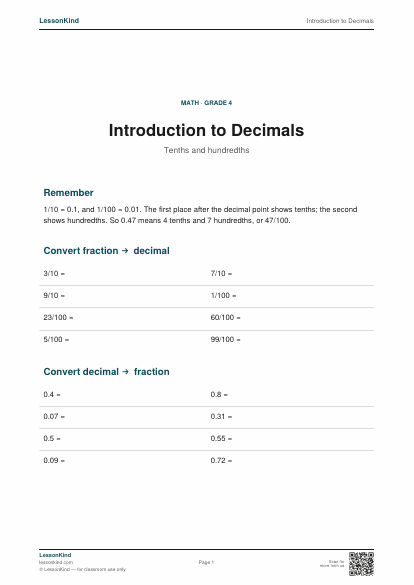
Introduction to Decimals
Tenths and hundredths explained, then 18 questions converting between fractions and decimals.
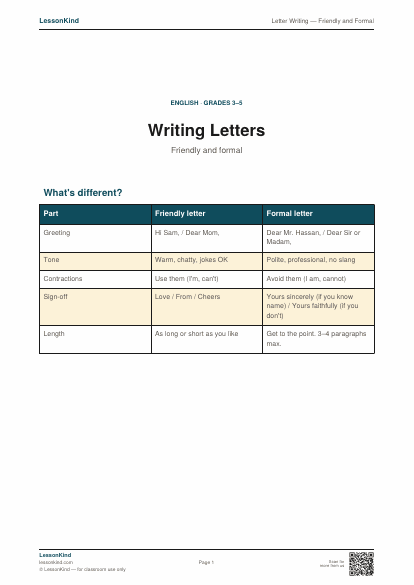
Letter Writing — Friendly and Formal
How to structure friendly and formal letters. Two side-by-side templates with prompts.
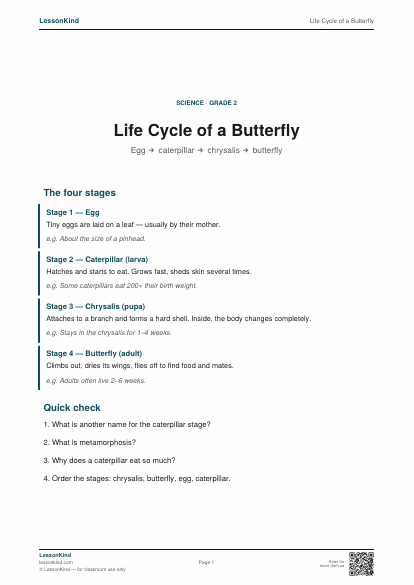
Life Cycle of a Butterfly
Sequence the four stages of metamorphosis with descriptions and a labelling task.
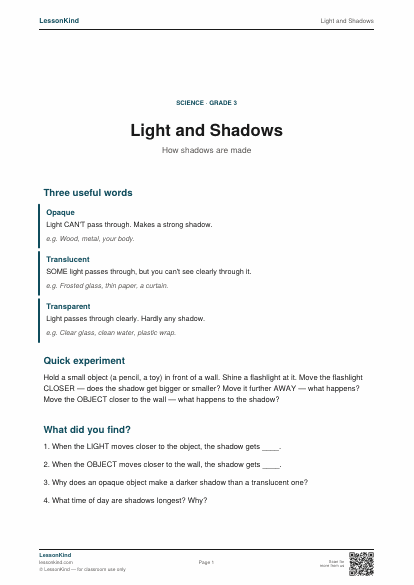
Light and Shadows
How shadows form, why they change size, and a quick experiment to test it.
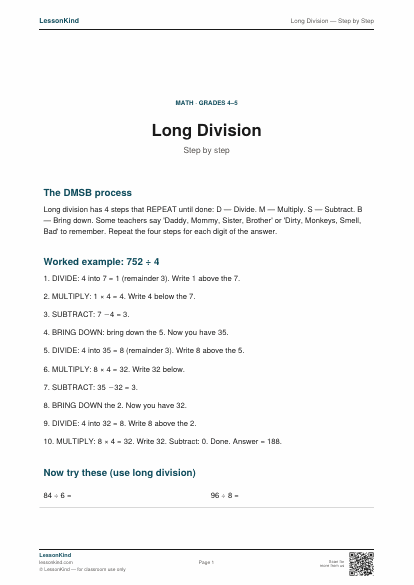
Long Division — Step by Step
Step-by-step process for long division with 2- and 3-digit dividends. Includes worked example.
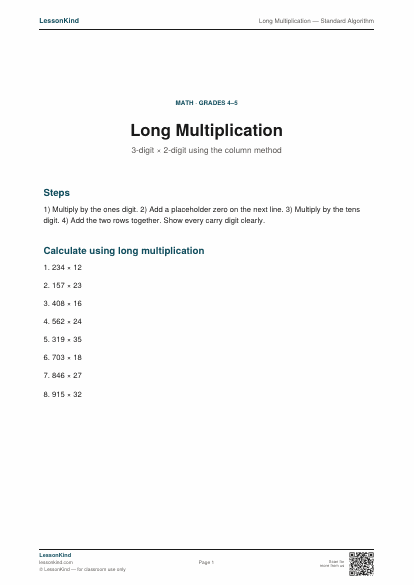
Long Multiplication — Standard Algorithm
Step-by-step long multiplication (3-digit × 2-digit) using the column method.
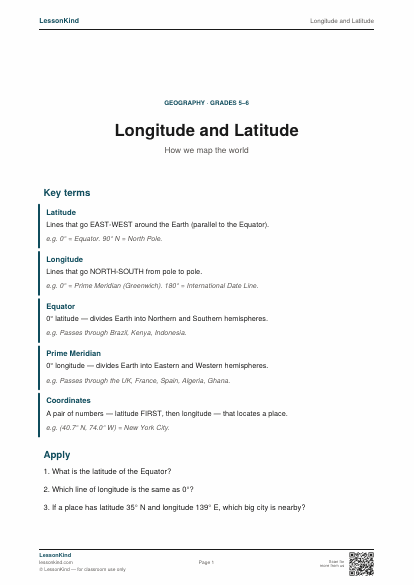
Longitude and Latitude
How the world is mapped using lines of longitude and latitude. Includes coordinate reading practice.
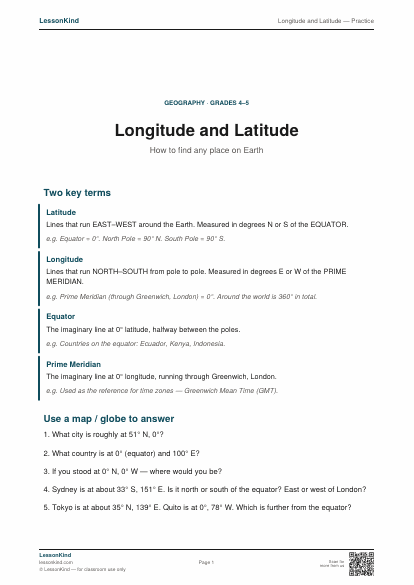
Longitude and Latitude — Practice
Read coordinates on a globe. Find places by their lat/long. Includes the equator, prime meridian, and major cities.
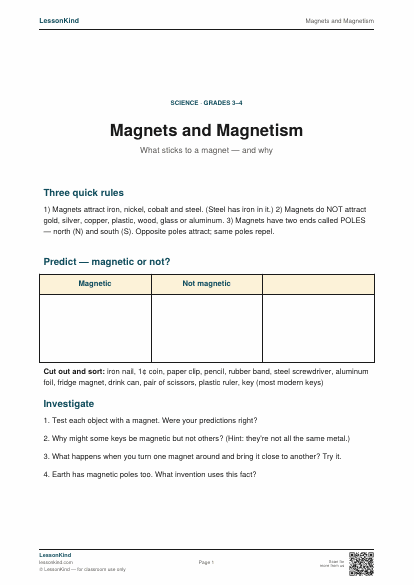
Magnets and Magnetism
What's magnetic, what isn't, and how to test things in the classroom. Includes a sorting investigation.
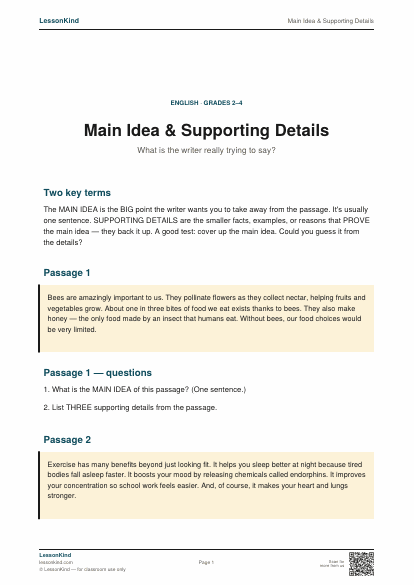
Main Idea & Supporting Details
Practice spotting the main idea of a short passage and identifying details that support it.
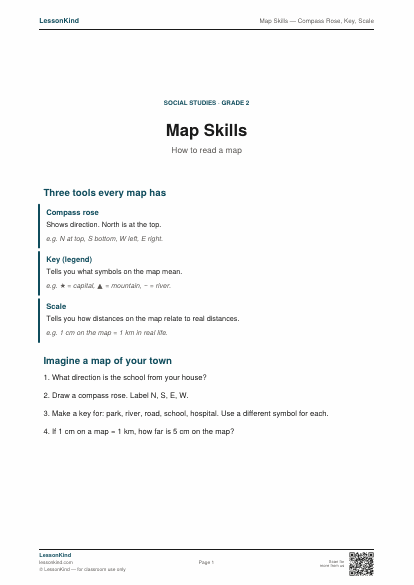
Map Skills — Compass Rose, Key, Scale
Read a simple map. Use the compass, key and scale to answer questions.
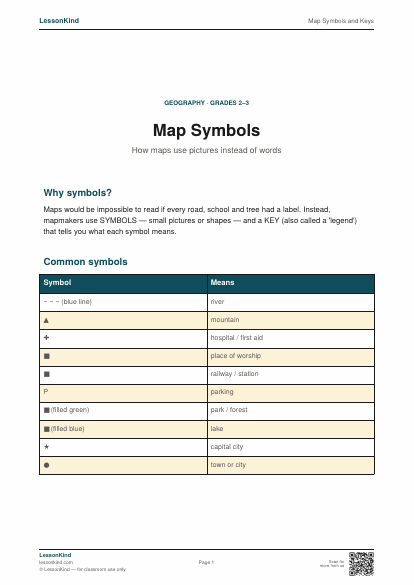
Map Symbols and Keys
Common map symbols explained, with a make-your-own-map activity using a key.
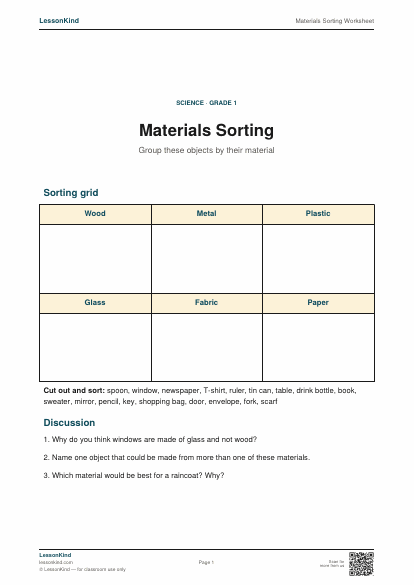
Materials Sorting Worksheet
Sort objects by their material — wood, metal, plastic, glass, fabric, paper.
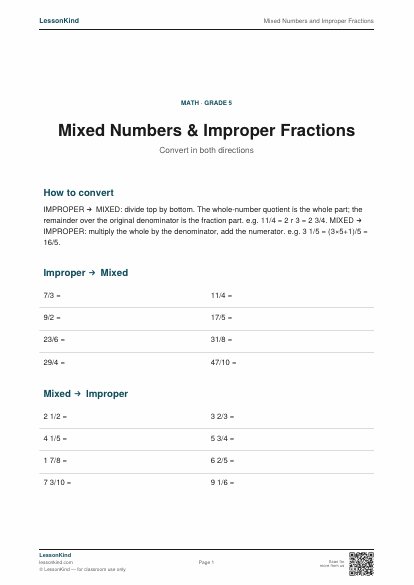
Mixed Numbers and Improper Fractions
Convert between improper fractions and mixed numbers. 20 practice problems.
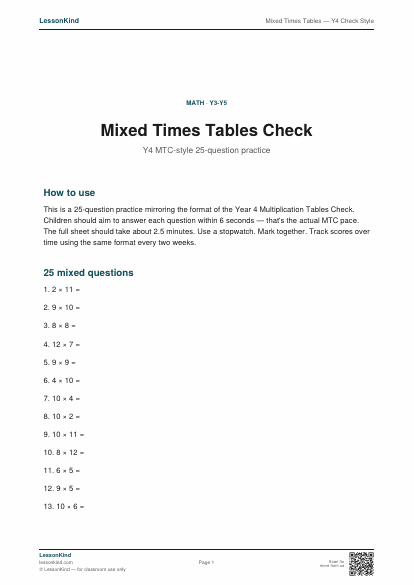
Mixed Times Tables — Y4 Check Style
25-question mixed multiplication check styled like the Year 4 Multiplication Tables Check (MTC). Six-second-per-question pace builds fluency for the real assessment.
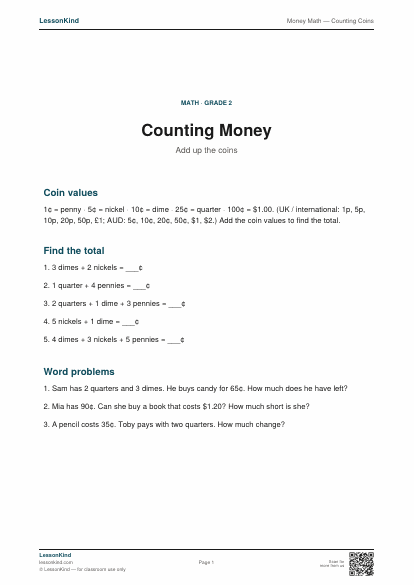
Money Math — Counting Coins
Add up coin values to find totals. Mixed coin combinations and word problems.
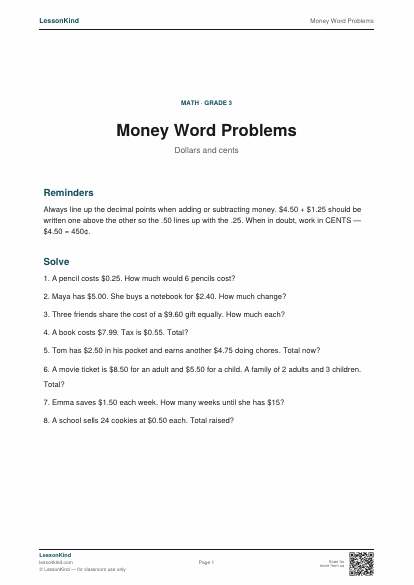
Money Word Problems
Real-world money problems involving adding, subtracting and multiplying with dollars and cents.
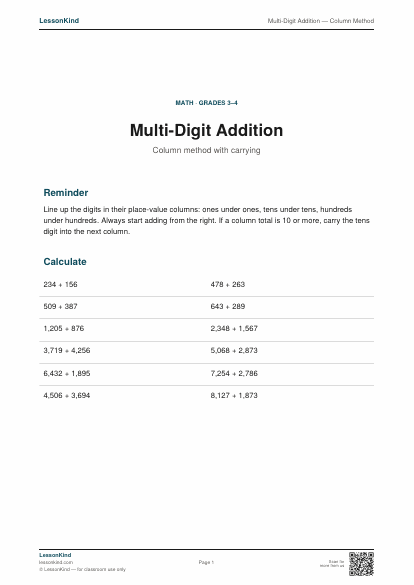
Multi-Digit Addition — Column Method
3- and 4-digit addition using the standard algorithm. Carrying practiced and modeled.
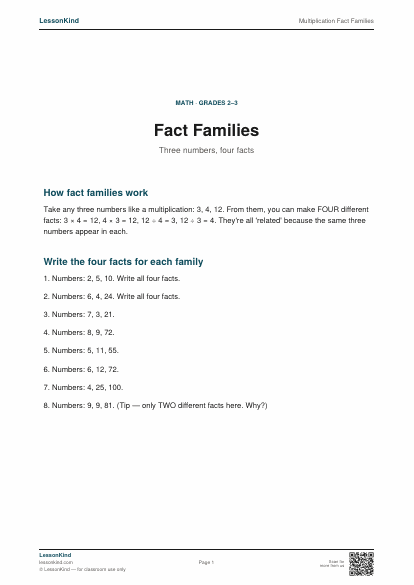
Multiplication Fact Families
From three numbers, write four related facts (2 multiplication, 2 division). Builds inverse-operation fluency.
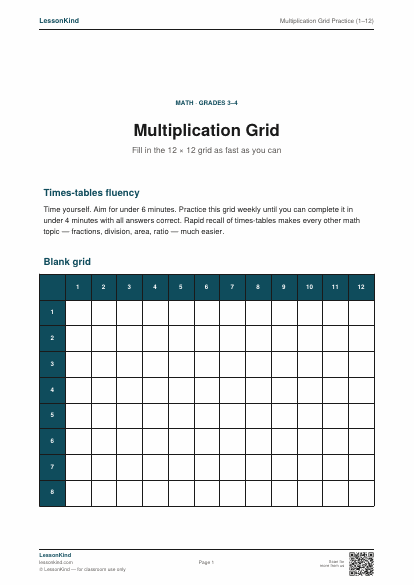
Multiplication Grid Practice (1–12)
Two blank 12×12 grids for timed times-tables practice.
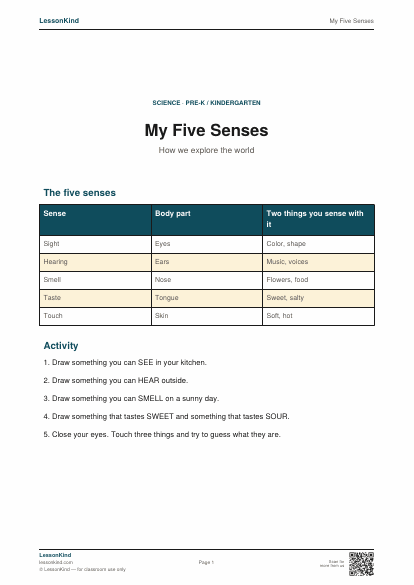
My Five Senses
Match each sense to its body part and to things you can sense with it.
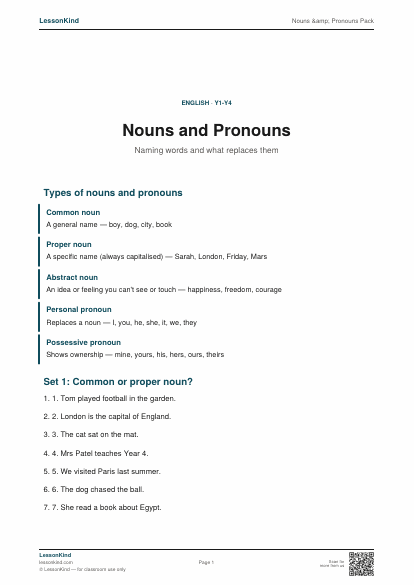
Nouns & Pronouns Pack
Ready-made nouns and pronouns worksheet — common, proper, abstract nouns plus personal and possessive pronouns. KS1 and KS2.
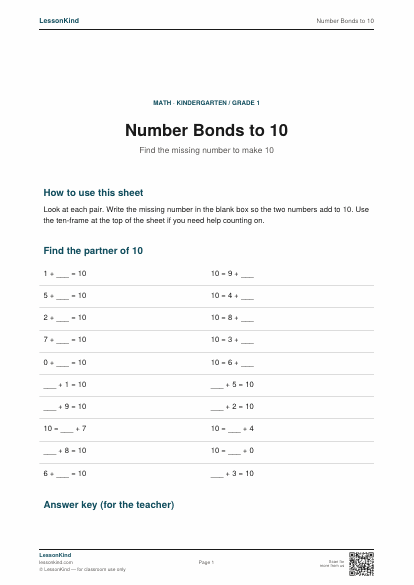
Number Bonds to 10
20 number-bond questions with a ten-frame visual support panel. Ideal for early addition fluency.
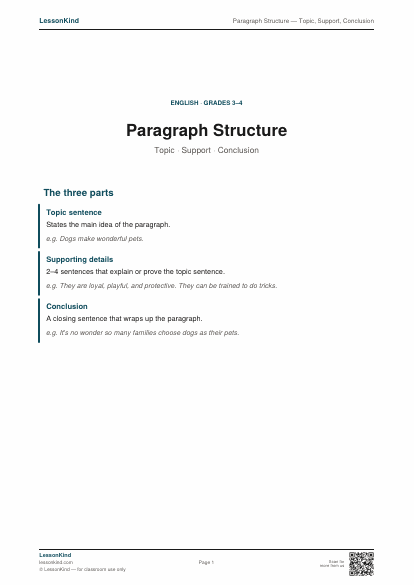
Paragraph Structure — Topic, Support, Conclusion
Build clear paragraphs with a topic sentence, supporting details, and a closing sentence.
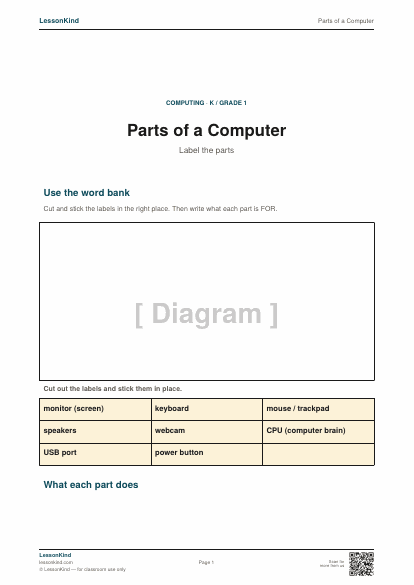
Parts of a Computer
Label the keyboard, monitor, mouse, speaker, webcam and CPU on a basic computer.
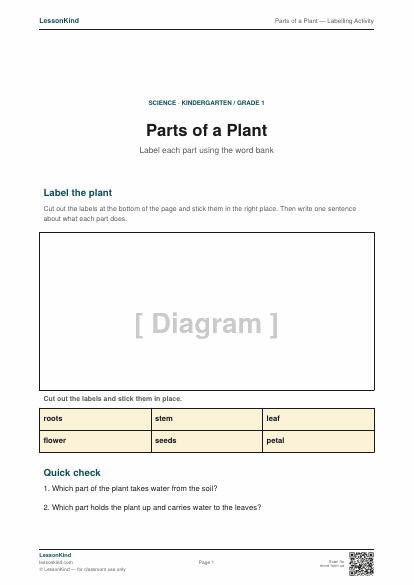
Parts of a Plant — Labelling Activity
Label the roots, stem, leaves, flower and seeds of a flowering plant.
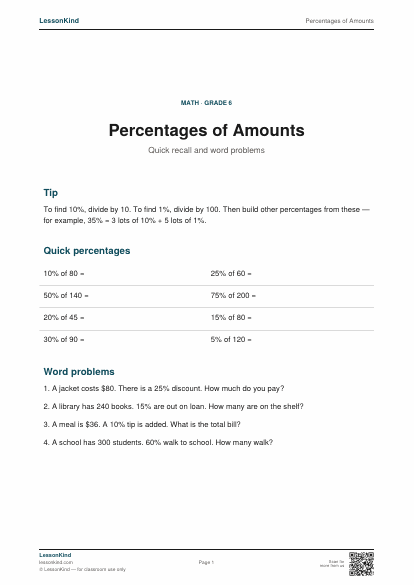
Percentages of Amounts
Find 10%, 25%, 50% and other percentages of amounts. Real-world money word problems.
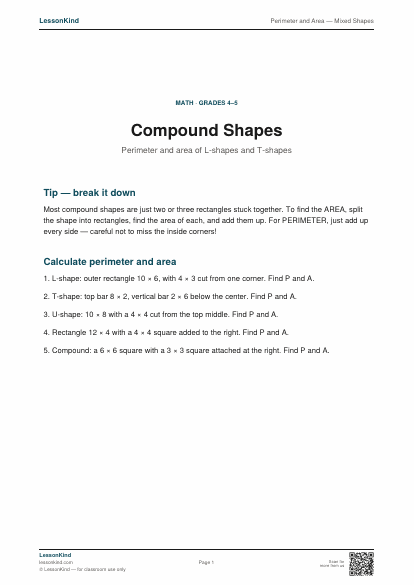
Perimeter and Area — Mixed Shapes
Calculate perimeter and area of compound shapes — L-shapes, T-shapes, irregular rectangles.
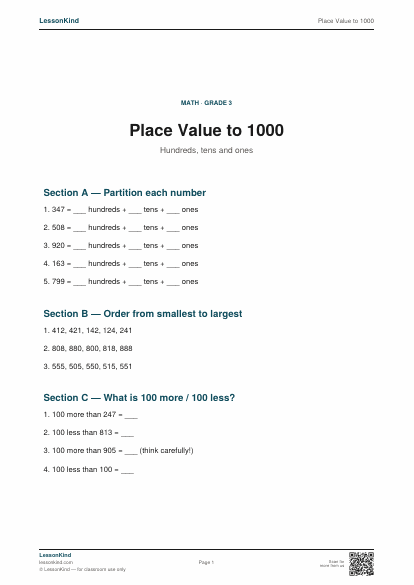
Place Value to 1000
Identify hundreds, tens and ones in 3-digit numbers. Includes partitioning and ordering.
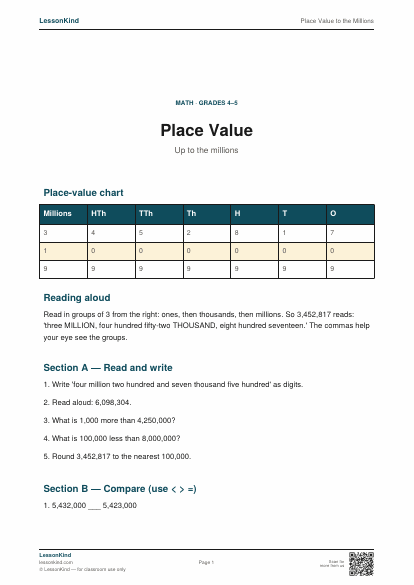
Place Value to the Millions
Read, write and compare numbers up to 9,999,999. With place-value chart and reading-aloud practice.
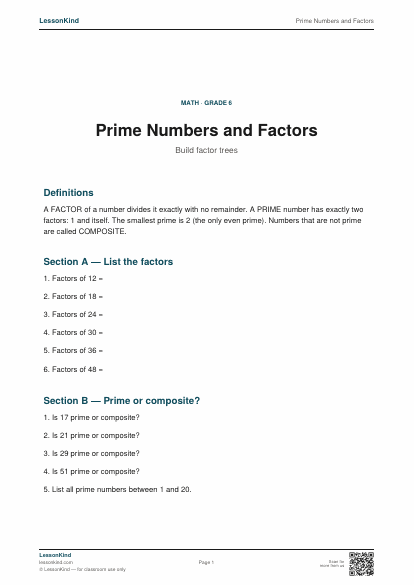
Prime Numbers and Factors
Identify primes up to 100, find factors, and build factor trees.
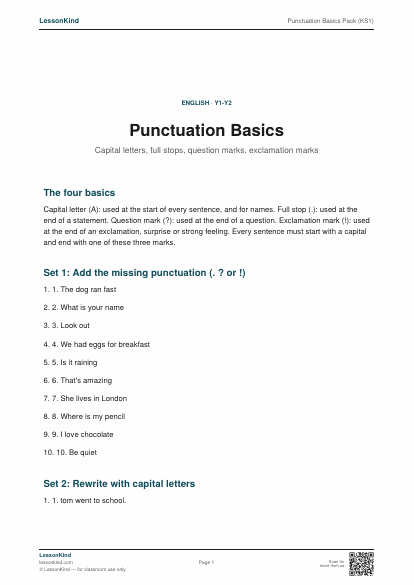
Punctuation Basics Pack (KS1)
KS1 punctuation pack — capital letters, full stops, question marks, exclamation marks. Ready-made print-and-go.
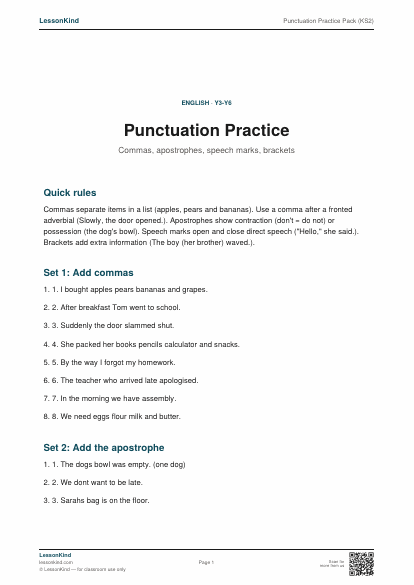
Punctuation Practice Pack (KS2)
KS2 punctuation pack — commas in lists, commas after fronted adverbials, apostrophes, speech marks, and brackets. Ready-made for Y3-Y6.
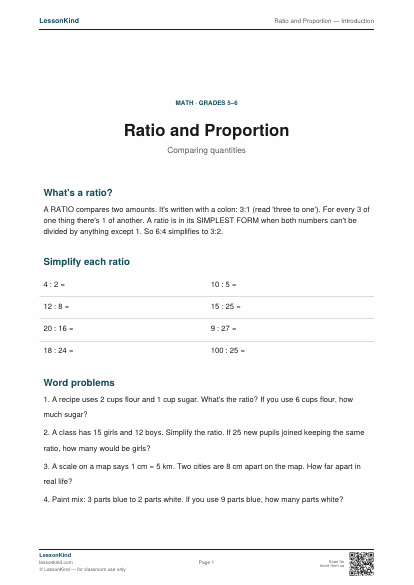
Ratio and Proportion — Introduction
Express ratios in their simplest form, then use proportional reasoning to solve scale problems.
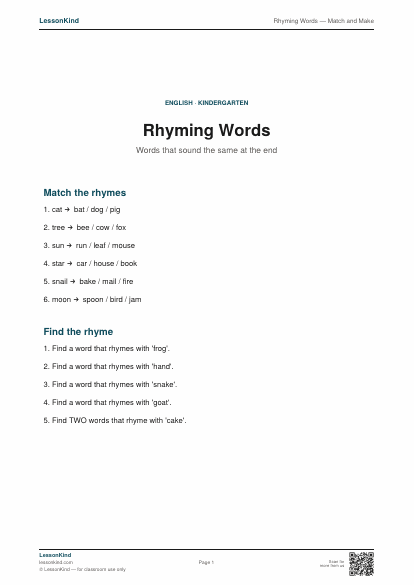
Rhyming Words — Match and Make
Match rhyming pairs, then make your own. Includes a rhyme-finder picture activity.
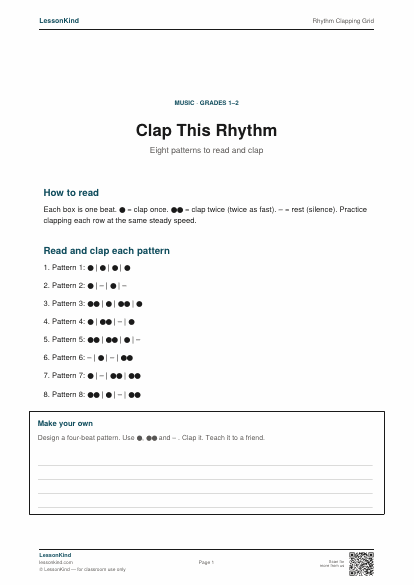
Rhythm Clapping Grid
Eight rhythm patterns notated with symbols. Read, clap and create your own four-beat pattern.
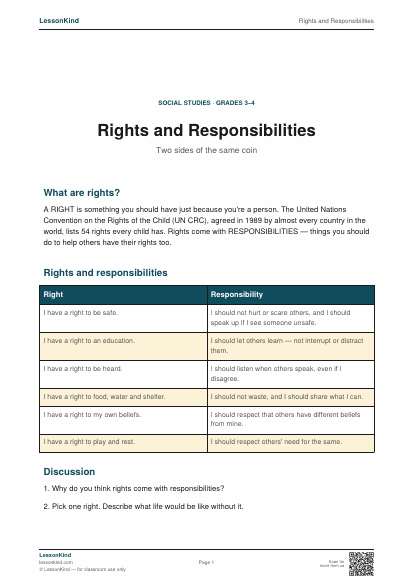
Rights and Responsibilities
What children's rights are, where they come from (UN CRC), and what responsibilities go with them.
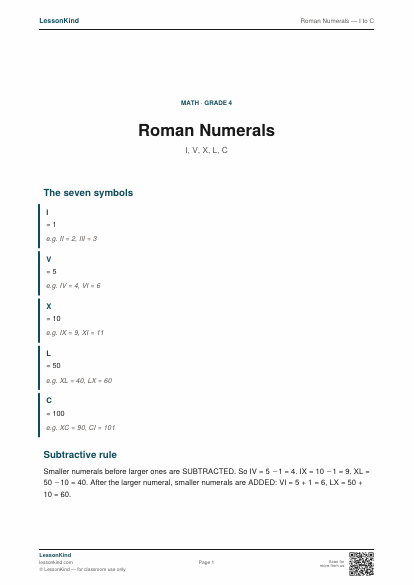
Roman Numerals — I to C
Read and write Roman numerals up to 100. Includes a vocabulary mat and 24 practice questions.
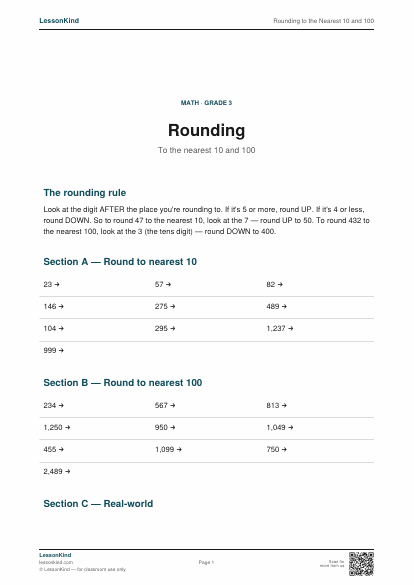
Rounding to the Nearest 10 and 100
Round 2- and 3-digit numbers to the nearest 10 and 100. With number-line visual support.
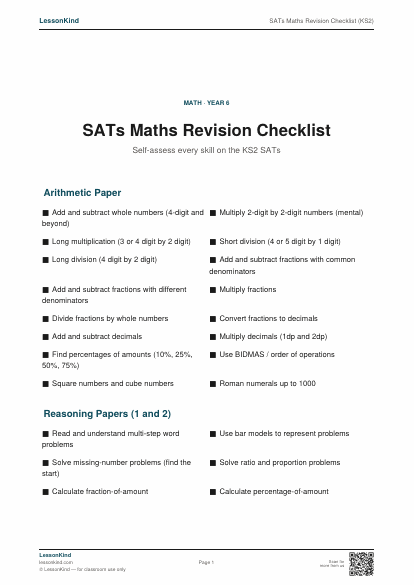
SATs Maths Revision Checklist (KS2)
A printable self-assessment checklist of every maths skill on the KS2 SATs Arithmetic and Reasoning papers. Y6 children tick off what they're confident with and what needs more practice.
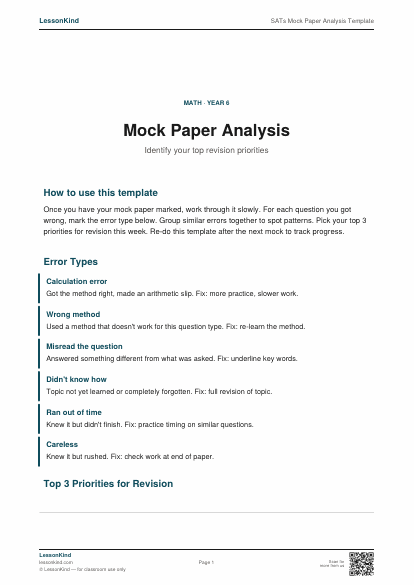
SATs Mock Paper Analysis Template
After every mock paper, children use this template to analyse what went wrong and identify their top 3 revision priorities. Works for both maths and English papers.
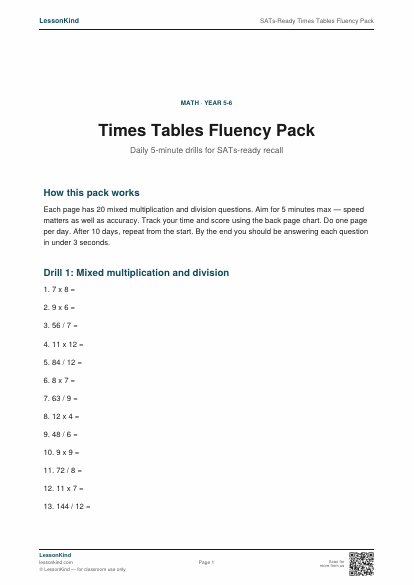
SATs-Ready Times Tables Fluency Pack
Daily 5-minute fluency drills covering all multiplication and related division facts to 12x12 — the foundation for SATs Arithmetic speed.
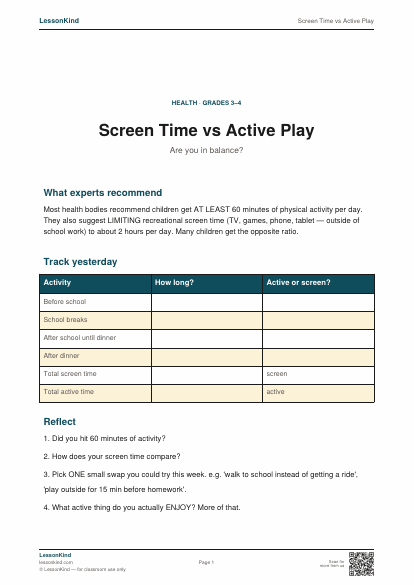
Screen Time vs Active Play
Track a typical day, reflect on screen-vs-active balance, and plan small swaps.
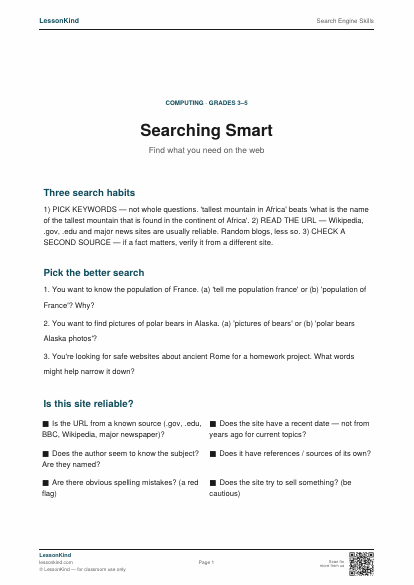
Search Engine Skills
Use search engines effectively — pick keywords, filter results, spot reliable sources.
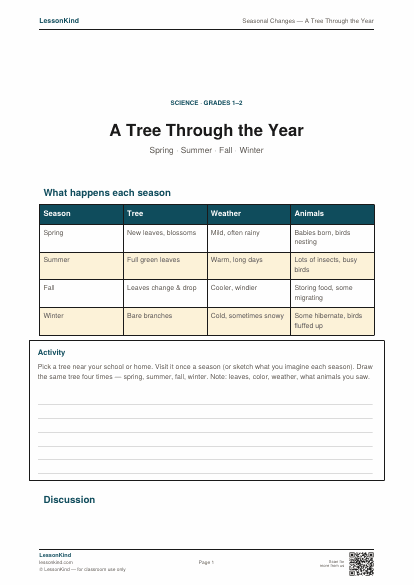
Seasonal Changes — A Tree Through the Year
Observe and draw a deciduous tree in each of the four seasons. Builds pattern-recognition over time.
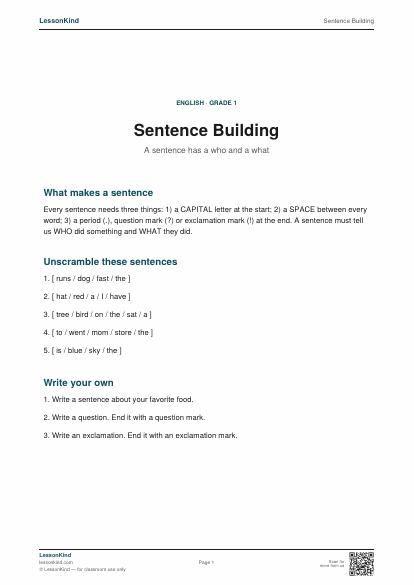
Sentence Building
Build complete sentences from word banks. Practice capital letters, spaces, and end punctuation.
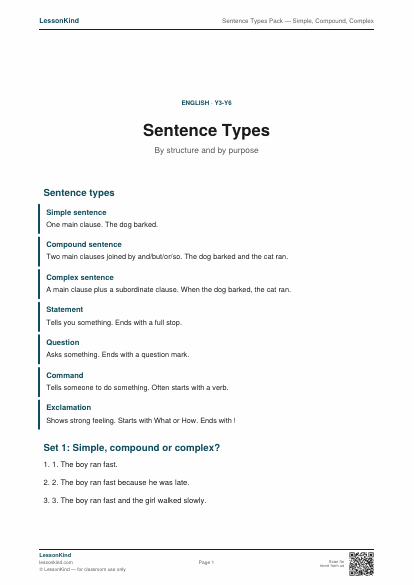
Sentence Types Pack — Simple, Compound, Complex
Sentence-types practice covering simple, compound and complex sentences plus the four sentence purposes (statement, question, command, exclamation). Upper KS2 focused.
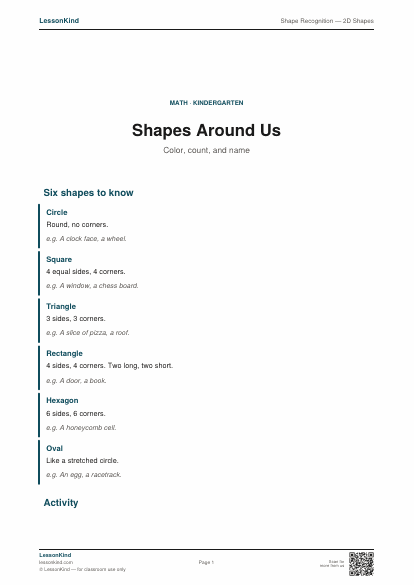
Shape Recognition — 2D Shapes
Identify circles, squares, triangles, rectangles, hexagons and ovals. Color and count.
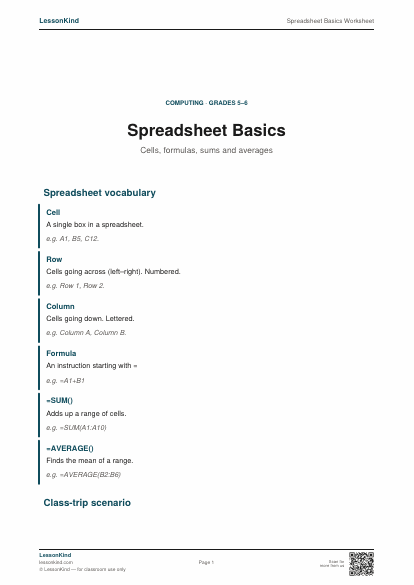
Spreadsheet Basics Worksheet
Cells, rows, columns, formulas (=SUM, =AVERAGE) explained with a class-trip data scenario.
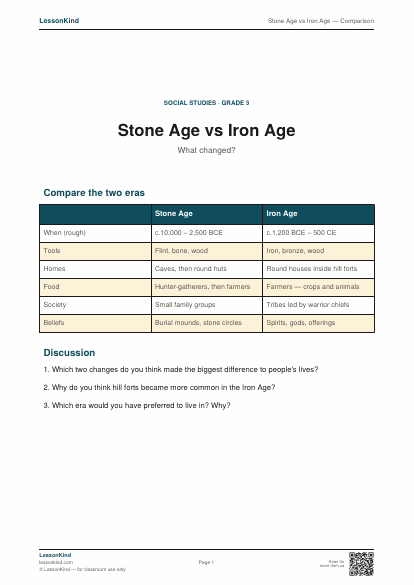
Stone Age vs Iron Age — Comparison
Compare daily life, tools, homes and beliefs across the two eras.
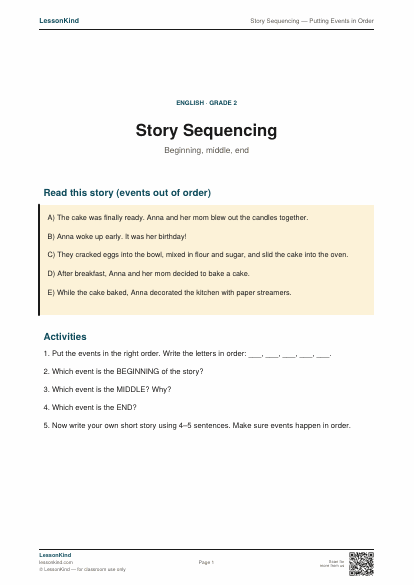
Story Sequencing — Putting Events in Order
Cut, mix and re-order story events. Builds narrative comprehension and writing structure.
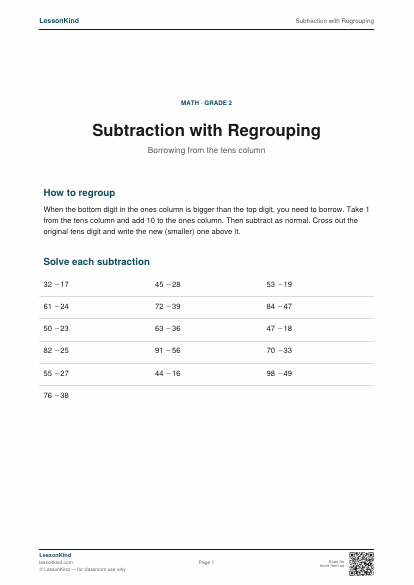
Subtraction with Regrouping
Two-digit subtraction with borrowing. Step-by-step examples and 16 practice problems.
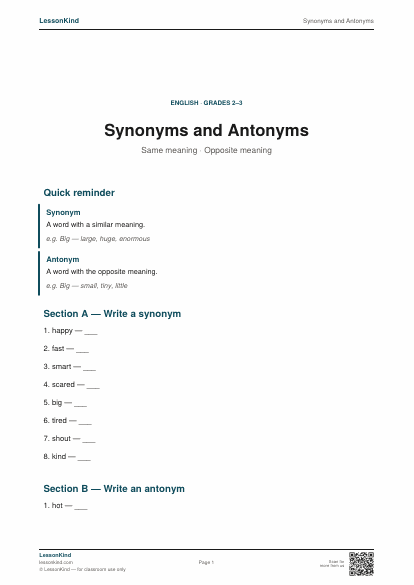
Synonyms and Antonyms
Match pairs and write your own. Builds vocabulary and word-choice flexibility.
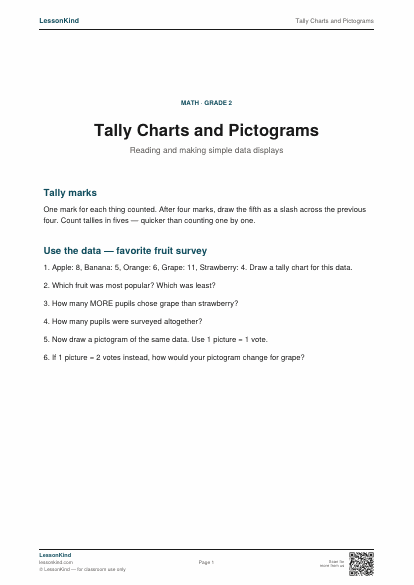
Tally Charts and Pictograms
Read and create tally charts and pictograms. Practice the most-and-fewest comparison vocabulary.
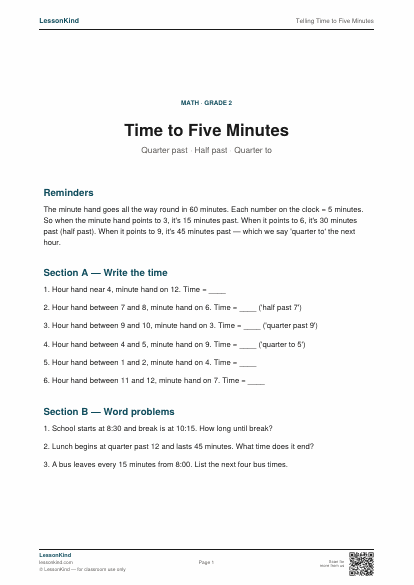
Telling Time to Five Minutes
Read analog clocks to the nearest five minutes. Includes 'quarter past', 'half past' and 'quarter to'.
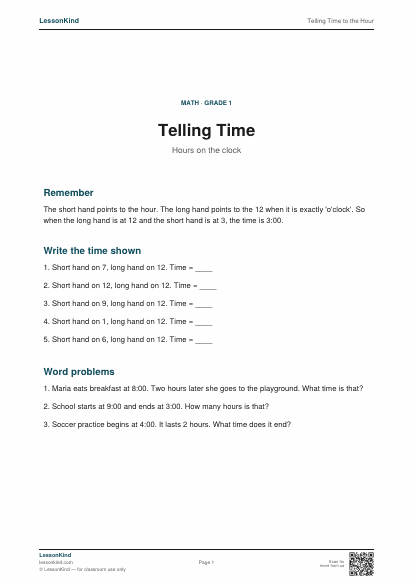
Telling Time to the Hour
Read analog clocks set to whole hours. Includes word problems and clock-drawing practice.
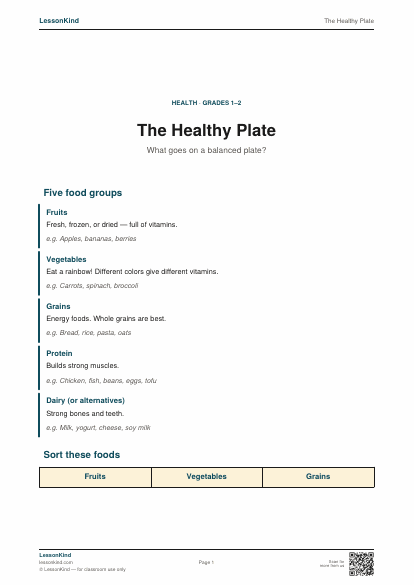
The Healthy Plate
Sort foods into the five food groups and design your own healthy plate.
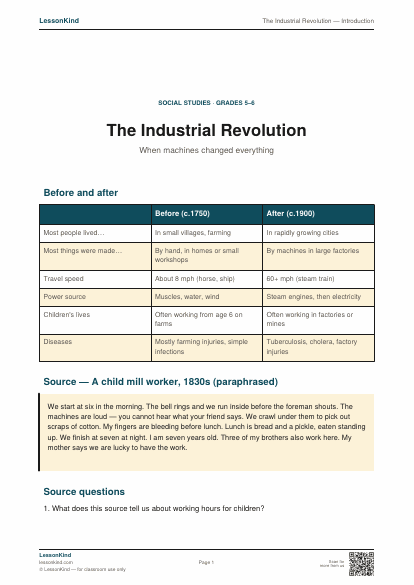
The Industrial Revolution — Introduction
How life changed when factories, steam engines and railways arrived. With three primary-source style descriptions.
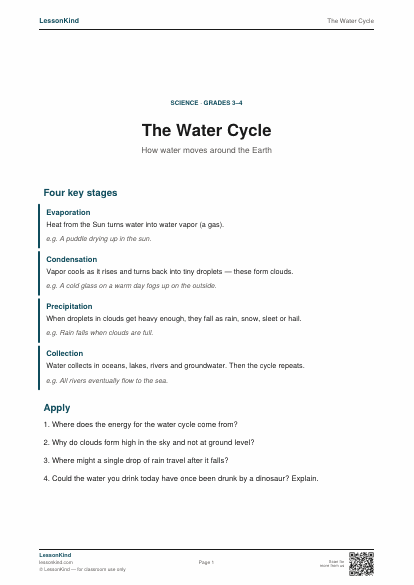
The Water Cycle
Label stages of the water cycle and answer questions about evaporation and precipitation.
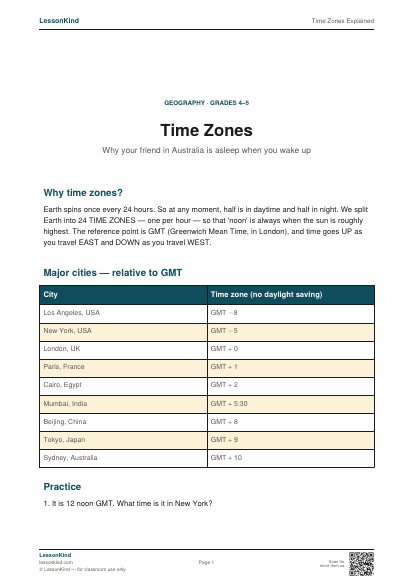
Time Zones Explained
Why different countries have different times — with practice questions converting between zones.
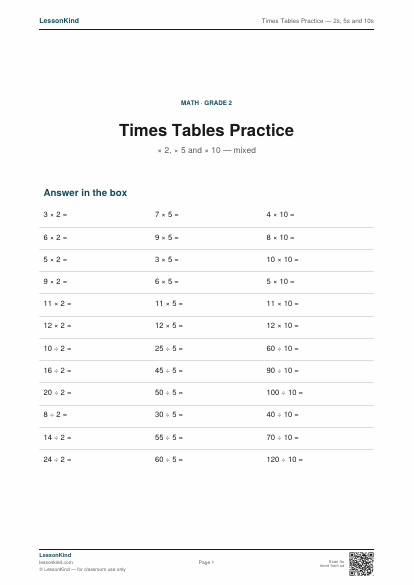
Times Tables Practice — 2s, 5s and 10s
Mixed-up times tables practice with 36 questions. Builds rapid recall of the 2, 5 and 10 tables.
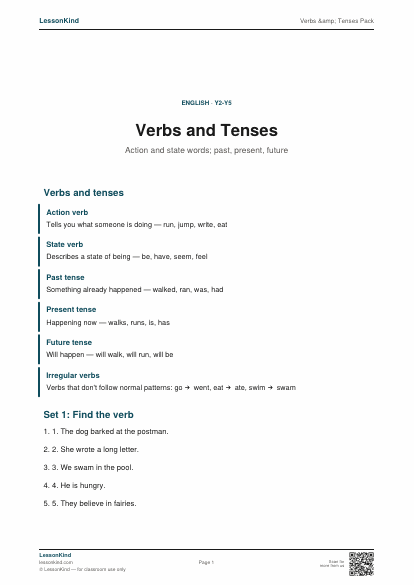
Verbs & Tenses Pack
Ready-made verbs worksheet covering action verbs, state verbs, and the three main tenses (past, present, future). KS2 focused.
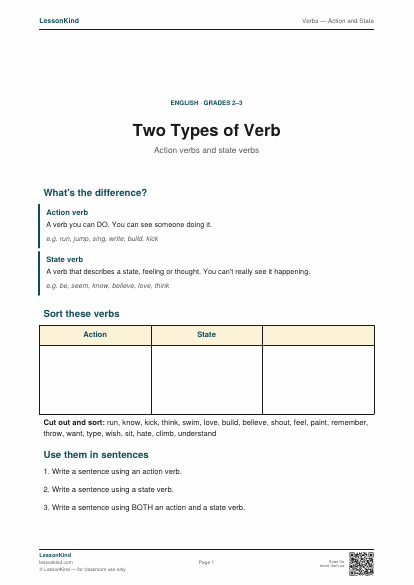
Verbs — Action and State
The two main types of verb explained. Sort 20 verbs into action vs state and write your own.
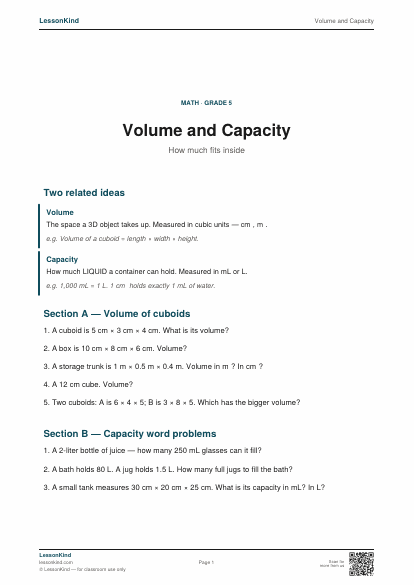
Volume and Capacity
Calculate volume of cuboids using length × width × height. Plus capacity word problems with mL and L.
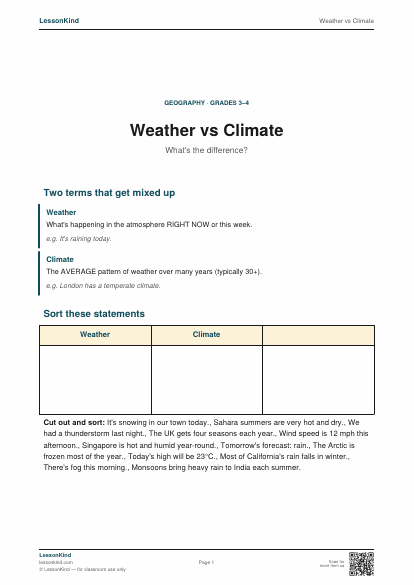
Weather vs Climate
Tell the difference between today's weather and a region's climate. Sort 12 statements into the right category.
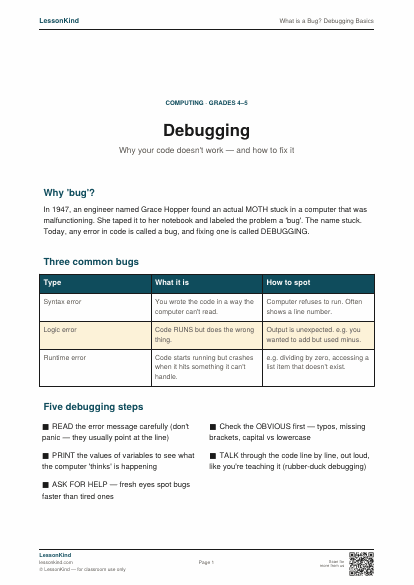
What is a Bug? Debugging Basics
What programmers mean by a 'bug', three common types, and a step-by-step approach to debugging.
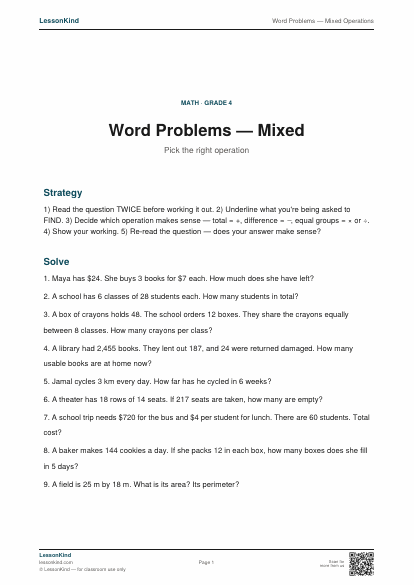
Word Problems — Mixed Operations
12 multi-step word problems mixing addition, subtraction, multiplication and division.
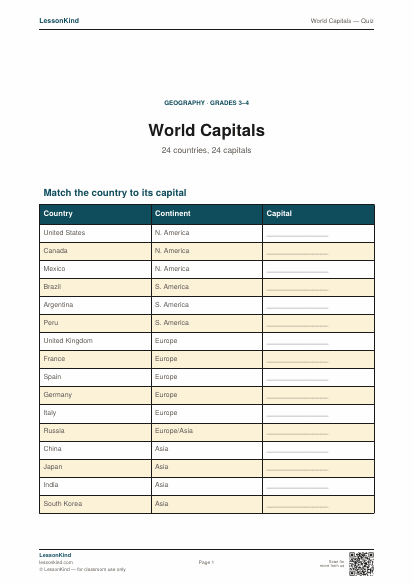
World Capitals — Quiz
Match 24 countries to their capitals from across all populated continents.
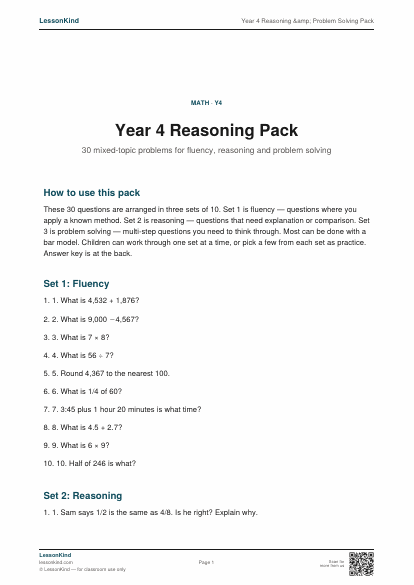
Year 4 Reasoning & Problem Solving Pack
30 mixed reasoning questions for Year 4, covering place value, four operations, fractions, time, and measure. Three difficulty stages — fluency to deeper reasoning.
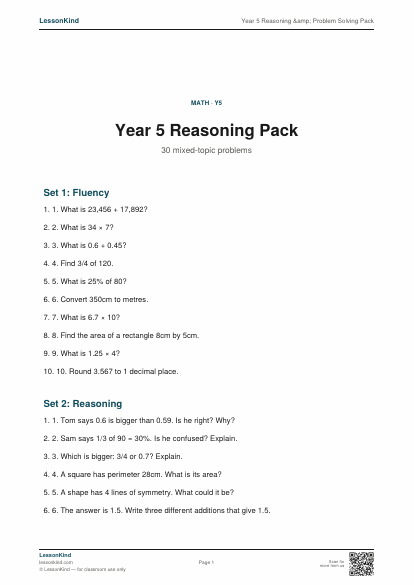
Year 5 Reasoning & Problem Solving Pack
30 mixed reasoning questions for Year 5 — covering decimals, fractions, percentages, area/perimeter, multiplication, time. Three difficulty stages from fluency to deeper reasoning.
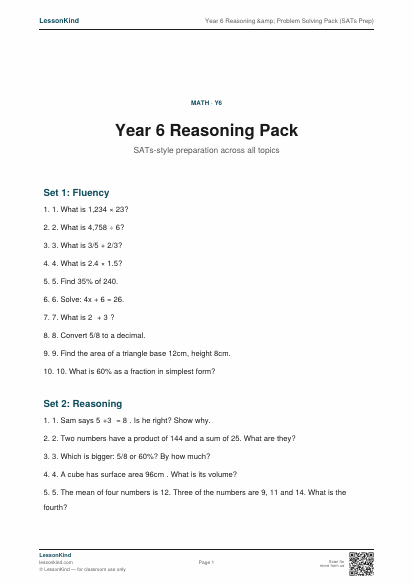
Year 6 Reasoning & Problem Solving Pack (SATs Prep)
30 SATs-style reasoning questions for Year 6 — algebra, ratio, percentages, decimals, geometry, multi-step problems. Designed as preparation for the SATs Reasoning papers.