EAL & inclusion · 6 min read
Dyslexia: What Teachers Actually Need to Know
Beyond letter reversals — what dyslexia really is and how to support children who have it
Published 2026-10-24
There's a comforting myth that dyslexia is "seeing letters backwards". It's neat, it's visual, and it's almost entirely wrong.
Children with dyslexia don't typically reverse letters more than other early readers do. What they have is something far less visual — a difference in how their brains process the *sounds* of language.
Understanding this changes everything about how to support them.
What dyslexia actually is
The current scientific consensus describes dyslexia as a difficulty with phonological processing — the ability to identify, manipulate, and remember the individual sounds in spoken words.
A typical reader hears "cat" and effortlessly breaks it into "c-a-t". They map those sounds to letters and read fluently.
A dyslexic reader hears "cat" and the sounds don't separate cleanly. Mapping to letters is harder. Even when they know the letters, the connection between sound and symbol isn't automatic.
This is a *neurological* difference, not a vision problem, not a sign of low intelligence (dyslexic children often have above-average reasoning ability), and not a result of poor teaching.
How dyslexia shows up in primary
The signs change with age:
**Reception/Year 1:** - Difficulty rhyming - Trouble remembering letter names and sounds despite repeated teaching - Family history of reading difficulty (dyslexia runs in families) - Late to talk, or persistent speech sound issues
**Year 2/3:** - Reads slowly and hesitantly - Can read a word on one page and not recognise it three pages later - Writes words like "becuse", "thay", "wos" persistently - Avoids reading aloud - Anxiety around literacy tasks
**Year 4-6:** - Reads but with low fluency (sounds out everything, doesn't read by sight) - Comprehension is sometimes good (because they're bright) but slow - Writing is much weaker than speaking — ideas are sophisticated, output is basic - Spelling is wildly inconsistent — same word spelled three different ways in one piece
The crucial pattern: persistent difficulty disproportionate to the child's general ability. A child who clearly understands complex ideas in conversation but cannot read a chapter book is signalling dyslexia.
What teachers can do without waiting for diagnosis
In the UK, formal dyslexia assessment usually doesn't happen before Year 3 or 4. Don't wait. The strategies that help dyslexic children also help every other child who's struggling with reading. Implement them now.
**1. Systematic synthetic phonics, properly.**
The single best intervention for early dyslexia is daily, systematic, structured phonics teaching. Not "playing with letters" — explicit teaching of grapheme-phoneme correspondences in a structured order. Any of the well-established DfE-validated synthetic phonics programmes, used systematically, is well-evidenced.
**2. Multi-sensory teaching.**
Dyslexic brains benefit from learning the same content through multiple channels: see the letter, say the sound, write the letter, do an action. Sand-tray writing, magnetic letters, air-tracing. The redundancy strengthens the connection.
**3. Reduce written demands, increase oral demands.**
A dyslexic child can usually *speak* what they know far better than they can *write* it. Where possible, allow oral responses, voice notes, mind maps. The point of most assessment is to find out what the child knows — not whether they can prove it through writing.
**4. Use technology unapologetically.**
Audiobooks, text-to-speech, speech-to-text, dyslexia-friendly fonts. These are not "cheating" — they're glasses for a brain that processes text differently. A dyslexic child who reads via audiobook is reading.
**5. Protect their self-image.**
By Year 2 or 3, dyslexic children often believe they're "stupid". This is the single biggest secondary harm of dyslexia, and it's preventable. Tell them their brain works differently, not worse. Find what they're brilliant at and celebrate it. Make sure they hear positive feedback at least as often as corrective feedback.
What doesn't help
- **More of the same.** If a child isn't picking up phonics with the standard programme, doing more of the same standard programme isn't the answer. They need *different* — slower pace, smaller steps, more multi-sensory input. - **Reading interventions that are just "read to an adult more".** Some progress, but not the structured intervention dyslexic children need. - **Coloured overlays/tinted lenses.** The evidence base is weak. They might help a few children, but they're not the magic bullet they're sometimes presented as. - **Waiting for formal diagnosis to act.** Strategies don't need a diagnosis. Implement them on observation.
The conversation with parents
Parents who suspect dyslexia in their child are often anxious — sometimes because they have it themselves and remember their own school experience. When you talk to them:
- Don't say "I think she has dyslexia" if you can't formally diagnose it. Say "I'm noticing some patterns that might point to dyslexia, and I'm putting interventions in place that will help whether or not she has it." - Explain what you're doing. - Be honest about the timeline. Formal assessment can be expensive (private) or slow (school-led). Strategies start now. - Recommend the British Dyslexia Association website. They have well-pitched parent resources.
The good news
Dyslexic children, properly supported, succeed enormously. Many of the most creative thinkers, entrepreneurs, scientists, and artists are dyslexic. The difference isn't a deficit — it's a different processing style that makes some things harder and some things easier. The job of primary school is to keep them confident enough to discover their strengths.
Mistakes early in primary, where dyslexic children are made to feel stupid, do far more damage than the underlying condition itself. The teacher who notices, intervenes, and protects their self-image is making a difference that will be visible 20 years later.
Free bundle for this topic
SEND Inclusion Toolkit
7 essential SEND resources covering autism, ADHD, dyslexia and emotional regulation.
Practical resources for this
Take this further
Printable, classroom-ready resources for the topics in this article.
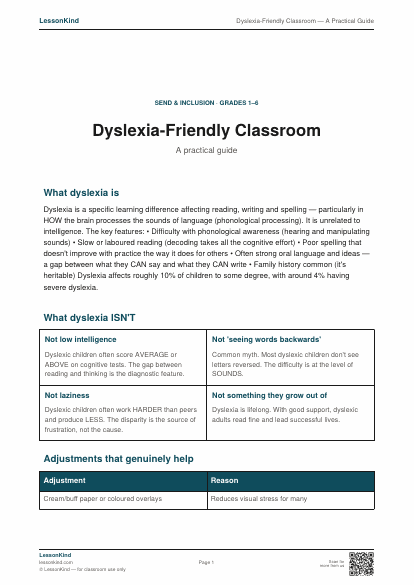
Dyslexia-Friendly Classroom — A Practical Guide
What dyslexia is and isn't, the most useful classroom adjustments, and the things that genuinely help dyslexic children access mainstream learning.
Dyslexia-Friendly Classroom — A Practical Guide
What dyslexia is and isn't, the most useful classroom adjustments, and the things that genuinely help dyslexic children access mainstream learning.
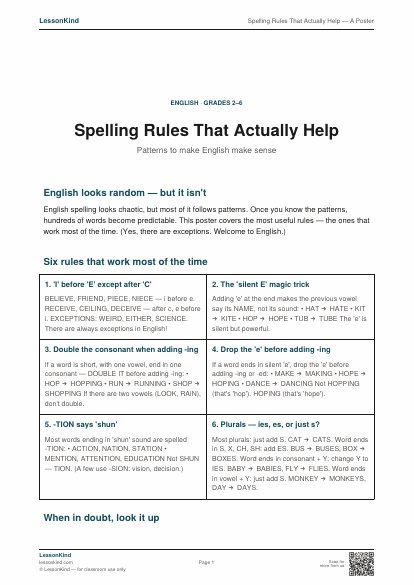
Spelling Rules That Actually Help — A Poster
The spelling rules that make English make sense — i before e, doubling consonants, dropping the e, and the magic of -tion. With clear examples.
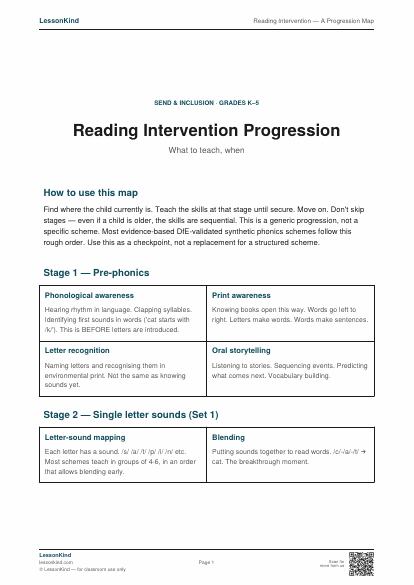
Reading Intervention — A Progression Map
A step-by-step progression for what to teach a struggling reader at each stage, from pre-phonics to fluency. Useful for class teachers, TAs and intervention leads.
Going deeper
Books on teaching children with dyslexia
Books we'd recommend on the topics raised in this article.
Practitioner
Convenience links to Amazon. As an Amazon Associate we earn from qualifying purchases at no extra cost to you. Read our affiliate disclosure.
Keep reading
Reading & literacy
Phonics vs Whole Language: The Fight Is (Mostly) Over
The 'reading wars' tore at education for decades. Here's where the science of reading has actually landed — and what it means for your classroom.
8 min read
Reading & literacy
What to Do When a Year 4 Child Still Can't Read
It happens in every primary school: a child arrives in Year 4 with reading two or three years behind. Here's what's likely going on, and what you can actually do about it.
9 min read
Reading & literacy
Spelling Isn't Just Memorisation
Most schools still run weekly spelling tests where children get 10/10 on Friday and misspell the same words on Monday. Here's why memorisation isn't the answer.
5 min read