Reading & literacy · 9 min read
What to Do When a Year 4 Child Still Can't Read
A sensitive, practical guide for teachers who've inherited a struggling reader
Published 2026-08-07
You inherit your class. There's a child in it — let's call them Jamie — who is nine years old and reads at roughly the level of a six-year-old. Their previous teachers have flagged this. There may have been interventions. The notes say "making progress" but Jamie can't yet read a Year 2 book independently. They are about to enter the years where the curriculum assumes you can read, and Jamie cannot.
This article is about what to do.
First: separate the questions
Before you do anything, you need to know what's actually going on. "Can't read" is not one problem. It can mean any of the following, and the right response depends on which:
**Decoding difficulty.** They cannot reliably decode unfamiliar words — they may know letter sounds individually but can't blend them, or they confuse similar-looking letters, or they substitute words that "look right" without checking. Most reading struggles in primary children are at this level.
**Fluency difficulty.** They can decode but very slowly — every word individually, with no rhythm or expression. Their decoding is using all their cognitive bandwidth, leaving none for comprehension.
**Comprehension difficulty.** They can read fluently aloud but don't actually understand what they've read. (This is rarer in younger children and more common from upper KS2 onwards.)
**Vocabulary difficulty.** They can decode words but the words themselves are unfamiliar. This is especially common with EAL children and children from low-language home environments.
**Engagement difficulty.** They can read but don't, because reading has been a punishing experience and they avoid it.
In practice, most struggling readers have a mix of these — but the dominant problem matters because the intervention differs.
Find out where they actually are
Don't trust the notes from previous years. Spend 20 minutes 1:1 with the child in the first week. Use a phonics screening check (the Y1 one is freely available from the Department for Education in the UK; equivalents exist for US, Australia and Canada). Have them read aloud a passage from a Year 2 book. Then ask them three comprehension questions about it.
You'll learn: - What letter sounds and letter combinations they know reliably - Whether they can blend - Whether they can read sight words - Whether they understand what they read - Whether they enjoy or dread the experience
Note: this assessment should not feel like a test. Frame it: "I'm new to your class — I want to know what you're good at and what would be helpful for me to know about how you read." Bring out a sticker or a piece of chocolate at the end. Make it positive.
Know that this is rarely about effort
The most damaging belief about struggling older readers is that they're not trying hard enough. By Year 4, a child who can't read has been told to "just try harder" hundreds of times. They have tried harder. And the gap has grown.
Reading is one of the most cognitively complex things humans do. Decoding alone requires you to: - Recognise letter shapes - Recall their sounds - Hold them in memory while you process the next ones - Blend the sounds together - Match the resulting word to vocabulary you already have - Adjust for context and grammar
Any one of these can be the breaking point. Children with phonological awareness difficulties may struggle to hold letter sounds in working memory long enough to blend them. Children with letter-sound knowledge gaps may have learned the alphabet but never reliably learned digraphs (sh, ch, ai, ee, etc). Children with weak vocabulary may decode "synthesise" perfectly but get nothing from it.
If you're new to a struggling reader, your first instinct should be: this child has been working hard for years and is exhausted. Be kind. Be patient. Be the teacher who finally cracks it open.
What works — the basics
The research on reading instruction is, by education-research standards, unusually clear. The reading wars of the 80s and 90s are essentially over: systematic synthetic phonics works for the great majority of children, especially struggling ones. The argument now is mostly about emphasis and sequencing, not about whether phonics matters.
For an older struggling reader, the basics that make the biggest difference:
**Daily, short, intensive 1:1 phonics work.** Not 45 minutes once a week. Twenty minutes every day. Pick a single phonics scheme and stay with it — the major DfE-validated systematic synthetic phonics schemes are all defensible. Inconsistency between schemes is what breaks struggling readers.
**Decodable books at their actual level.** A Year 4 child reading a Year 2 phonics book is not "behind". They're working at the level they can succeed at. Don't give a struggling Year 4 reader a Year 4 book and hope. They'll fail. Give them a Year 2 decodable, build success, build fluency, then climb.
**Read TO them.** A child who can't read independently can still develop vocabulary, comprehension and love of story by being read to. Read aloud to your whole class, daily. The struggling readers benefit most.
**Audiobooks are not cheating.** A child who can't yet decode can still enjoy and understand sophisticated literature in audio form. Audiobooks build vocabulary, comprehension and the habit of being absorbed in story. They are not a substitute for learning to decode, but they keep the love of stories alive while decoding catches up.
**Avoid round-robin reading.** Asking a struggling reader to read aloud to the class is one of the most damaging practices in primary education. Their public failure is reinforced thirty times in front of an audience. If you must do whole-class reading, use choral reading (everyone reads together) or pair reading.
When to bring in specialists
Some children need more than a kind class teacher and a phonics scheme can give them. Signs that this child may need specialist assessment:
- Persistent difficulty with phonological awareness (rhyming, segmenting words into sounds) despite teaching - Letter-sound confusion that doesn't resolve over months of work - Significant gap between oral language ability and reading ability - Strong family history of reading difficulties (dyslexia is heritable) - Difficulty that persists after a structured, daily phonics intervention for at least a term
Dyslexia is real, distinct, and helps some children when it's diagnosed because it changes how they understand themselves ("I'm not stupid — I have a specific learning difference") and unlocks specialist support. Don't be afraid of the label. But also don't reach for it as the explanation for every struggling reader; many struggling readers have simply not yet been taught well.
What to say to the child
This matters more than any technique. By Year 4, the struggling reader has often given up on themselves. Whatever else you do, your job is to undo that.
"I know reading has been hard for you. We're going to work on it together. It is going to take time. But you are going to read. I have taught children who started where you are now, and they got there. So will you."
Mean it. Then back it up with daily practice and patience.
A final word on the home situation
Many struggling older readers come from homes where reading is also struggling. Parents who can't read well themselves. Homes where the only books are school reading books. Homes where the priority is, reasonably, putting food on the table.
If this is your child, do not assume the parents don't care. They almost always do — they are often anxious about exactly the same thing you are, and don't know what to do. Send small, specific, doable suggestions: "Could you read to Jamie for ten minutes at bedtime? Any book is fine, even an old picture book. Just hearing fluent reading helps." Or: "Could you ask Jamie to tell you the story of what they read at school today?"
Don't send weekly reading records that the parent can't fill in. Don't send a guilt trip. Send small things they can succeed at.
The long game
Children who learn to read late often catch up. Some never quite catch up. A small number, with the right diagnosis and support, become passionate readers as adults — sometimes more so than the children for whom it came easily.
But the worst outcome is not "didn't catch up". The worst outcome is "decided they were stupid". You can prevent that, even if you can't fully fix the reading. Be the teacher who treated them with respect, who never made them read aloud against their will, who praised effort, who read to them, who believed they would get there.
That part — the part about who they are, not what they can do — sticks for life.
Free bundle for this topic
EYFS Essentials Pack
8 early-literacy essentials — provision, phonics-readiness, mark-making and storytime support.
Practical resources for this
Take this further
Printable, classroom-ready resources for the topics in this article.
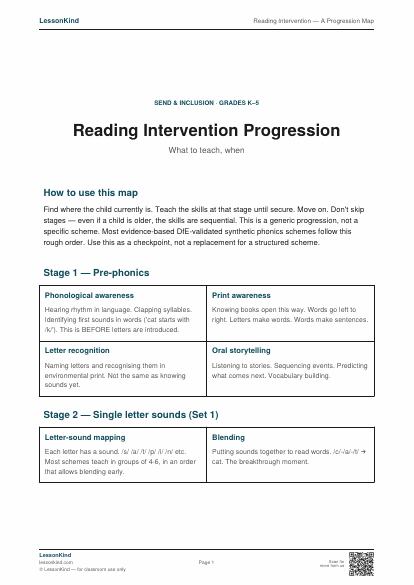
Reading Intervention — A Progression Map
A step-by-step progression for what to teach a struggling reader at each stage, from pre-phonics to fluency. Useful for class teachers, TAs and intervention leads.
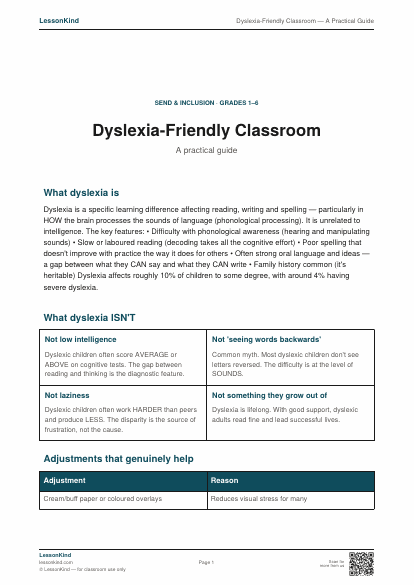
Dyslexia-Friendly Classroom — A Practical Guide
What dyslexia is and isn't, the most useful classroom adjustments, and the things that genuinely help dyslexic children access mainstream learning.
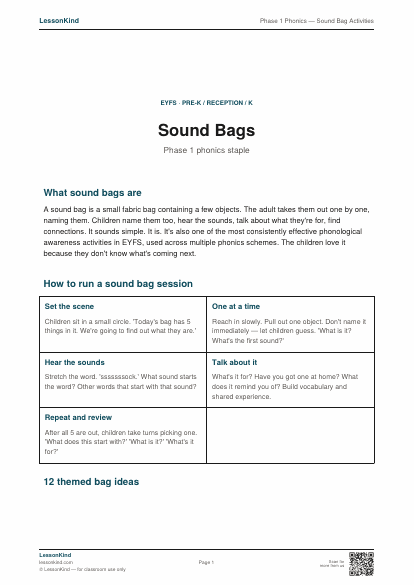
Phase 1 Phonics — Sound Bag Activities
How to set up and use sound bags — a Phase 1 phonics staple. With 12 themed bag ideas and how to scaffold across the year.
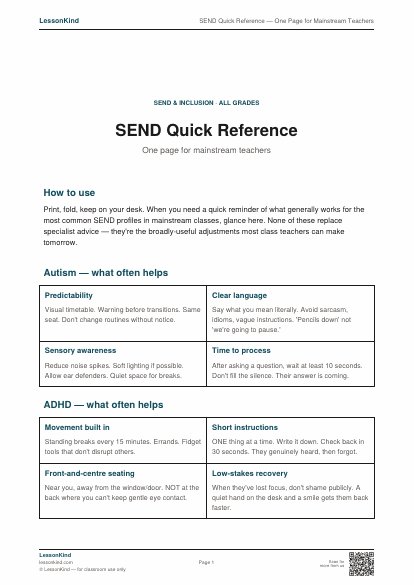
SEND Quick Reference — One Page for Mainstream Teachers
A one-page reference summarising the most useful adjustments for the four most common SEND profiles — autism, ADHD, dyslexia, anxiety. Print and stick on your desk.
Going deeper
Books for supporting struggling older readers
Practitioner-focused books on intervention with KS2 children who still struggle to read.
For teachers and SENCos
For parents at home
Convenience links to Amazon. As an Amazon Associate we earn from qualifying purchases at no extra cost to you. Read our affiliate disclosure.
Keep reading
Reading & literacy
When to Worry About a Five-Year-Old Who's Not Reading Yet
Reception and Year 1 parents worry constantly about their child's reading. Most of the worry isn't warranted. Some of it is. Here's how to tell the difference — and what to do about both.
8 min read
Reading & literacy
Phonics vs Whole Language: The Fight Is (Mostly) Over
The 'reading wars' tore at education for decades. Here's where the science of reading has actually landed — and what it means for your classroom.
8 min read
Reading & literacy
Phonics Screening: A Parent's Honest Guide
Every June, parents of UK Year 1 children worry about a 40-word test their child has to take. Here's what it's actually measuring, what the result means, and what to do about it — including the bit most schools don't tell you.
8 min read