Classroom culture · 5 min read
Five Minutes That Change the Day
The case for the morning meeting (and why most teachers never get round to it)
Published 2026-07-02
Time, in elementary, is everything. There's already too much to fit in. The math block is tight. Reading needs to happen. Science. Social studies. PE. Lunch. The day is bursting. So when someone suggests adding a five-minute MORNING MEETING — a brief class circle to start the day — the response from many new teachers is reasonable: I don't have five minutes.
This piece argues you should make them.
What a morning meeting looks like
Done well, a morning meeting is short — 5–10 minutes — and has three or four predictable parts:
A greeting. The teacher greets the class. The class greets each other. Eye contact, names, smiles. ("Good morning, class." — "Good morning, Miss Patel." — and then children turning to greet the person next to them by name.)
A check-in. Each child says one word for how they're feeling, or holds up fingers (1–5 for how their morning's been). You don't have to discuss; you just notice.
A shared activity. A quick game, a question of the day ("what's something you saw on the way to school?"), a short news item, a thought to consider.
A look ahead. Two sentences about what today will hold. Anything special. Anything that might need flexibility.
That's it. Five minutes. No therapy. No deep emotional sharing. Just a structured way to begin together.
Why it pays back
It tells you who's struggling. Children who arrive at school anxious, hungry, sleep-deprived or worried often hide it well — until they fall apart in math. A morning meeting surfaces this BEFORE the bad moment, when you can do something about it. A child who held up "1" with their fingers needs different attention today than one who held up "5".
It builds belonging. Children who feel SEEN by their teacher and PEERS at the start of the day learn better, behave better, and care more. Belonging is not a soft skill — it's an academic predictor.
It calms the start. Many children come in after a difficult morning at home — rushed, shouted at, bus problems. The first five minutes of school can either compound that or repair it. A predictable, warm morning meeting repairs it.
It teaches turn-taking. Every child gets to speak. Every child gets to listen. This is, for many children, the first time in their day that someone has actually listened to them.
Why teachers skip it (and shouldn't)
It feels indulgent. With everything to teach, sitting in a circle saying good morning can feel like a luxury. It isn't. It's the operating system of the day — without it, every program runs slower.
It's hard at first. The first week of morning meetings is awkward. Children don't know what to do. Some giggle, some refuse, some say something silly. This is normal. By week three it's the part of the day everyone leans into.
It can feel performative. If you're inwardly grumpy, the cheerful greeting can feel false. That's worth honest reflection. Often the meeting becomes more sincere when YOU are the one who needs it most.
A starter version
If 10 minutes feels like too much, start with three:
1) A greeting (60 seconds — go around the circle) 2) A one-word check-in (60 seconds) 3) "Today we will…" (60 seconds — preview the day)
That's three minutes. You can find three minutes. And once you do it for two weeks, you'll start to notice the difference — not in the morning, but in how the rest of the day runs.
For elementary children, the start of the day is the hinge that the whole day swings on. Five minutes there saves twenty later.
Free bundle for this topic
Cover Day Survival Pack
9 resources for cover days and routines, including behavior systems and morning meeting scripts.
Practical resources for this
Take this further
Printable, classroom-ready resources for the topics in this article.
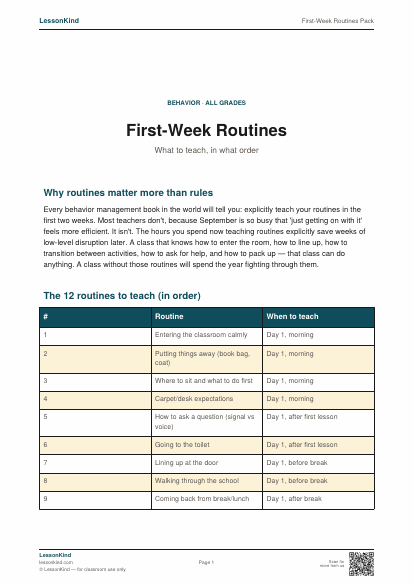
First-Week Routines Pack
The 12 routines you must establish in the first two weeks — entry, transitions, lining up, asking for help, finishing work, end of day. With explicit teaching scripts.
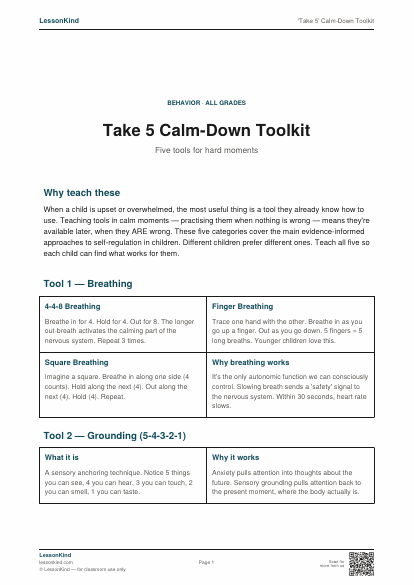
'Take 5' Calm-Down Toolkit
Five evidence-informed calming techniques children can use independently — breathing, grounding, movement, sensory, and cognitive. With age-appropriate adaptations and a take-home card.
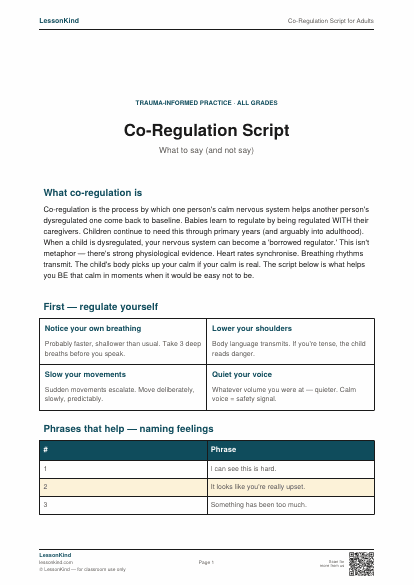
Co-Regulation Script for Adults
What to actually say (and not say) when a child is dysregulated. Phrase by phrase, based on the principles of co-regulation. Useful for the staff briefing.
Keep reading
Behavior & classroom management
The First Two Weeks: The Behavior Foundation You Can't Build Later
Most teachers know the first two weeks matter. Few know how MUCH they matter, or what to do with them. The behavior of your class in June is largely determined by what you do — or fail to do — in September.
8 min read
Classroom culture
Why Your Routines Matter More Than Your Lesson Plans
First-year teachers spend hours on lesson plans and almost no time on routines. The teachers whose classrooms run beautifully have it the other way around.
6 min read