Behavior & Classroom Management
First-Week Routines Pack
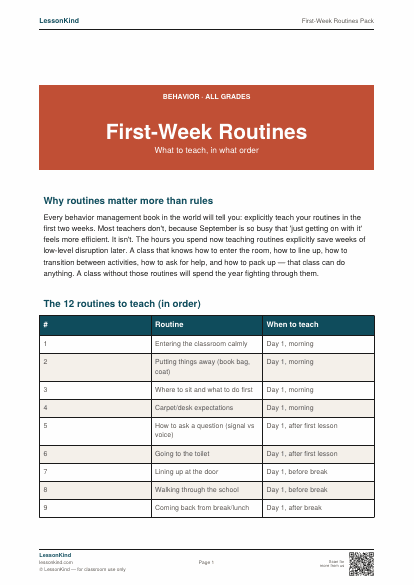
The 12 routines you must establish in the first two weeks — entry, transitions, lining up, asking for help, finishing work, end of day. With explicit teaching scripts.
Preview
Page count: 6. Print-ready PDF — letter / A4 friendly. Click image to see all pages.
Learning objective
Set up and explicitly teach the routines that make the rest of the year run smoothly.
About this resource
- Subject: Behavior & Classroom Management
- Type: Checklist
- Grade levels: Kindergarten (ages 4-6, ≈ Reception / Y1), Grade 1 (ages 6-7, ≈ Year 2), Grade 2 (ages 7-8, ≈ Year 3), Grade 3 (ages 8-9, ≈ Year 4), Grade 4 (ages 9-10, ≈ Year 5), Grade 5 (ages 10-11, ≈ Year 6), Grade 6 (ages 11-12, ≈ Year 7)
- Pages: 6
- Date added: 2026-09-01
- Credit: Qualified primary teacher
Books on setting up routines and expectations
Convenience links if you'd like to look any of these up. We've recommended these books in the resource above.
Essential reading
- W When the Adults Change, Everything Changes — Paul Dix
- R Running the Room: The Teacher's Guide to Behaviour — Tom Bennett
- T Teach Like a Champion 3.0 — Doug Lemov
Classroom supplies for routines
- V Visual timetable cards classroom display
- C Classroom rules poster A2 display
- N Noise level chart traffic light display
Disclosure: Links above go to Amazon. LessonKind may earn a small commission if you buy via these links — at no extra cost to you. We only link to books and items we already recommend in our resources. We are not paid by Amazon to recommend specific titles.
Part of these collections
Curated bundles where this resource appears alongside related ones.
Read more about this
Articles that go deeper on the topic this resource covers.
First-year teaching · 7 min read
Five Mistakes I Made as a New Elementary Teacher
If I could go back and shake my first-year teacher self by the shoulders, here's what I'd say.
Classroom culture · 6 min read
Why Your Routines Matter More Than Your Lesson Plans
First-year teachers spend hours on lesson plans and almost no time on routines. The teachers whose classrooms run beautifully have it the other way around.
Classroom culture · 6 min read
The Most Important Week of the Year
Most teachers think the first week is for getting to know the children. The teachers whose classrooms run beautifully use it for something quite different.
Classroom culture · 5 min read
Five Minutes That Change the Day
A short, deliberate morning circle changes how the rest of the day runs. Here's why it works — and why teachers who skip it end up paying for it.
Teacher wellbeing · 7 min read
Why September Feels So Hard (And Why That's Normal)
Every teacher knows September is hard. Fewer know that October is harder, that November is the lowest point, and that the system more or less requires you to push through. Here's what to expect and how to survive it.
Behavior & classroom management · 8 min read
The First Two Weeks: The Behavior Foundation You Can't Build Later
Most teachers know the first two weeks matter. Few know how MUCH they matter, or what to do with them. The behavior of your class in June is largely determined by what you do — or fail to do — in September.
First-year teaching · 7 min read
What They Don't Tell You in Teacher Training
Teacher training prepares you for lesson planning. It does not prepare you for what your first term as a class teacher actually feels like. Here's the honest version.
First-year teaching · 6 min read
The First Week of School (and How Not to Wreck It)
The first week of school sets the tone for the entire year. Most NQTs spend it doing the wrong things. Here's what experienced teachers prioritise.
First-year teaching · 5 min read
Managing the Class You Inherited
Inheriting a class with established habits — good and bad — is harder than starting fresh. Here's how to reset without blaming the previous teacher.
Classroom culture · 5 min read
The Classroom Rules Paradox
Many classrooms have detailed rules covering every situation. The research suggests this approach actively backfires. Here's what works instead.
First-year teaching · 6 min read
Working With Your Teaching Assistant
Your teaching assistant is in the room with you every day. How you work together determines what kind of room it is. Most teacher training says almost nothing about this — here's what actually helps.
First-year teaching · 6 min read
The ECT Induction: What Actually Matters in Your First Two Years
The ECT induction (formerly NQT) spans two years, involves formal observations, mentor meetings, and a mountain of paperwork. Here's what actually matters and what you can let go of.
You might also like
Selected based on subject, grade, and type — with a free option always included.
Behavior Reflection Sheets — Three Age Levels
Three age-graded behavior reflection sheets — KS1 (drawing-led), lower KS2 (simple sentences), upper KS2 (full restorative reflection). Print, keep handy, use as the structure for a calm one-to-one.
30 Brain Breaks for Primary Classrooms
30 brain break activities organised by purpose — energising, calming, focusing, social. Each is 1-3 minutes, no resources needed. Print, laminate, draw one when needed.
Behavior Books That Actually Help — Practitioner Reading List
A curated reading list for primary teachers wanting to read seriously about behavior — restorative practice, classroom management, the children who don't fit, and the wider thinking on relational schools.
Classroom Rules Poster (Three Principles)
Principle-based classroom rules — Be Safe, Be Kind, Be Ready to Learn — with concrete examples for each. Based on the article 'The Classroom Rules Paradox'.
Calm Corner Steps Poster
5-step regulation poster for the calm corner — what children can do when they feel overwhelmed. Based on trauma-informed practice.
Carpet & Lining-Up Expectations Poster
A two-poster set showing exactly what 'good carpet' and 'good lining up' look like. Visual support for younger children — print A3, mount where children can see.