Parent communication · 5 min read
How Much Homework Should My Primary Child Have?
What the evidence says — and what to do if there's too much or too little
Published 2026-05-12
Almost every parent of a primary school child has an opinion about homework. Some feel there's too much — it eats into family time, causes stress, and shouldn't be a feature of childhood. Others feel there's not enough — their child should be doing more practice at home. The school newsletter almost always promises to 'strike the right balance', without specifying what that balance is.
Here's what the research actually says — and what it means for you.
What the research shows
For primary school children (roughly ages 5–11), the research evidence on homework is genuinely mixed. Unlike secondary school homework — where there is clear evidence of positive effects — primary homework has been studied extensively and the results are considerably less clear.
The most robust finding: reading at home has a significant positive effect on literacy development across all age groups. This is one of the most consistent findings in educational research. Reading with a child, and supporting a reading habit, makes a measurable difference.
On other forms of homework at primary age: the effects are much smaller and vary widely depending on the type of homework, how it's set, and how it's used in school. Practice tasks (times tables, spelling) can have positive effects when they reinforce learning that has happened in class. But long, complex homework tasks — especially those that require significant parental support — show very little evidence of academic benefit at primary age.
The one clear negative effect: homework that causes significant family stress or conflict is associated with negative attitudes toward school. A child who dreads the Sunday evening homework battle is building an association between learning and anxiety.
What a sensible homework policy looks like
A reasonable primary homework expectation: - Daily reading (10–20 minutes) - Times tables practice (5–10 minutes, especially in Years 3 and 4) - Occasional spellings to practise - The odd longer project once or twice a term
Most primary schools in England follow guidance suggesting no more than 1 hour per week for Key Stage 1 (Years 1–2) and 1.5 hours per week for Key Stage 2 (Years 3–6). If what your child is being sent home with significantly exceeds this, you have grounds to raise it.
If there's too much homework
If your child is regularly spending more than these guideline times on homework, or if homework is a consistent source of distress, it's worth speaking to the teacher. Be specific: 'This week's maths homework took about 45 minutes, which felt like too long — is that expected?' This is usually well-received and often results in useful clarification.
You are also allowed to make a pragmatic decision as a parent: stop when you've done enough. An incomplete piece of homework handed in with a note is better than 90 minutes of family conflict. Most teachers would agree.
If there seems to be not enough
Some parents feel their child's school sets very little homework. If you want to support your child's learning at home beyond what's set, the most valuable things are also the simplest: read together, practise times tables, talk about what they're learning at school. These are more effective than any additional worksheet.
The one thing that matters most
Whatever your school's homework policy, the habit that matters most in the long run is reading. A child who reads for pleasure at home — consistently, across the primary years — enters secondary school with significant advantages in vocabulary, comprehension, general knowledge, and writing. No other homework habit comes close to this in terms of lasting impact.
If there's one investment to make in your child's home learning, it's building a reading habit they'll carry into adulthood.
Practical resources for this
Take this further
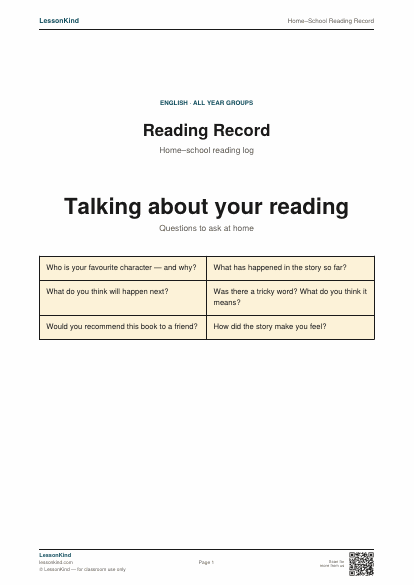
Printable, classroom-ready resources for the topics in this article.
Keep reading
Teaching strategy
Homework: What the Evidence Actually Says
Homework is one of the most-debated and least-evidence-based parts of elementary education. Here's a straight-talking summary of what we know.
7 min read
Teaching strategy
The Purpose of Homework (And Why Most Schools Get It Wrong)
Homework is one of the most contentious parts of primary education. The research is clearer than schools admit. Here's what works, what doesn't, and why.
5 min read
Parent communication
How to Help Your Primary Child With Reading at Home
Reading at home matters, but the approach makes all the difference. Here's what the research says about how parents can genuinely support a child's reading — and what to avoid.
7 min read