Teaching strategy · 8 min read
How Music Coordinators Actually Run a Primary Music Programme
What the role actually involves — the Christmas production politics, the staff who can't sing, the recorder cupboard, and the quietly important work of building children who love music
Published 2026-11-10
Every primary school has someone running music. The job titles vary — Music Coordinator, Music Lead, Subject Lead Music — and the role is sometimes held by a music specialist, but more often by a general class teacher with some musical confidence and a willingness to say yes when asked.
What the role looks like from the outside is mostly visible at the Christmas production and the leavers' assembly. What it looks like from the inside is a year-round operation involving curriculum planning, repertoire selection, instrument management, staff CPD, peripatetic music teacher contracts, parent permissions, and the slow patient work of keeping music alive in schools where the academic pressure to focus on maths and English never lets up.
This article is about what the role actually looks like from the inside. It's written for Music Coordinators themselves, for class teachers who work alongside one (it'll explain what they're carrying), and for school leaders deciding what the role actually needs.
The role from the inside
A primary music coordinator holds: the music curriculum across 7 year groups, weekly singing assemblies, the Christmas production, sometimes a spring concert, the leavers' performance, the school choir if there is one, peripatetic music teacher contracts, the instrument cupboard, the music budget, the SSP-equivalent decision (which scheme of music? Charanga? Sing Up? Out Of The Ark?), and the support of the staff team who deliver weekly music lessons in classrooms across the school.
Music in primary occupies a strange position. It's a statutory subject — children are entitled to it. But it's also vulnerable to being squeezed when SATs pressure rises in spring or when the curriculum is "tight." Headteachers under pressure to lift maths and English data sometimes implicitly accept that music gets less time. The Music Coordinator's job is sometimes simply protecting that 30 minutes a week.
The role is rarely as supported as English or Maths Lead. Music Coordinators often have less release time, smaller budgets, and less SLT engagement. This makes the role both more autonomous (nobody is checking) and more isolated (nobody is helping).
The annual cycle
Music Coordinator work follows a calendar that's quite different from English or Maths.
**September.** Confirm peripatetic teacher schedule. Audit instrument stock — what survived the summer? Confirm scheme subscription is current. Brief new staff on how the school does music. Plan first half-term repertoire for assemblies.
**October-December.** The Christmas production dominates. Eight weeks of preparation: scope agreed with the head in early October, song list distributed to class teachers in week 2, rehearsals from week 5, dress rehearsal week 7, performance(s) week 8 (mid-December). The Christmas production is often the single biggest project the Music Coordinator runs all year, and it's emotionally important to parents in ways the Music Coordinator may not fully control.
**January-March.** A quieter period operationally — though this is when the strategic work happens. Music week planning. Spring concert if there is one. Y4 instrumental programme if applicable. CPD for class teachers on music delivery.
**April-July.** Y6 leavers' performance preparation. Music week (often a themed week celebrating different cultures or genres). Final concerts. Audit and plan for next year. Many Music Coordinators do their best curriculum review work in July.
The cycle repeats every year. The repertoire bank grows. The instrument cupboard slowly improves. The staff team's music delivery — slowly, sometimes — gets better.
The Christmas production politics
The Christmas production is a real test of the Music Coordinator role. It involves:
- Agreement with the head about scope (nativity? songs only? full show with script? two evening performances? one daytime plus one evening?) - Repertoire selection that balances tradition, cultural diversity, and what the children can actually pull off - Coordination with class teachers — who are doing what, who's leading which song - Costume coordination, often with parent volunteers - Technical setup (sound, lights, staging) - Communication with parents about dates, ticketing, photography - Managing the children's emotional energy in the final week — they're usually exhausted and excitable
Done well, the Christmas production is the cultural high point of the autumn term. Done badly, it's a stress event that exhausts the Music Coordinator and leaves staff and parents disgruntled.
The single most important conversation is the one with the head in early October: what scope are we doing this year? Get it agreed in writing. Mid-November scope creep — "could we add a sing-along ending?" — is what kills Music Coordinators. The scope is locked, or it becomes uncontrolled.
The "I can't sing" problem
About one in three primary teachers feel unconfident in music. Many genuinely struggle to carry a tune. Many carry music-related anxiety from school. Most are uncomfortable being asked to sing in front of children — especially in front of older children who notice.
The Music Coordinator's job here is structural rather than persuasive. Telling teachers "you can sing, just try harder" doesn't work. What works is changing what's required of them.
A class teacher delivering music doesn't have to sing well. They can:
- Use a backing track and let the recording lead the singing - Mouth or quietly join in rather than carrying the melody - Lead listening lessons (no singing required) - Use body percussion (no singing required) - Identify a confident child to lead the singing while they direct - Be honest with the class: "I'm not the strongest singer but you are — you lead and I'll keep us together." Children respond well to this.
The Music Coordinator builds these alternative pathways into the school's approach. Teachers who feel safe can deliver music; teachers who feel exposed shut down. The structural work matters more than the persuasive work.
The instrument cupboard
Most primary schools have £500-£3000 of school-owned instruments — recorders, ukuleles, glockenspiels, tambourines, claves, hand bells. Without active management, this stock degrades quickly. Mallets break. Bells lose their strikers. Tambourines lose their skins. Recorders disappear.
The Music Coordinator's quiet ongoing job is keeping the cupboard usable:
- An instrument loan tracking system (sign-out, sign-in, condition log) - Parent permission slips for any take-home loans (otherwise replacement cost falls on the school) - An annual audit in July (what's lost, what's broken, what needs replacing) - A budget conversation with the head each year - Storage that's labelled, accessible, and child-proof
The schools that keep their instrument stock healthy do this consistently. The schools that don't end up with cupboards full of broken or unidentifiable instruments and have to start from scratch every 5-7 years.
The cultural work
Underneath all the operational work is the question that most matters: are children leaving primary school still loving music?
Music is one of the subjects where primary years can either hook children for life or put them off entirely. The same children who joyfully sing in Reception can — if it's done badly — be the Y6 children who refuse to sing because they think they're not good enough.
Building a school where children stay engaged with music involves:
- Daily or near-daily music — not just one 30-minute lesson per week - Wide repertoire across cultures and genres - Listening lessons that genuinely engage, not just play music while children draw - Performance opportunities at the children's level (not just polished concerts) - Adult enthusiasm — staff who openly love music, even if they "can't sing" - Connection to wider musical life (visiting musicians, community choirs, secondary music departments)
This work is invisible in OFSTED data. It rarely shows up in spreadsheets. It is, however, what genuinely matters — and what a Music Coordinator gets up for.
The hardest parts
Three things make the role uniquely demanding.
**The Christmas production weight.** Every Music Coordinator carries the Christmas production in their head from October to mid-December. It's an enormous emotional and operational lift. It can't be delegated. It either works, or it doesn't, and the difference is visible to 200+ parents on the same evening.
**The squeezing pressure.** When SATs pressure rises in spring, music time gets quietly compressed. Head doesn't always say so explicitly, but the curriculum tightens. Music Coordinators learn to hold the line on minimum delivery without making the head feel attacked.
**The under-resourced position.** Music Coordinators often have less release time and less budget than English or Maths Leads. The role can feel less institutionally backed. Music Coordinators who last in the role find ways to make it sustainable despite this.
What helps
For Music Coordinators navigating the role, a few things consistently help:
- A scope-locked Christmas production. Get it agreed in early October. - A scheme that's genuinely usable by non-specialists. Charanga, Sing Up, Out Of The Ark all work; pick one and embed it. - Backing tracks for everything. Reduces the singing burden on uncertain class teachers. - A peer network. Local music hubs, Music Mark, the network of primary music coordinators. Doing this in isolation is harder than it needs to be. - Realistic expectations. Most schools won't become music specialist schools. The goal is good-enough music delivered consistently across all year groups.
For class teachers reading this
If your Music Coordinator seems harassed in November and December, they probably are. The Christmas production is enormous. Three things class teachers can do that genuinely help:
- Take the songs they ask you to teach seriously. Practise them daily, even briefly. Children learning songs in fragments produce a Christmas production that doesn't quite work. - Don't push back on song choice unless there's a substantial reason. The Music Coordinator has thought about it. - Volunteer for one specific job at the production (costumes, props, behind-stage management). The Music Coordinator can't do everything alone.
For headteachers
If your Music Coordinator is reading this, three things you can do that genuinely help:
- Protect their non-contact time, even when it's tempting to redirect it elsewhere. - Fund a scheme subscription that's appropriate to your school. Free options exist (Sing Up has free elements; YouTube has resources) but a coherent scheme is worth the £200-£600 a year. - Back the curriculum protection. When SATs pressure tries to compress music to nothing in spring, hold the line on the minimum 30 minutes a week.
The role in one sentence
A Music Coordinator's job is to make sure children at the school have access to good music — to listen to, to make, to perform — regardless of which teacher they have or how the SATs pressure is going.
Done well, the children leave still loving it.
Practical resources for this
Take this further
Printable, classroom-ready resources for the topics in this article.
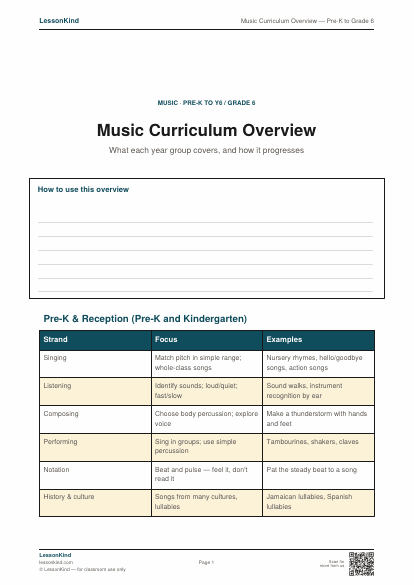
Music Curriculum Overview — Pre-K to Grade 6
A whole-school music curriculum overview showing what each year group covers, how skills progress, and how assessment connects across the years. Designed for music coordinators working with non-specialist class teachers who need to know what comes before and after their year.
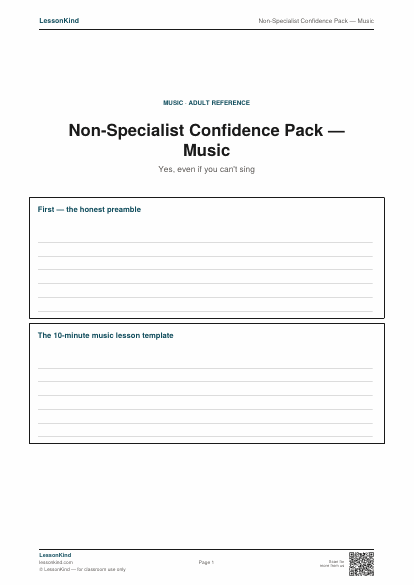
Non-Specialist Confidence Pack — Music
For class teachers who 'can't sing' or 'don't know music' but have to deliver music lessons. Practical confidence-builders, scripts for what to say, low-stakes activities that work even if you can't carry a tune. Written by people who understand the anxiety.
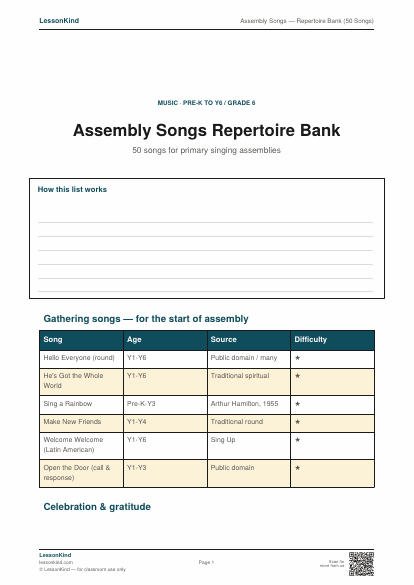
Assembly Songs — Repertoire Bank (50 Songs)
Fifty songs suitable for primary school assemblies, organised by theme (gathering, celebration, gratitude, kindness, multicultural, seasonal). Each entry notes age range, key, source, and rough difficulty. The reference document a music coordinator wishes they had on day one.
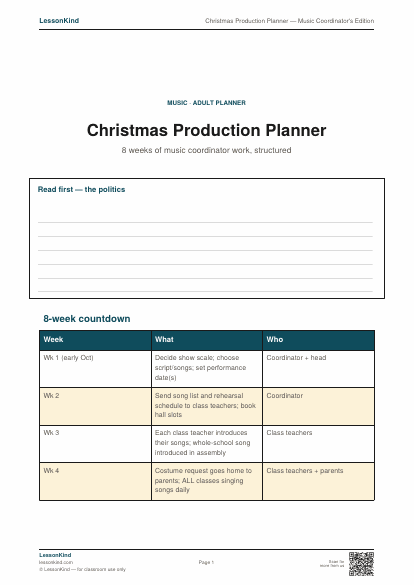
Christmas Production Planner — Music Coordinator's Edition
An 8-week countdown plan for delivering a primary school Christmas production. Includes the song-list-to-send-to-class-teachers, rehearsal schedule, technical requirements, and the conversations to have with the head before the project starts.
Classroom Percussion Starter Kit — Coordinator's Setup Guide
What instruments to buy, how many, how to store them, and how to roll them out so they last. The setup guide for coordinators starting from scratch — or refreshing an inherited cupboard chaos.
Instrument Loan Tracker — Template Pack
Templates for tracking school instrument loans (recorders, ukuleles, glockenspiels, etc.) — sign-out/sign-in sheet, condition log, parent-permission slip, end-of-year audit checklist. Replaces the chaos of 'whose ukulele is this?'
Keep reading
Reading & literacy
How English Leads Actually Run Their Schools' Reading Culture
An honest account of what English Lead work actually involves at primary — the phonics scheme decision, building a school where children genuinely want to read, the staff team's varying confidence, and the long arc of cultural change that can take 3-5 years to embed.
9 min read
Math
How Maths Leads Actually Run Their Calculation Policy
An honest account of what Maths Lead work actually involves at primary — the calculation policy that depends on every teacher doing it the same way, the manipulatives that sit unused in upper KS2, the staff team carrying their own maths anxiety from school, and the long work of building fluency.
9 min read
EAL & inclusion
How SENDCos Actually Run Their Cases
SENDCo is one of the most demanding roles in primary, done by people on a fraction of a day's release. This is what the role actually looks like from the inside — the cycles, the decisions, the difficult conversations, and the rhythms that separate the SENDCos who burn out from the ones who last.
9 min read