EAL & inclusion · 9 min read
How SENDCos Actually Run Their Cases
What the role looks like from the inside, why it's harder than the job description suggests, and the rhythms that make it sustainable
Published 2026-10-31
Every primary school in the UK has a SENDCo. Most US elementary schools have an equivalent (Inclusion Coordinator, Special Education Lead, varies by district). The role is statutory in the UK; the SEND Code of Practice gives it specific duties around identifying need, coordinating provision, working with parents, and writing or reviewing EHC plans.
What the statutory framework doesn't capture is what the role actually feels like from the inside. SENDCo is one of the most demanding jobs in primary, usually done by someone who is also a class teacher, behaviour lead, or assistant head. The release time is typically half a day a week. The caseload runs to 30, 50, sometimes 80 children with varying levels of identified need. The annual paperwork cycle is unforgiving.
This article is about what the role actually looks like from the inside — the cycles, the decisions, the difficult conversations, and the rhythms that separate SENDCos who burn out from the ones who last.
It's written for SENDCos themselves (you'll recognise things), for class teachers who work with SENDCos (it'll explain why your SENDCo seems harassed), and for school leaders deciding what kind of support the role actually needs.
The annual cycle
Most external accounts of SENDCo work focus on individual children. The reality is that SENDCo work is structured by an annual cycle that has rhythms most class teachers never see.
**Autumn term.** Settling in new EHCP children, drafting initial concerns lists from class teachers, first parent meetings of the year, autumn EHCP reviews (most LAs do annual reviews on a rolling basis, but autumn is heavy). New referrals to the SENDCo from teachers who've spent the first half-term observing children.
**Spring term.** EHC plan work peaks. Statutory annual reviews require formal meetings with parents, professionals, and the LA. Each one involves preparing reports, gathering evidence, coordinating attendance. SENDCo time can be 40-50% absorbed in EHCP work alone during peak weeks. Meanwhile, new identifications keep coming.
**Summer term.** Year 6 transition planning to secondary (this is enormous — every Y6 child with SEND needs careful handover, often with multiple secondary schools to liaise with depending on parent choice). Year 1 transition prep from EYFS. Late-spring EHCP reviews. End-of-year reports. Then the slower bit — SEND development work, CPD planning for staff, writing the next year's SEND policy update.
**Holidays.** Most SENDCos do meaningful work in holidays. EHC paperwork is impossible to keep up with during term time. The Easter and summer holidays are often the only time for sustained writing.
This is the structural reality: the role is more like project management on a 12-month cycle than like teaching. The decisions are different. The successes are diffuse. The pressure points are different from class teaching pressure.
The case management problem
Most SENDCos manage 30-80 active cases at any time. Of those:
- **5-10 are EHCP children** — formal local-authority-issued plans. Each requires statutory annual review, monitoring of provision, liaison with external professionals, reports for the LA. - **15-30 are SEN Support level** — identified need, on the school's own tracking system, with documented provision but no statutory plan. Needs are reviewed termly with class teachers. - **20-40 are 'monitoring'** — children where there's a concern but the picture isn't yet clear. Watch and wait, or watch and gather evidence for possible referral. - **A handful are pre-identification** — class teacher has flagged something but nothing's formal yet. SENDCo's job here is judgement: is this a need, or a developmental thing, or a teacher-pupil mismatch, or something else?
Holding all of this in your head while also (usually) teaching a class is genuinely difficult. The SENDCos who manage it well almost always have systems — tracking sheets, rotation schedules, named termly review windows. The ones who don't have systems usually rely on memory, and memory eventually fails. A child slips through. A review gets missed. A parent emails to ask why nothing's happened with their concern from October.
The case management problem is the hardest unsupervised part of the role. Class teaching has a timetable. SENDCo work has only the cycle, and the cycle has too many things in it.
What class teachers don't see
Class teachers see the SENDCo when they have a concern, when there's a meeting, or when the SENDCo comes in to observe. What they don't see:
**The parent meetings.** A SENDCo might do 4-6 parent meetings in a typical week, on top of teaching. Each one needs preparation (the parents have records, you need to read them; you need to know the latest assessment data; you need to know what the class teacher has tried). Each one needs a follow-up note. Each one might generate an action that needs scheduling.
**The professional liaison.** Educational psychologists, speech and language therapists, occupational therapists, CAMHS, social workers. The SENDCo coordinates with all of them. Phone calls, emails, scheduling joint observations, reading reports, writing reports back. None of this is visible from a classroom.
**The LA paperwork.** EHC plan applications, annual review forms, top-up funding applications, transition documentation. This is genuine bureaucracy with deadlines and consequences for getting it wrong. A delayed annual review can mean a child loses funding.
**The judgement calls.** A class teacher says "I think Sam might have ADHD." The SENDCo's job is to think: is this an ADHD picture, or is it boredom, or trauma, or unmet need at home, or a clash with this specific teacher? Wrong call in either direction has costs. Pushing too fast for assessment when it's not the right fit pathologises children unnecessarily. Pushing too slow when it IS the right fit means months of unnecessary struggle.
**The conflict.** Parents who want assessments their child won't qualify for. Parents who refuse assessments their child needs. Class teachers who want a child OUT of their class (sometimes for legitimate reasons, sometimes not). LA officers who push back on EHC plans for budget reasons. Headteachers who want quick fixes the SENDCo knows aren't possible.
These are the hard parts that don't show up in any job description.
The decision-making patterns that work
SENDCos who last and run good provision tend to share specific decision-making patterns. Worth naming because they're learnable.
**They distinguish between "needs" and "wants" early.** A class teacher saying "I want this child assessed for autism" is sometimes a need (they need help) and sometimes a want (they want the child to be someone else's problem). Both are legitimate, but they call for different responses. The SENDCo who treats every referral identically misses the texture.
**They protect their judgement from external pressure.** Parents pushing for diagnosis, teachers pushing for removal, LAs pushing for cheaper solutions — all generate pressure. The good SENDCos resist letting pressure substitute for evidence. "I can see why you want X. Here's what we'd actually do." Polite, firm, evidence-led.
**They build the staff team's capacity, not just their own.** The SENDCo who tries to be the sole expert burns out by Christmas. The SENDCo who runs short, regular CPD with class teachers — "this term let's all get better at autism-friendly routines" — distributes the work. Class teachers become more capable. The SENDCo's caseload still has 80 cases but the pressure on each one is lower because the classrooms can hold more.
**They write things down.** Verbal agreements with parents, action items from meetings, observations of children — written, dated, filed. This is partly defensive (records protect against later disputes) but mostly cognitive: with 80 cases, the human brain genuinely cannot remember what was agreed in March.
**They protect non-meeting time.** A SENDCo who's available to anyone any time has no time to think. The good ones block out windows for paperwork, observation, planning, and treat them like teaching periods — non-negotiable to other adults.
**They escalate appropriately.** When a child needs more than school can offer, the SENDCo's job is to ask the LA for more — politely, formally, with evidence. The SENDCo who tries to absorb everything at school level fails the child and burns themselves out. Knowing when to push paperwork up is part of the role.
What separates burnout-SENDCos from sustainable ones
Most SENDCos burn out within 5-7 years of taking the role. The ones who last 15+ years usually have specific habits.
**They don't try to know every child personally.** They know the EHCP children deeply, the SEN Support children moderately, the monitoring children at a tracking-sheet level. Trying to be the personal advocate for 80 children is the fastest path to burnout.
**They have a working relationship with their head.** Heads either get SEND or don't. The SENDCos who last either work at schools where the head genuinely understands the role, or they actively educate their head about what the role requires. SENDCos at schools where the head sees SEND as an inconvenience rarely last.
**They take their release time as actual release time.** Not "release time but I'll cover this Y4 absence." Not "release time but I'll catch up on marking." Actual release time, in the office, for SENDCo work. This is hard to defend but matters enormously.
**They have a network outside their school.** Local SENDCo forums, regional networks, online groups. SEND work is unique enough that other people in the school often can't help. A SENDCo with a peer network has people to consult on tricky cases, share template documents, and decompress with.
**They keep up with research without obsessing.** Not every new framework needs adopting. The SENDCo who spent 2018 implementing one trauma-informed framework, 2019 implementing another, 2020 implementing zones of regulation, 2021 implementing emotion coaching, ends up with staff who've stopped listening. Pick the frameworks that fit your school, embed them, leave them alone.
**They genuinely like the children.** This sounds obvious but isn't. SENDCos who took the role for the management upgrade rarely last. The ones who took it because they care about the children with hardest profiles tend to find energy for the bad days.
What schools can do better
Most heads aren't trying to undermine their SENDCo. Most just don't know what would help.
Things that genuinely help:
- **Adequate release time.** The Code of Practice says "appropriate," which most schools interpret as half a day. For caseloads over 40, half a day isn't enough. A full day matters. - **Admin support.** A part-time office support person who can chase paperwork, schedule meetings, file reports — this is the single highest-impact intervention. Few schools fund it. It pays back in SENDCo retention. - **Standing meetings, not crisis meetings.** A weekly 30-minute SENDCo-and-head meeting prevents most crises. Sporadic emergency meetings burn both parties out. - **Recognising the cycle.** Spring is the heavy term. Pile less on a SENDCo in spring than in autumn. - **Backing up their judgement publicly.** When parents push back, the head should default to backing the SENDCo's professional judgement (with private review if there are real concerns). Public undermining destroys trust. - **Funding their CPD.** SEND CPD is constantly available; budget rarely is. £500-£1000 a year for SENDCo-specific CPD is peanuts in school terms and transformative in role terms. - **Pay it properly.** SENDCo pay (often a small TLR2 or no extra pay at all) doesn't reflect the role. Schools that recognise this with appropriate pay keep their SENDCos.
Things that don't help:
- "Have you tried being more positive?" - Treating SENDCo like a clerical role - Assuming SEND issues should resolve themselves with adequate teaching - Treating SEND as an inconvenience that's getting in the way of "real" school priorities - Surprising the SENDCo with a parent meeting they didn't know about
What parents could do better
If you're a parent of a child with SEND, your SENDCo is mostly trying to help you. They're also overwhelmed.
Things that help:
- **Email rather than calling for non-urgent things.** SENDCos are often teaching. An email gets answered when they're at their desk; a phone call interrupts a lesson. - **Be specific about what you're asking.** "I'd like a meeting about Sam's reading" is more useful than "I'm worried about Sam." - **Bring written notes to meetings.** Helps you remember what to ask. Helps the SENDCo write follow-up notes accurately. - **Wait a few days for non-urgent replies.** A SENDCo at a typical primary has 30+ active parent contacts. 48 hours is reasonable. - **Understand the LA isn't the SENDCo.** When the LA refuses funding or assessment, the SENDCo isn't the gatekeeper. They often agree with you. - **Recognise effort separately from outcomes.** Outcomes for SEND children are often slow. The SENDCo can be working hard for your child without yet having visible results. Both can be true.
Things that don't help:
- Repeated emails escalating in tone over the same week - Treating the SENDCo as the cause of a slow LA decision - Comparing your child's provision to other children's openly - Assuming the SENDCo doesn't care because results haven't appeared yet
A note on the SENDCos who quit
A real proportion of SENDCos quit the role within a few years. They don't always tell you why. The honest reasons usually include:
- The case load is unsustainable on the time available - The role lacks recognition - The pay doesn't reflect the work - The conflict (with parents, LA, sometimes own staff) is exhausting - The paperwork is genuinely too much - The head doesn't back them up
When good SENDCos leave the role, they often leave SEND work entirely. That's a loss the school doesn't always notice for a year — until the new SENDCo, who doesn't yet know the children or the systems, starts making different decisions and parents start calling.
A final word
SENDCo work, done well, is one of the most valuable roles in primary education. The children whose lives are made meaningfully better by good SENDCo provision usually don't know who to thank. The schools where SEND runs well are usually schools where the head actively values the role, the SENDCo has reasonable infrastructure, and the SENDCo themselves has habits that keep them sustainable.
If you're a SENDCo reading this: most of what makes the role hard isn't your fault. The system is genuinely under-resourced for what it asks. Protect your time. Build your network. Write things down. Distinguish the children's needs from the adults' wants. Take your release time. Don't try to be the personal advocate for every case.
If you're a head reading this: your SENDCo is doing more than you can see. The single best return on investment is admin support and adequate release time. The cheapest investment is publicly backing their judgement.
If you're a class teacher reading this: when you refer a child to the SENDCo, the most useful thing you can do is be specific. "Sam can't sustain attention beyond five minutes; I've tried these three things; here's what I notice happening" is far more useful than "I think Sam has ADHD." The first lets the SENDCo work. The second forces them to start from scratch.
If you're a parent reading this: your SENDCo is probably trying. The frustrations you feel about the SEND system are usually correctly aimed at the LA and the funding model rather than at your child's school. The SENDCos most worth knowing are the ones who'll level with you about what's possible and what isn't.
The role is structurally hard, often invisible, and disproportionately important. The people who do it well — who last, who hold the cases, who know the children, who keep their judgement intact under pressure — are running a quiet machinery that most schools couldn't function without.
Free bundle for this topic
SEND Inclusion Toolkit
7 essential SEND resources covering autism, ADHD, dyslexia and emotional regulation.
Practical resources for this
Take this further
Printable, classroom-ready resources for the topics in this article.
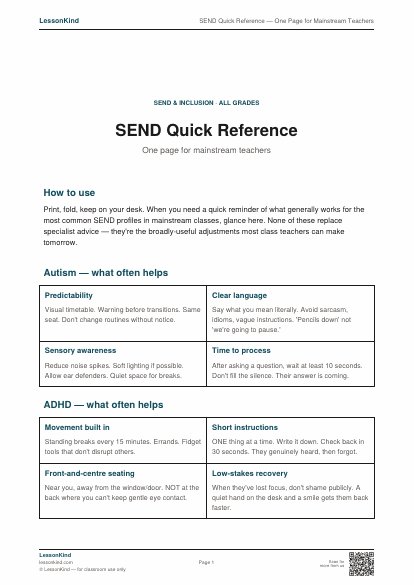
SEND Quick Reference — One Page for Mainstream Teachers
A one-page reference summarising the most useful adjustments for the four most common SEND profiles — autism, ADHD, dyslexia, anxiety. Print and stick on your desk.
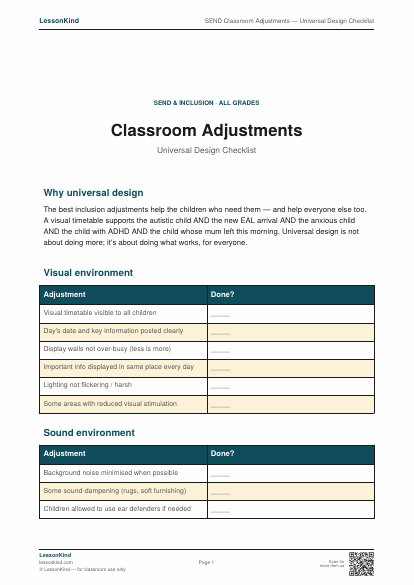
SEND Classroom Adjustments — Universal Design Checklist
A walk-through audit of adjustments that benefit children with SEND but help everyone else too. Audit your classroom in 15 minutes.

Pupil Passport Template — Know This Child
A one-page profile of a child with SEND — strengths, what helps, what doesn't, who to contact. Print one per child, share with supply teachers and TAs.
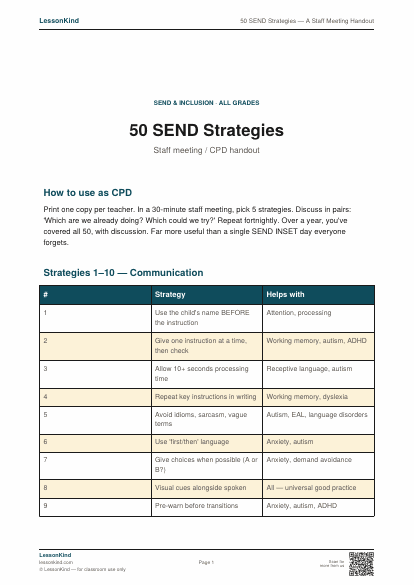
50 SEND Strategies — A Staff Meeting Handout
50 specific, named, takeaway-able strategies for supporting children with SEND in mainstream classrooms. Use as a CPD handout — discuss 5 a fortnight.
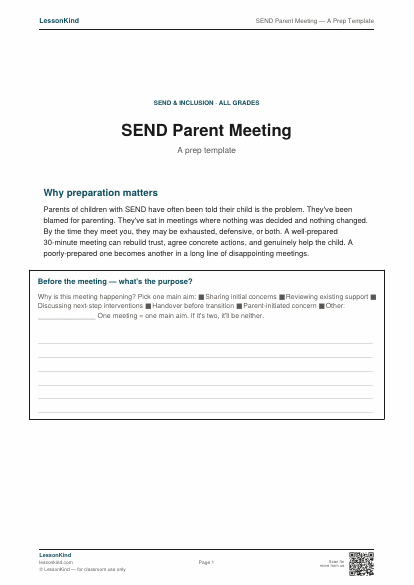
SEND Parent Meeting — A Prep Template
A template for preparing for parent meetings about a child with SEND — what to say, what to listen for, and how to leave with concrete next steps.
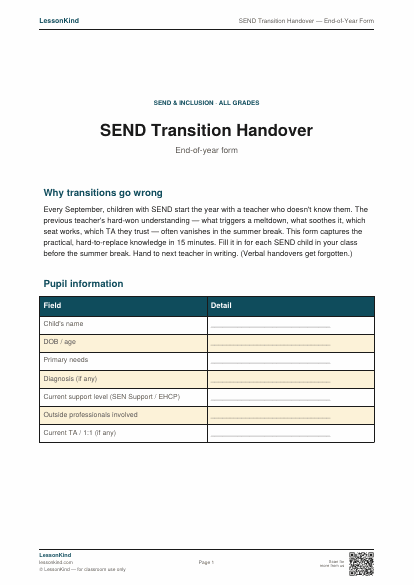
SEND Transition Handover — End-of-Year Form
A handover form for passing SEND information to a child's next teacher — strengths, what works, what to watch for, contacts. The information that often gets lost between July and September.
Going deeper
SENCo — professional reading
Reading for SENCos and aspiring SENCos.
SEND practitioner
Convenience links to Amazon. As an Amazon Associate we earn from qualifying purchases at no extra cost to you. Read our affiliate disclosure.
Keep reading
EAL & inclusion
Understanding the Autism Spectrum in Primary School
Most teachers will have at least one autistic child in their class. Most teacher training spends maybe an hour on autism. This article fills in the gap: what the spectrum actually looks like, what helps, and the things teachers commonly get wrong.
9 min read
EAL & inclusion
ADHD Isn't a Lack of Attention — and Why That Matters
The label is the worst part of the diagnosis. ADHD is not 'attention deficit' — it's an attention regulation difference, and that distinction changes almost everything about how schools should respond.
8 min read
Behavior & classroom management
What Trauma-Informed Teaching Actually Means in Year 4
'Trauma-informed' has become a school slogan, sometimes deployed by leadership without actually changing anything. This article is about what genuinely changes when the framework is taken seriously — and what doesn't.
9 min read
Behavior & classroom management
When the Kids Who Need You Most Are the Ones You Find Hardest
The marble jars and traffic lights work for the children who didn't really need them. Here's what actually moves the kids who keep blowing the system up.
8 min read
Assessment & feedback
How Assessment Coordinators Actually Run the Annual Cycle
An honest account of what assessment coordination actually involves at primary — the calendar that drives the year, the moderation conversations that bring teacher judgements into line, the parent meeting prep, and the long-running tension between collecting data and protecting teaching time.
9 min read
Reading & literacy
How English Leads Actually Run Their Schools' Reading Culture
An honest account of what English Lead work actually involves at primary — the phonics scheme decision, building a school where children genuinely want to read, the staff team's varying confidence, and the long arc of cultural change that can take 3-5 years to embed.
9 min read