Math · 9 min read
How Maths Leads Actually Run Their Calculation Policy
The reality of running primary maths — calculation policies, manipulatives, the staff team's anxiety, and the slow embedding of fluency
Published 2026-11-10
Every primary school has someone running maths. The role is usually one of the largest TLRs alongside English Lead, often held by a class teacher who is also deputy head or experienced senior teacher. Some schools combine the English and Maths Lead roles into a single "core subjects" coordinator post — a workload that's barely sustainable.
What the published guidance doesn't capture is what running primary maths actually feels like from the inside. The job depends on every class teacher in the school teaching calculation in a coherent sequence — and class teachers carry their own maths histories, their own confidence levels, and their own preferences about how to teach things. Holding that coherent sequence across 7 year groups, when each year group has its own teacher with their own ideas, is the actual work.
This article is about what the role looks like from the inside. It's written for Maths Leads themselves, for class teachers who work alongside one, and for school leaders deciding what the role actually needs.
The role from the inside
The Maths Lead's job spans the calculation policy across all year groups, the Y4 Multiplication Tables Check (statutory), KS2 SATs maths (three papers worth 50% of the SATs total), the manipulatives in every classroom, and the staff team's confidence — including the teachers who carry their own maths anxiety from school.
The work has a specific texture that English Lead work doesn't quite share. Maths is more procedural — children either can do column subtraction or they can't, either know 7×8 or don't. This makes the work simultaneously easier (you can see what's missing) and harder (the gaps compound across years quickly).
A child who didn't secure number bonds in Y2 is the child who can't do column addition in Y3. The child who can't do column addition in Y3 is the child who can't do long multiplication in Y5. The child who can't do long multiplication in Y5 is the child who freezes on the SATs Reasoning paper in Y6. The chain is unforgiving.
The annual cycle
Maths Lead work follows an annual rhythm that mirrors but isn't identical to English.
**Autumn term.** Establishing the year. New staff briefed on the calculation policy. Reception number sense and counting work. Manipulatives audit if it's been a year. First round of monitoring walks. Times tables practice routines confirmed across year groups. KS2 fluency baselines noted.
**Spring term.** Data starts coming in. Y4 children's MTC practice scores tracked from January. Y6 SATs prep ramps up. End-of-year-group expectations checked against trajectory. CPD on whatever the cohort needs — often calculation strategies, manipulatives use, or addressing maths anxiety in staff.
**Summer term.** The Y4 Multiplication Tables Check (June, 3-week window). KS2 SATs (May). EYFS Profile completion. Then post-test work — handover, manipulatives audit if needed, planning for September. Many Maths Leads do their strategic policy work in July when classes are in transition mode.
The cycle repeats. Each year, the goal is making it slightly better than the last — embedding what worked, adjusting what didn't.
The calculation policy problem
Every primary school needs a calculation policy. The policy specifies what method is taught when, what manipulatives are used, what the visual representation looks like, and what the formal written method is, across all four operations from Reception through Y6.
Without a calculation policy, Year 4 children meet column addition for the first time in their life because the Y3 teacher "always covers it later" and the Y4 teacher "thought it was already done in Y3." The result is gaps that compound.
With a calculation policy, every child in the school is on a coherent journey. By Y6, every child has been taught addition through the same progression. There are no surprises.
But the policy is only as good as its implementation. And implementation depends on every teacher in every classroom doing the same thing. This is the actual work of the Maths Lead — not writing the policy, but ensuring it's followed.
The trap most Maths Leads fall into: spending three months writing or refining the policy, then assuming staff will follow it because it's been emailed round. They won't. Implementation requires monitoring walks, CPD, conversations, modelling, and patience over years. The policy is the easy part; the implementation is where the role lives.
The manipulatives problem
Every primary school has manipulatives — counters, cubes, ten-frames, place value cards, fraction strips. Most have £500-£2000 worth scattered across classrooms. The trouble is that manipulatives only work when they're used.
In KS1, manipulatives are universally used. In LKS2, they're used by some teachers and not others. In UKS2, they're often stored in cupboards. Y6 children, told that "manipulatives are for younger children," develop a shame around them. Children who genuinely need them to understand fractions or decimals don't reach for them because they feel embarrassed.
The Maths Lead's job is changing this culture. Every classroom (including Y6) should have manipulatives accessible. Teachers should use them when modelling. Greater-depth children should use them too — this signals "manipulatives are for understanding, not for catch-up." When the cleverest children use fraction strips, every child can.
This change takes 1-2 years. It happens through CPD, through the Maths Lead modelling in their own class, through Y6 teachers being explicitly resourced and supported, and through periodic walks where the use of manipulatives is gently observed and celebrated.
The staff team's maths anxiety
About one in three primary teachers carries maths anxiety from their own schooling. They're often unaware they're transmitting it to children. Their lessons feel uncertain, their voice changes, they speed through the topics they don't enjoy, they leave the manipulatives in cupboards.
The Maths Lead's job here is delicate. Calling out staff anxiety directly tends to backfire — teachers feel exposed and defensive. The work has to happen sideways:
- CPD that addresses adult maths anxiety as a topic in itself, not as a personal failure - Pairing anxious teachers with confident colleagues - Modelling lessons in their own class, in front of nervous teachers, with grace about what's hard - Building a school culture where saying "I find this bit difficult" is professional rather than embarrassing
The teachers who shift the most are usually the ones who feel safest. The ones who feel judged retrench. Maths Leads who get this right end up with calmer, more confident teachers and — eventually — calmer, more confident children.
The hardest parts
Three things make the role uniquely demanding.
**The chain of dependencies.** Maths attainment is more chained than English attainment. A child who's lost in Y3 is harder to recover than a child lost in English. The Maths Lead carries the weight of knowing that small drift in Y2 produces a major problem in Y5 — and feeling responsible for catching it before it does.
**The MTC and SATs visibility.** Maths results are starkly visible. The Y4 MTC produces a score per child. The SATs produce three papers' worth of data per child. There's no soft framing available. Maths Leads work under more visible pressure than English Leads do, even though the work is similarly long-arc.
**The "this isn't how I learned maths" pushback.** From parents, sometimes from staff, occasionally from school governors. Modern primary maths uses methods that look different from how adults learned. Bar models, ten-frames, partitioning, CPA progressions — none of these were used in 1980s schools. Parents who try to help with homework can confuse their children. The Maths Lead has to communicate the why without making parents feel stupid.
What helps
For Maths Leads navigating the role, a few things consistently help:
- Protected non-contact time, like every TLR. The role can't run on goodwill alone. - A manipulatives refresh budget. £200-£500 a year keeps stock current and signals that manipulatives matter. - A times tables tool the school commits to. Pick one digital fluency platform and use it consistently rather than switching every year. - Headteacher backing on the long arc. Calculation policy embedding takes 18-24 months. Don't switch scheme based on one cohort's MTC data. - A peer network. Maths hubs (free, DfE-funded), local Maths Lead networks, NCETM communities, Twitter. The role is hard in isolation.
For class teachers reading this
If your Maths Lead seems frustrated when calculation methods aren't being followed, it's because the calculation policy depends on every teacher doing it the same way. Not because they're being pedantic.
Three things class teachers can do that genuinely help:
- Follow the calculation policy as designed, even when you have a method you prefer. Coherence across years matters more than any individual teacher's preference. - Use manipulatives in your classroom. All year groups, including upper KS2. Model their use yourself. - Tell the Maths Lead what you're noticing. Children's confusion in your class often signals patterns in earlier year groups they can act on.
For headteachers
If your Maths Lead is reading this, three things you can do that genuinely help:
- Protect their time. Don't expect substantial Maths Lead work on top of full-time class teaching with no protected time. - Fund manipulatives properly. Most schools have stock that's 5+ years old. £200-£500 a year on refreshing keeps it usable. - Back consistent calculation policy decisions. When the Maths Lead chooses a scheme or policy, the school commits to at least 3 years. Don't switch because of one cohort's MTC data.
The role in one sentence
A Maths Lead's job is to make sure every child in the school is on a coherent mathematical journey — and to make sure every teacher delivering it has what they need to do their part of the journey well.
Done well, this work is invisible until you see what its absence looks like in a different school.
Free bundle for this topic
KS2 Maths Pack
10 favourite maths resources — times tables, fact families, mental maths, fractions.
Practical resources for this
Take this further
Printable, classroom-ready resources for the topics in this article.
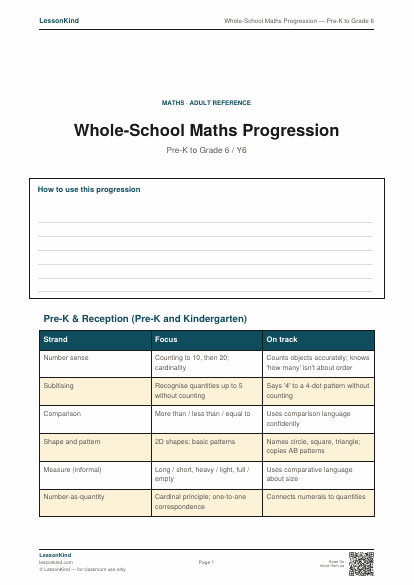
Whole-School Maths Progression — Pre-K to Grade 6
How maths skills develop across primary — number sense from Pre-K through KS2 fractions, decimals, ratio, and algebra. Year-by-year skill expectations across number, calculation, fractions, geometry, statistics, and reasoning. The reference document a Maths Lead returns to most often.
Fluency vs Reasoning — A Maths Lead's Guide
Why fluency and reasoning are both essential, what they actually mean, and how to build each across the school. Includes specific routines for each (e.g. number talks, fluency starters, reasoning prompts). Settles the staffroom debate about 'spending too much time on times tables' vs 'not doing enough word problems'.
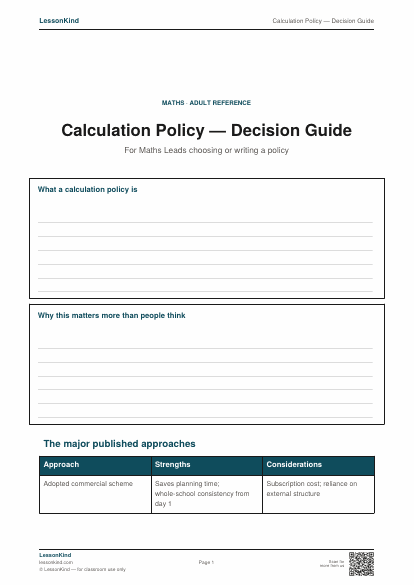
Calculation Policy — Decision Guide
What a calculation policy is, why every school needs one, and how to choose or write one. Includes implementation timeline and how to ensure consistency across the school.
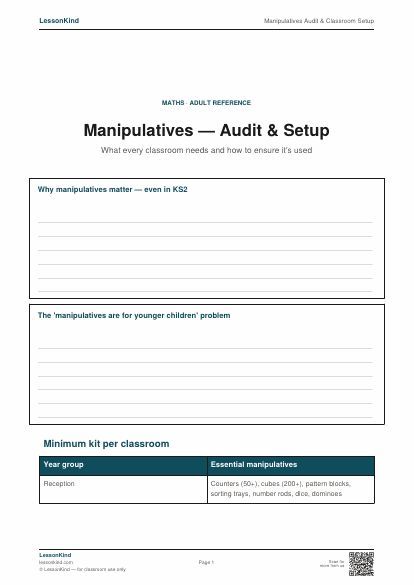
Manipulatives Audit & Classroom Setup
What manipulatives every primary classroom should have, why concrete materials matter even in upper KS2, and how to audit and refresh existing stock. Includes minimum kit by year group, storage strategies, and the 'manipulatives are for the children who need them' problem.
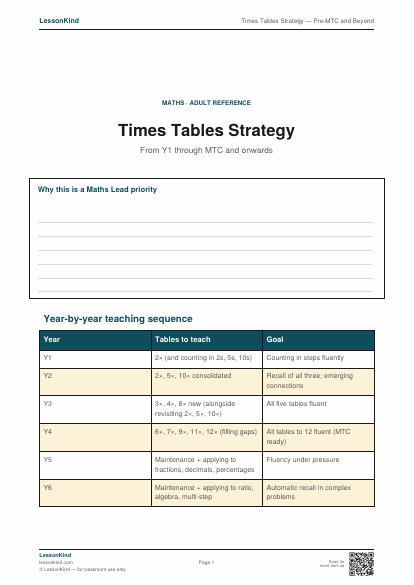
Times Tables Strategy — Pre-MTC and Beyond
How to build whole-school times tables fluency leading to the Y4 Multiplication Tables Check (MTC) and beyond. Covers the year-by-year teaching sequence, daily routines, digital tool options, and what to do for children who fall behind. Strategic, not just 'practice harder'.
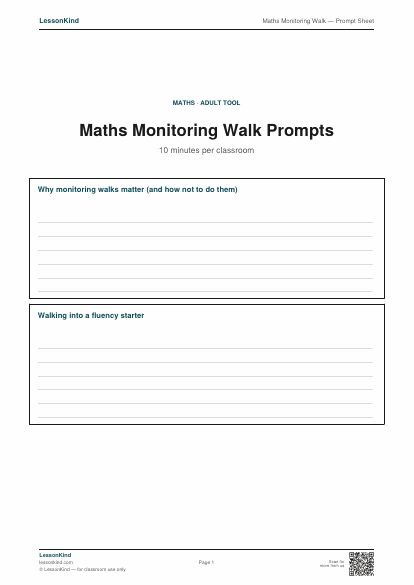
Maths Monitoring Walk — Prompt Sheet
What to look for during a 10-minute classroom monitoring walk for maths. Specific prompts for fluency starters, main lessons, manipulatives use, and reasoning culture. Designed for Maths Leads doing learning walks without it feeling like inspection.
Going deeper
Maths Lead — professional reading
Reading for the primary Maths Lead.
Foundational
Convenience links to Amazon. As an Amazon Associate we earn from qualifying purchases at no extra cost to you. Read our affiliate disclosure.
Keep reading
EAL & inclusion
How SENDCos Actually Run Their Cases
SENDCo is one of the most demanding roles in primary, done by people on a fraction of a day's release. This is what the role actually looks like from the inside — the cycles, the decisions, the difficult conversations, and the rhythms that separate the SENDCos who burn out from the ones who last.
9 min read
EYFS & early years
How EYFS Leads Actually Run Their Settings
EYFS leadership is one of the least-discussed roles in primary, despite running the foundational years that shape everything that comes after. This is what the role actually looks like from the inside — the planning, the parent conversations, the OFSTED preparation, and the rhythms that separate sustainable EYFS leads from burned-out ones.
9 min read
Reading & literacy
How English Leads Actually Run Their Schools' Reading Culture
An honest account of what English Lead work actually involves at primary — the phonics scheme decision, building a school where children genuinely want to read, the staff team's varying confidence, and the long arc of cultural change that can take 3-5 years to embed.
9 min read