Reading & literacy · 9 min read
How English Leads Actually Run Their Schools' Reading Culture
What the role looks like from the inside — phonics decisions, library refresh, the long work of building readers
Published 2026-11-10
Every primary school has someone running English. The job titles vary — English Lead, Literacy Coordinator, KS2 English Lead, Phonics Lead. The role is one of the largest TLR posts in most primaries, usually held by a class teacher who is also deputy head, assistant head, or experienced senior teacher.
What the published guidance doesn't capture is what the role actually feels like from the inside. English Lead is one of those jobs where the difference between "doing it" and "doing it well" is enormous, and where the work that genuinely matters — building a reading culture — happens slowly across years rather than in visible deliverables.
This article is about what the role actually looks like from the inside. It's written for English Leads themselves (you'll recognise things), for class teachers who work alongside one (it'll explain what they're doing in your classroom on Tuesday afternoon), and for school leaders deciding what the role actually needs.
The role from the inside
The English Lead role spans the entire school. Reception phonics. Year 1 phonics screening. KS2 SATs reading and writing. The school library. The staff team's confidence in teaching reading aloud. The reluctant readers. The greater-depth writers. The whole-school strategy that says "this is how reading and writing happen here."
Most class teachers see the English Lead occasionally — when a phonics scheme arrives, when a library refresh happens, when an INSET runs. What they don't see is the pattern underneath: the English Lead is holding the school's reading and writing trajectory across seven year groups simultaneously.
Done well, this means children arrive at Year 6 with cumulative skill development and a strong reading habit. Done badly, this means each year group teaches what they teach, the gaps compound, and Y6 children arrive at SATs with random patches of strength and weakness because nobody coordinated the trajectory.
The annual cycle
English Lead work is structured by a recurring annual cycle that maps loosely to the calendar.
**Autumn term.** Establishing the year. New staff briefed on the phonics scheme and how the school does English. Reception phonics started fresh. Y1 phonics tracking begins immediately because the screening check is in May and the runway is short. Library audit if it's been a year. First round of monitoring walks — what's actually happening in classrooms, not what's claimed?
**Spring term.** The data starts coming in. Y1 phonics practice scores from January show who's on track and who isn't. Y6 SATs prep ramps up. KS2 writing moderation if the LA has scheduled a visit. CPD on whatever the cohort needs — usually one strand, delivered across two or three twilight INSETs.
**Summer term.** The big tests. Y1 phonics screening (May or June, depending on the year). Y6 SATs (May, four mornings). EYFS Profile completion (June). Then the post-test work — handover to next year groups, library refresh budgeted, decisions about scheme adoption, planning for September. Many English Leads do their best strategic work in July and August because that's when the operational pressure lifts.
This cycle repeats every year. The skill of the English Lead is making each cycle better than the last — embedding what worked, adjusting what didn't.
The phonics scheme decision
Every English Lead inherits or chooses a phonics scheme. Since 2022, English primaries are required to use a scheme validated by the DfE as Systematic Synthetic Phonics (SSP). The decision matters because:
- Schemes embed over 18-24 months. Switching too often means children in transition cohorts get incoherent teaching. - Staff need consistent CPD on whichever scheme is chosen. Some schemes are CPD-intensive — others are designed to be picked up faster. Whichever your school chooses, commit to the training. - The scheme dictates everything from sound charts on classroom walls to the decodable books in the library to the parent communication. Changing scheme is a whole-school disruption, not just an English department change.
English Leads new to the role often inherit a scheme partway through implementation. The right move is usually to keep going with what's there — even if you'd choose differently — and review properly at the end of two full years of data. Switching for ideological preference, mid-implementation, almost always damages the children currently in Reception and Y1.
Building a reading culture
This is the work that matters most and that nobody outside the role really sees.
A school where children genuinely read for pleasure — voluntarily, regularly, across genres — is a school where reading attainment trends upward, vocabulary grows, writing improves, and SATs results follow. Research on this is unusually consistent. Reading for pleasure is the strongest single predictor of long-term reading attainment, stronger than parents' education, household income, or school's Ofsted rating.
Building this culture is slow. The Open University's research identifies four conditions: reading environments (book corners, libraries, displays), reading teachers (adults who themselves read and talk about books), reading aloud (daily, by adults to children, no questions attached), and informal book talk (children recommending books to each other).
Most schools have some of these. Few have all four embedded. The English Lead's strategic job is closing the gaps. This usually means:
- A library refresh, often with parent-fundraised money, because school book budgets rarely keep pace with what's needed - Daily class read-aloud across every year group — non-negotiable, and surprisingly difficult to maintain when teachers are under pressure to "cover content" - Staff CPD on what to read aloud at different ages and how to do it well - Pupil librarians, book recommendations, displays of "what Mr X is reading right now" in every classroom - Parent engagement on home reading without it becoming pressure or homework
This work doesn't show up in OFSTED data for at least two years. Headteachers under pressure for quick wins find it hard to back. Strong English Leads protect this work anyway because they know what it produces in the long run.
The staff team's varying confidence
A primary staff team's confidence in teaching English varies widely. Some teachers love reading and bring children into it naturally. Some find writing difficult themselves and dread teaching it. Some carry their own school-age phonics anxiety. Most are confident in some areas (reading aloud, comprehension teaching) and uncertain in others (phonics, vocabulary teaching, writing feedback).
The English Lead's job is raising the floor without crushing anyone. This means:
- CPD that's specific and practical, not "here's research, now do better" - Pairing confident teachers with hesitant ones - Modelling — running your own class lessons that other teachers visit, rather than telling them how to do it - Avoiding the trap of treating CPD attendance as a stick to beat people with - Accepting that some teachers will never be reading evangelists, and finding what they CAN do well
The "you have to love reading to teach it" framing is often unhelpful. Some excellent reading teachers don't read much themselves. They're skilled at making children love it.
The hardest parts
Three things make the role uniquely demanding.
**Holding the long arc.** Reading culture takes 3-5 years to embed. Most English Leads serve in the role 2-4 years before moving on (promotion, moving school, role rotation). This means the person doing the cultural work rarely sees the full results. The next English Lead inherits the trajectory.
**The weight of phonics decisions.** A phonics scheme decision affects every child in Reception and Y1 for years. Get it wrong, or get it right but implement badly, and a cohort underperforms on the screening check at age 6 — affecting their whole reading trajectory. Few decisions in primary leadership carry that weight.
**The visibility gap.** A great English Lead's work is mostly invisible. Children read more. Writing slowly improves. Staff confidence quietly grows. None of this shows up in spreadsheets the way "we ran X intervention and Y children improved" does. This makes the role hard to advocate for, hard to celebrate, and hard to fund.
What helps
For English Leads navigating the role, a few things consistently help:
- Protected non-contact time. The role can't run on goodwill. Half a day a week minimum; ideally a full day for substantial schools. - A library refresh budget protected from year to year. £500-£1000 minimum. - Headteacher backing on the long arc. If the head is impatient for quick wins, the cultural work gets sacrificed for performative ones. - A peer network. Local English Lead networks, Twitter education community, conferences. Doing this role in isolation is harder than it needs to be. - Realistic expectations on what one year produces. The first year is mostly orientation. Year two starts producing visible change. Year three is when the culture starts to feel different.
For class teachers reading this
If your English Lead seems harassed, it's because they probably are. The role spans the school in a way that most TLR posts don't. The visible parts — phonics scheme, library, INSET — sit on top of the invisible parts (cultural work, monitoring, succession planning, parent communication, statutory paperwork).
Three things class teachers can do that genuinely help:
- Engage with the phonics scheme as designed. Following the scheme isn't lazy or unimaginative. Coherence across teachers is what makes it work. - Read aloud daily. Even when there's no time. Even when you're tired. The 15 minutes of read-aloud is the single most influential thing you do. - Tell the English Lead what you're noticing. Patterns in your class often signal patterns in the year group or wider school. They can act on what they hear.
For headteachers
If your English Lead is reading this, three things you can do that genuinely help:
- Protect their time. Don't add the English Lead role to a deputy head with no release. Don't expect substantial English Lead work on top of full-time class teaching with no protected time. - Fund the library properly. Ofsted-rated schools that get reading right almost universally have well-stocked, current libraries. The school library is one of the highest-leverage spending areas at primary. - Back the long arc. Don't change phonics scheme based on one cohort's data. Don't ditch reading-for-pleasure work because it doesn't show in the next data drop. The English Lead is doing patient work; protect it.
The role in one sentence
An English Lead's job is to make the school a place where children become readers and writers — not because they're tested on it, but because reading and writing have become part of who they are.
Done well, this work is invisible until you see what its absence looks like in a different school.
Free bundle for this topic
EYFS Essentials Pack
8 early-literacy essentials — provision, phonics-readiness, mark-making and storytime support.
Practical resources for this
Take this further
Printable, classroom-ready resources for the topics in this article.
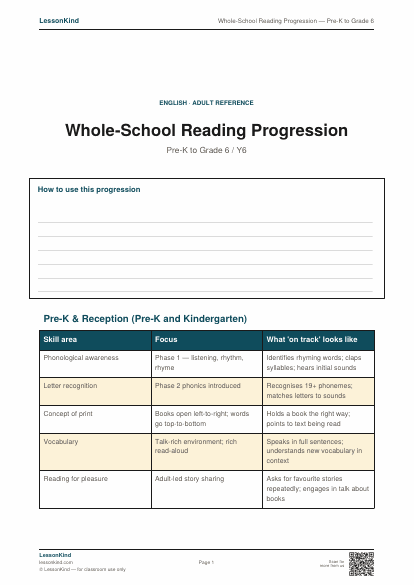
Whole-School Reading Progression — Pre-K to Grade 6
How reading skills develop across primary — phase 1 phonics through KS2 inference, summarisation, and critical reading. Includes year-by-year skill expectations, common misconceptions, and the assessment markers that show whether children are on track. The reference document an English Lead returns to most often.
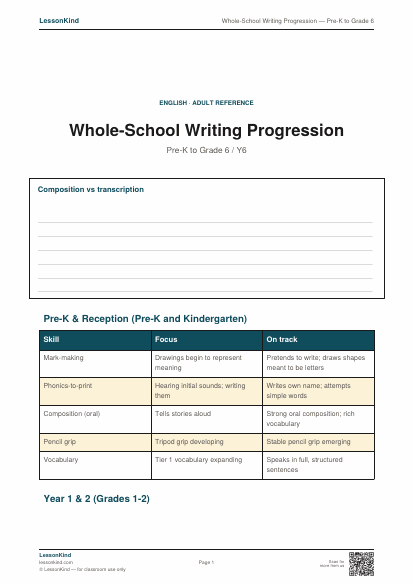
Whole-School Writing Progression — Pre-K to Grade 6
How writing skills develop across primary — emergent mark-making through KS2 sustained writing. Year-by-year skill expectations covering composition, transcription, vocabulary, sentence structure, and editing. Pairs with the reading progression as the English Lead's two foundational reference docs.
Reading for Pleasure — Whole-School Strategy
How English Leads build a school-wide reading culture. Covers the Open University's 4-strand model, library setup, daily read-aloud rituals, reluctant-reader strategies, parent engagement, and how to measure reading-for-pleasure (it's harder than measuring fluency). The most important single thing an English Lead does.
School Library — Setup and Management Guide
How to set up and run a primary school library — book selection, organisation, lending systems, refresh cycles, parent volunteer roles, and the difference between 'a room with books' and 'a library children actually use'. For English Leads inheriting a tired library or starting from scratch.
English Monitoring Walk — Prompt Sheet
What to look for during a 10-minute classroom monitoring walk for English. Specific prompts for reading lessons, writing lessons, phonics lessons, and book corner audits. Designed for English Leads doing learning walks without it feeling like inspection.
Y6 Reading List — Books for the Year of Secondary Transition
Books for Y6 children — the year before secondary, where reading taste matters most and reading is the strongest predictor of secondary attainment. Calibrated for the Y6 cohort specifically — friendship, identity, change, growing up.
Going deeper
English Lead — professional reading
The texts on the desk of every primary English Lead worth their salt.
Reading pedagogy
Reading for pleasure
Convenience links to Amazon. As an Amazon Associate we earn from qualifying purchases at no extra cost to you. Read our affiliate disclosure.
Keep reading
EAL & inclusion
How SENDCos Actually Run Their Cases
SENDCo is one of the most demanding roles in primary, done by people on a fraction of a day's release. This is what the role actually looks like from the inside — the cycles, the decisions, the difficult conversations, and the rhythms that separate the SENDCos who burn out from the ones who last.
9 min read
EYFS & early years
How EYFS Leads Actually Run Their Settings
EYFS leadership is one of the least-discussed roles in primary, despite running the foundational years that shape everything that comes after. This is what the role actually looks like from the inside — the planning, the parent conversations, the OFSTED preparation, and the rhythms that separate sustainable EYFS leads from burned-out ones.
9 min read
Reading & literacy
What 'Reading Level' Actually Means in Year 2
If your child has come home with a book labelled 'orange band' or 'lime' or 'level 9,' you've probably wondered what it actually means. The honest answer is messier than schools tend to admit.
7 min read