EYFS & early years · 8 min read
Play-Based Learning Isn't Lower Expectations — It's Different Expectations
Why parents and Year 1 teachers misread the EYFS classroom — and what it's actually doing
Published 2026-09-10
Walk into a Reception classroom and you'll see children playing. Some are building with blocks. Some are baking imaginary cakes. Some are climbing on the outdoor frame. Some are drawing a wonky picture of their family.
Walk into a Year 3 classroom and you'll see children working. They're sitting at desks. They've got pencils in their hands. They're producing pages of writing.
For most adults — parents, governors, even some senior leaders — the second classroom looks more rigorous than the first. The Year 3 children are obviously LEARNING. The Reception children are obviously PLAYING.
This intuition is one of the most damaging misunderstandings in primary education, and it produces some of the worst pressure put on EYFS practitioners every year: pressure to make Reception look more like Year 3, to introduce more worksheets, to start formal phonics earlier, to stretch carpet times longer, to "ready" children for school.
This article is about why that pressure is misplaced. Play-based learning isn't lower expectations. It's different — and arguably HIGHER — expectations.
What play-based learning actually is
When done well, EYFS play-based learning is one of the most cognitively demanding educational approaches there is. It requires children to:
- Generate their own ideas (most lessons in older years tell children what to think about) - Sustain engagement without external structure (most older lessons have built-in scaffolding) - Collaborate without adult management (most older lessons have explicit social structure) - Apply emerging skills in unfamiliar contexts (most older lessons rehearse skills in familiar formats) - Tolerate uncertainty and try things that might not work (most older lessons reduce risk and signal "right answers") - Make their own choices about what to attempt (most older lessons direct what to attempt) - Self-regulate over extended periods of unstructured time (most older lessons regulate from the front)
These are some of the highest-order cognitive skills humans develop. Adult professionals — designers, scientists, entrepreneurs — spend their lives doing some version of these things. Reception children are practising them every day.
The reason it doesn't LOOK like learning is that it doesn't look like school. We've inherited a mental model of "learning = sitting at a desk, doing what you're told, producing work on paper" — and a four-year-old building an elaborate small-world scenario doesn't fit that picture. So we conclude they're "just playing."
They aren't.
What you'd see if you watched closely
Stand for an hour in a well-run Reception classroom. Pick a child. Just watch.
You'd see them choose construction. They'd struggle with a block that won't balance — try once, try again, change the angle, succeed. (Engineering thinking. Spatial reasoning. Fine motor. Persistence.)
They'd be joined by another child. The two would negotiate what they were building. (Communication. Compromise. Theory of mind.)
They'd give roles to imaginary characters. The narrative would have a problem and a resolution. (Story structure. Narrative thinking. Vocabulary deployment.)
A third child would arrive and try to take over. The first child would respond — maybe with conflict, maybe by making space. (Social regulation. Boundaries.)
The teacher would join briefly. Notice something specific. Add vocabulary. Sustain shared thinking. (This is teaching. It's invisible to anyone who isn't looking for it.)
The play would shift. Maybe the child would move to mark-making and write — badly, with letter reversals — about the dragons they'd just built. (Symbolic representation. Phonics application. Hand strength.)
In one hour, you'd have watched cognitive, linguistic, social, emotional, fine-motor and self-regulation development. The child wouldn't have produced anything you could pin on a wall. To an outsider, it would look like an hour of play. To anyone trained in early-years pedagogy, it would look like an hour of multi-domain development.
The research
The evidence base for play-based learning is one of the most robust in education research. A few headline findings:
**Children in play-based programmes match or exceed academic outcomes** of children in formal-instruction programmes by age 7-8, and consistently exceed them in social-emotional measures (Marcon, 2002; Lillard, 2005; long-running Finnish and Norwegian studies).
**Earlier formal instruction does not produce earlier or better readers.** Comparisons of European countries with different start-of-formal-school ages consistently find that countries starting formal reading at 6 or 7 produce equally good (or better) readers than countries starting at 4 (Suggate, 2011; Sebastian Suggate's later meta-analyses).
**Self-regulation, not academic skill, is the strongest predictor of school success.** Children with strong self-regulation in EYFS do better in primary school across all subjects than children with strong academic skills but weak self-regulation (Blair & Razza, 2007; many subsequent studies).
**Play strengthens executive function**, the cluster of cognitive skills (working memory, inhibitory control, cognitive flexibility) that predict adult outcomes more strongly than IQ (Barker et al, 2014; many studies in the Diamond lab).
The picture from the research is consistent: rich, high-quality, play-based EYFS produces better outcomes than formal instruction. Earlier doesn't mean better. Worksheets in Reception are, at best, neutral; at worst, actively harmful to the dispositions you actually want to build.
Why we keep getting this wrong
If the evidence is so clear, why does the pressure for more formal instruction in Reception keep coming?
A few reasons.
**Adults are biased towards what's visible.** A worksheet is visible evidence of "work." Block play isn't. Visible evidence reassures parents, leaders, inspectors. Invisible learning makes them anxious.
**Earlier formal instruction LOOKS like it's working short-term.** A child taught letters early can name letters early. This produces apparent gains that show up on entry assessments. The catch is that the apparent gains tend to flatten out by age 7-8, while the children who had richer EYFS often surge ahead at that point — but by then, the original "evidence" of early instruction has shaped policy.
**International league tables.** Countries are pressured to "catch up" with high-performing nations. The (mostly wrong) assumption is that earlier formal instruction is what those nations are doing. Often, the opposite is true — Finland's enviable PISA performance comes from a system that doesn't start formal school until age 7.
**The accountability system rewards what's measurable.** EYFS profile data and Year 1 phonics screening checks measure SOME things well (phonics knowledge) and other things badly or not at all (executive function, narrative thinking, oral language depth). Schools chase what's measured. Reception sometimes pays the price.
What good EYFS leadership looks like
A few markers of school leadership that gets EYFS right.
**Resists pressure to "ready them for Year 1."** The job of Reception is not to prepare children for Year 1. It's to develop them as Reception-aged children. Year 1 should be ready for them, not the other way around.
**Defends play time fiercely.** When the timetable gets crowded — assemblies, special weeks, visitors, interventions — play time is what gets cut. Good EYFS leadership refuses. Play time is curriculum, not extra.
**Trusts the practitioners.** EYFS practitioners often have the deepest training in child development of anyone in the school. They are not "just" reception teachers — they are specialists in 4-and-5-year-old development. Trust their judgement.
**Doesn't push EYFS expectations onto Year 1 too fast.** Year 1 should retain elements of EYFS into autumn term — continuous provision available, shorter formal sessions, plenty of movement. The transition to fully formal teaching should happen across the year, not in week one.
**Defends Reception against parental anxiety.** Some parents will worry their child isn't doing "enough" formal work. Good leadership confidently explains why EYFS does what it does, with reference to the research. Doesn't capitulate to anxiety by adding worksheets.
What good practitioners do
Practitioners who get EYFS right do a few things consistently.
**They plan provision intentionally.** Continuous provision isn't random. Every area is set up to develop specific things. Every enhancement is chosen for a reason.
**They observe purposefully.** They notice WHAT is happening, not just THAT something is happening. They write down the moments that matter. They use observation to plan next steps.
**They sustain shared thinking.** They don't leave children to play in isolation. They join, briefly, ask the right kinds of questions, add vocabulary, model thinking aloud — and then leave again. The art is timing.
**They teach when teaching is needed.** Play-based doesn't mean no direct instruction. Phonics is taught. Number bonds are taught. Behaviour is taught. The TEACHING happens — but it sits inside a play-based culture, not on top of it.
**They protect children from over-stimulation.** Quiet corners. Calm spaces. Reduced visual clutter. Daily rhythms. Children at this age are not designed for the constant stimulation many classrooms inadvertently produce.
A final note for parents
If your child is in Reception or Pre-K, and you're worrying that they "don't seem to be doing much," consider:
- They are absorbing extraordinary amounts every day - The skills they're building (regulation, social, oral language) are the foundations for academic skills later - Comparing them to slightly older children doing more visible work is unfair — they're doing different work - The teacher knows what they're doing, even if you can't see it on the wall - Trust the process. By the end of Year 1, you'll see what was building
And if you're a Reception teacher reading this — keep going. The work is harder than it looks, more rigorous than it looks, and more important than the worksheet brigade gives you credit for. The children you're shaping right now will benefit for life. The difficulty is that nobody will be able to point at the worksheets and say "look what they did this term." But the children themselves will be the evidence, in time.
Free bundle for this topic
EYFS Essentials Pack
8 essentials for Reception and Kindergarten — provision, observation tools and activity cards.
Practical resources for this
Take this further
Printable, classroom-ready resources for the topics in this article.
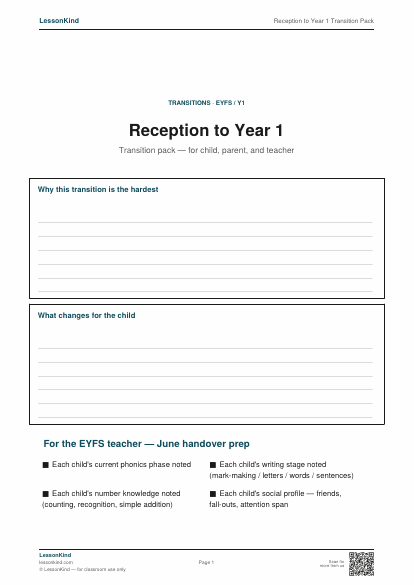
Reception to Year 1 Transition Pack
The single biggest transition in primary — from play-based EYFS to a more structured Year 1 classroom. Activities, parent letter, classroom routines, and EYFS-to-KS1 staff handover sheet for the gentlest possible move.
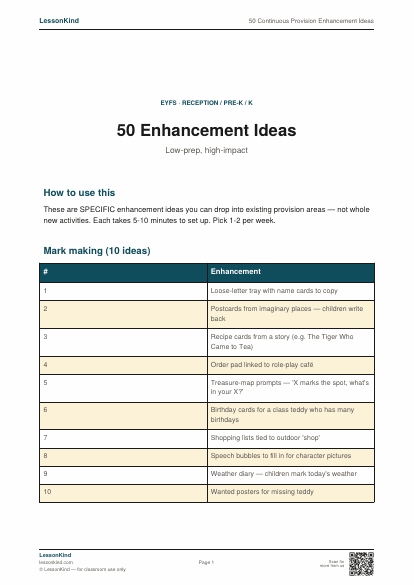
50 Continuous Provision Enhancement Ideas
50 specific, low-prep enhancements for the main provision areas — by area, by season, by skill. Useful for the Sunday-night moment when you're staring at the planning sheet.
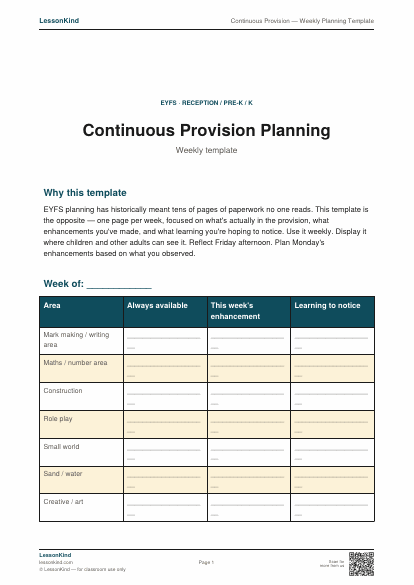
Continuous Provision — Weekly Planning Template
A simple weekly planning template for continuous provision — what's available where, what's been enhanced, what learning is being noticed. Replaces 30-page planning documents with one page that actually gets used.
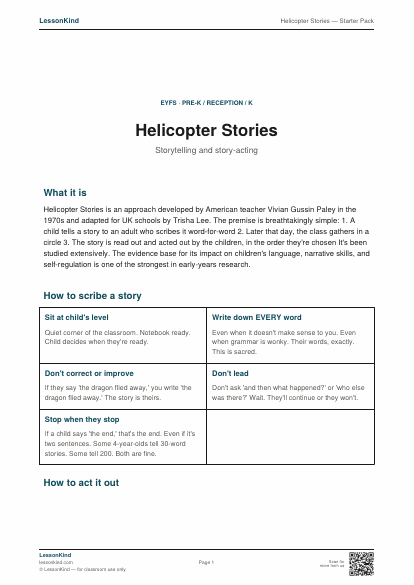
Helicopter Stories — Starter Pack
An introduction to Helicopter Stories — Vivian Gussin Paley's storytelling-and-story-acting approach. One of the most evidence-informed early-language interventions there is.
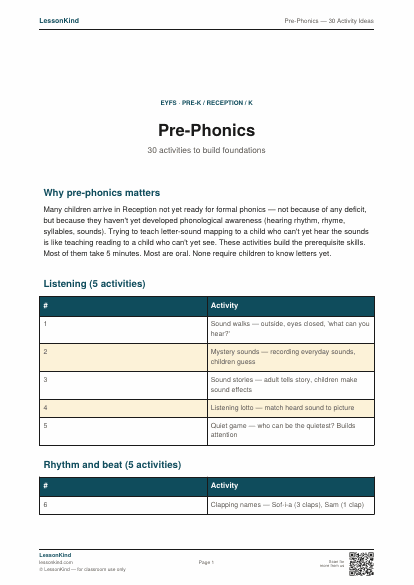
Pre-Phonics — 30 Activity Ideas
30 activities to develop the foundations BEFORE introducing letters — listening, rhythm, rhyme, alliteration, oral blending. The skills that determine how well phonics will land later.
Reception Classroom — Essential Picture Books
The 30 picture books every Reception classroom should have — read-aloud favourites, repeat-read classics, and the books that build the foundational vocabulary, rhythm, and story-sense Reception children need.
Going deeper
EYFS — recommended reading
The texts that have shaped the case for play-based learning as rigorous.
Foundational
Convenience links to Amazon. As an Amazon Associate we earn from qualifying purchases at no extra cost to you. Read our affiliate disclosure.
Keep reading
EYFS & early years
What 'School Readiness' Actually Means (And What It Doesn't)
Every year, parents worry about whether their 4-year-old is 'ready for school.' Schools advertise 'school readiness' programmes. Politicians make speeches about it. Most of what gets said about school readiness is wrong.
7 min read
Teaching strategy
Ability Grouping in Primary: What the Evidence Actually Shows
Most primary classrooms still group children by 'ability' for maths and English. The evidence on this is unusually clear — and unusually ignored. Here's what the research says, why schools keep doing it anyway, and what good mixed-attainment teaching actually looks like.
9 min read
Teaching strategy
Ability Grouping in Primary: What the Evidence Shows
The debate about ability grouping is often ideological. The evidence is more nuanced and more actionable than either side usually acknowledges.
6 min read
EYFS & early years
How EYFS Leads Actually Run Their Settings
EYFS leadership is one of the least-discussed roles in primary, despite running the foundational years that shape everything that comes after. This is what the role actually looks like from the inside — the planning, the parent conversations, the OFSTED preparation, and the rhythms that separate sustainable EYFS leads from burned-out ones.
9 min read