EYFS & early years · 9 min read
How EYFS Leads Actually Run Their Settings
What the role looks like from the inside, why it's harder than the job description suggests, and the rhythms that make it sustainable
Published 2026-11-02
Every primary school with a Reception or Nursery class has someone running EYFS. In most schools that's a lead practitioner who is also a class teacher. In larger settings it might be a phase leader with release time. In the smallest schools it might be the deputy head wearing yet another hat.
Whatever the structure, the role does specific work. EYFS leads coordinate provision across multiple staff (teachers, teaching assistants, often nursery nurses). They manage the indoor and outdoor learning environments. They monitor children's development against the EYFS framework. They run parent meetings, write reports, prepare for OFSTED, transition children up to Year 1 every July, settle new children every September.
What the job description doesn't capture is what the role feels like from the inside. EYFS leadership is one of the least-discussed roles in primary education despite running the most foundational years. The KS2 leads in the same school usually have more visible budgets, more obvious data to point to, and more inspection-relevant outputs. EYFS work is harder to make visible.
This article is about what the role actually looks like — the cycles, the planning, the difficult conversations, and the rhythms that separate the EYFS leads who burn out from the ones who last.
It's written for EYFS leads (you'll recognise things), for primary heads who line-manage them (it'll explain why your EYFS lead seems perpetually busy), and for parents whose children are in EYFS settings.
The annual cycle
EYFS work has a strong annual rhythm. Most external accounts focus on individual children. The reality is that EYFS leadership is structured by predictable cycles most class teachers in KS1/KS2 never see.
**September.** The biggest single moment in the EYFS year. New Reception children settle in (some half-time, some full-time, some still distressed about leaving parents at the door). Nursery has its own intake. Within the first three weeks the EYFS lead has met dozens of new families, established routines for two or three age cohorts, and is already making early observations about which children might need additional support.
**Autumn term.** Routines bedding in. Phonics starts in earnest in Reception. First parent meetings, which carry weight because parents have been waiting since July to know what's actually happening with their child. Halloween, bonfire night, Diwali, Christmas — multiple seasonal moments in 12 weeks. A Christmas nativity that absorbs a whole week of staff time.
**Spring term.** The middle stretch. By spring, the EYFS lead is making serious judgements about which children are on track, which are below age-related expectations, which might need referral to outside services. SEND identifications often crystallise in spring — what looked like "settling-in difficulties" in autumn often turns out to be something more.
**Summer term — May.** OFSTED-prep window if the school is in the inspection band. The EYFS provision gets a different kind of scrutiny in inspection than KS2 — more about "characteristics of effective learning" and "continuous provision quality" than data. Inspectors observe, talk to children, watch how staff interact with the environment. EYFS leads often spend May polishing routines they thought were already polished.
**Summer term — June/July.** The transition months. Reception children moving up to Year 1 (a real shift — Y1 is desk-and-table, EYFS is play-and-provision). Nursery children moving up to Reception. New children visiting from the local nurseries who'll arrive in September. Parents starting school visits for their not-yet-3 children. Multiple cohorts in motion simultaneously.
**Holidays.** EYFS leads do meaningful work in holidays. Setting up the environment for September is genuinely big work — provision planning, area refresh, resource ordering, display preparation. The summer holidays are often the only time for the long, uninterrupted thinking the role requires.
This is the structural reality: EYFS leadership is more like running a small business with three product lines (Nursery, Reception, transitions) than like teaching a class. The decisions are different. The successes are diffuse. The pressure points are different from KS2.
The provision problem
Most EYFS leads spend more of their week on PROVISION work than on direct teaching. Provision is the umbrella term for everything that's set up around the room — the home corner, the maths area, the writing area, the sensory tray, the outdoor mud kitchen, the loose parts shelf. It's also the planning that goes into all of that.
Good provision answers four questions:
1. **What learning is each area designed to provoke?** A water tray isn't just water — it's volume comparison, pouring control, language development, social negotiation about who has the jug. 2. **How does the area change to keep the learning fresh?** Children who play in the same home corner for 12 weeks stop learning from it. The lead's job is to know when an area needs an enhancement, when it needs replacing entirely, and when it just needs different children using it. 3. **How does the team know what's there for?** Staff who don't understand WHY an area is set up a certain way can't direct children to use it well. The provision document — written by the lead — has to be readable by everyone on the team. 4. **How do we know it's working?** Observations. Photos. Quiet conversations with the children. Looking at who plays where, with whom, and with what concentration. Most observations should produce small changes, not radical overhauls.
This is the unglamorous core of EYFS leadership. Most class teachers in KS1/KS2 have never had to think this way. The provision-and-observation cycle runs in the background of every day.
What class teachers in KS1/KS2 don't see
Class teachers see the EYFS lead at staff meetings, in the corridor, occasionally during a transition meeting. What they don't see:
**The parent conversations.** EYFS parents have far more questions than KS2 parents. The transition into formal education is anxiety-inducing for many families. The lead might do 5-8 parent conversations in a week, on top of teaching a class. Each one needs preparation (you need to know the child, the latest observations, what's been tried). Each one might generate a follow-up.
**The professional liaison.** Speech and language therapists, health visitors, family support workers, sometimes social workers. The EYFS lead coordinates with all of them in ways KS2 doesn't typically experience. Reception is when many services first meet the school.
**The data work.** Baseline assessment in September, ongoing observations through the year, the EYFS profile in summer (the statutory end-of-Reception assessment). All of this requires reading and writing. None of it shows up in classroom observation.
**The environment work.** Setting up provision in September takes a week of pre-term work. Maintaining it through the year takes hours each week. Refreshing it for big changes (a new theme, a new season, a new cohort) takes more.
**The judgement calls.** Is this child not yet talking because they're shy, or because there's an SLCN profile? Is this child's behaviour about settling, or about home stress, or about an underlying need? Is this child "not academic" or are we missing something? Wrong call in either direction has costs. EYFS leads make these calls constantly.
**The pre-OFSTED stress.** Inspectors arrive at primary schools and often go straight to EYFS as a quality indicator. The lead's provision is the first thing they see. The pressure isn't always made explicit but it's there.
The decision-making patterns that work
EYFS leads who last and run good settings tend to share specific decision-making patterns. Worth naming because they're learnable.
**They lead with the framework, not against it.** The EYFS framework (and Development Matters in England) is the official guidance. Some leads spend energy fighting it — "we don't really do the prime areas" or "characteristics of effective learning is just an OFSTED thing." The good leads use the framework as scaffold, not enemy. It gives staff a shared language.
**They protect the play.** Pressure from above to "look more like Year 1" is constant in many primaries. Some heads want Reception children sat at tables for longer, doing more recorded work, hitting phonics targets earlier. The EYFS leads who last push back politely but firmly. Play-based learning isn't lower expectations — it's a different pedagogy with strong evidence behind it.
**They build their team's capacity.** The lead who tries to be the only EYFS expert is overwhelmed by week three. The lead who runs short, regular CPD with their team — "this term let's all practice using open-ended questions during play" — distributes the work. Staff become more capable. The lead's own load drops.
**They write things down.** Provision plans, observation notes, parent meeting follow-ups, end-of-week reflections. With multiple children at multiple developmental stages, memory genuinely cannot hold it all. The leads who write things down can sleep at night.
**They protect non-teaching time.** EYFS leads who answer every question from every staff member at every moment have no time to think. The good ones block out windows for paperwork, observation, planning, and treat them like teaching periods — non-negotiable to other adults, except in real emergencies.
**They treat the team as colleagues, not subordinates.** EYFS staff teams often include teaching assistants and nursery nurses with deep knowledge of the children. Leads who consult them, share decisions, value their input have lower turnover and better provision. Leads who direct from above tend to lose their best staff.
What separates burnout-EYFS-leads from sustainable ones
Many EYFS leads quit the role within 5-7 years. The ones who last 15+ years have specific habits.
**They don't try to know every child personally at the same depth.** They know the SEND children deeply, the children with vulnerabilities moderately, the bulk of the cohort at the level the framework requires. Trying to be the personal advocate for 60 children across Nursery and Reception is the fastest path to exhaustion.
**They have a working relationship with their head.** Heads either understand EYFS or don't. The leads who last either work at schools where the head genuinely values play-based learning, or they actively educate their head over time. EYFS leads at schools where the head sees EYFS as "the babysitting bit" rarely last.
**They take their release time as actual release time.** Not "release time but I'll cover Y3 PPA" or "release time but I'll prep for the parent meeting." Actual release time, in the office, for EYFS leadership work. This is hard to defend in primary culture but matters enormously.
**They have a network outside their school.** Local EYFS networks, regional groups, online communities. EYFS work is unique enough that other people in the school often can't help. A lead with a peer network has people to consult on tricky cases, share planning, and decompress with.
**They keep up with research without obsessing.** Not every new approach needs adopting. The lead who switches from EYFS Profile-led to Birth-to-Five-led to Development-Matters-led each time guidance changes, who tries every new pedagogy that comes through CPD — ends up with staff who've stopped listening. Pick the frameworks that fit your setting, embed them, leave them alone.
**They genuinely like the children at this age.** This sounds obvious but isn't. People who took EYFS leadership for the management upgrade or because it was the only TLR available rarely last. The leads who took it because they're fascinated by 4-year-olds tend to find energy for the bad days.
**They protect their relationship with food, sleep, and weekends.** EYFS work is physically and emotionally demanding. The lead who works through every weekend, eats lunch at their desk for nine months running, and never leaves on time burns out within two years. The 15-year leads have boundaries — sometimes obvious ones like "I leave at 4:30 on Fridays" or "I don't open work email after 7pm."
What schools could do better
Most heads aren't trying to undermine their EYFS lead. Most just don't know what would help.
Things that genuinely help:
- **Adequate release time.** EYFS leadership realistically needs at least half a day a week, often more. Many schools give 30 minutes of PPA-equivalent and call it leadership time. That's not enough. - **Admin support.** Even a few hours a week of office support for EYFS-specific paperwork (parent communications, baseline assessment data entry, transition documentation) is transformative. - **Recognising the cycle.** September and July are the heavy months. Pile less on an EYFS lead in those windows than in the spring middle. - **Backing up their pedagogical judgement.** When parents push back on play-based learning ("when will my child do REAL work?"), the head should default to backing the EYFS lead's professional judgement. Public undermining destroys trust. - **Funding their CPD.** EYFS-specific CPD (Helicopter Stories training, Tales Toolkit, Anna Ephgrave provision work, Sue Cowley behaviour, Stuart Shanker self-regulation) is constantly available; budget rarely is. £500 a year is peanuts in school terms and transformative in role terms. - **Pay it properly.** Many EYFS leadership posts come with no extra pay or a small TLR3. Schools that recognise this with appropriate pay keep their EYFS leads. - **Visit the setting regularly.** Not for performance management — just to see it. Heads who only visit EYFS for inspections, parents' evenings, or when something goes wrong miss the daily texture of what's happening.
Things that don't help:
- "Can you make it look more like Year 1?" - Treating EYFS as the practice-ground for new staff - Assuming the role is "just supervising play" - Surprising the lead with new children (managed admissions, bereavement, unexpected SEND placements) without planning support - Squeezing the EYFS budget when the rest of the school protects theirs
What parents could do better
If you're a parent of a Nursery or Reception child, your EYFS lead is mostly trying to help your child thrive. They're also overwhelmed.
Things that help:
- **Email rather than phoning for non-urgent things.** EYFS leads are often teaching when parents call. - **Be specific about what you're asking.** "I'd like to discuss my daughter's communication" is more useful than "I'm worried about her." - **Bring questions written down to meetings.** Helps you remember what to ask. Helps the lead write follow-up notes accurately. - **Wait a few days for non-urgent replies.** EYFS leads have a high parent-contact rate. 48 hours is reasonable. - **Trust the play.** When your child says "we did playing today," they did learning. Provision-based pedagogy looks like play and IS play, but it's also targeted, observed, and progressive. - **Talk to your child about their day in open-ended ways.** "What did you make today?" "Who did you play with?" "What did you get to choose?" rather than "Did you do reading?" The EYFS lead's job is much easier when parents support play-based learning at home.
Things that don't help:
- Comparing your child's progress to specific other children publicly - Pushing for more formal academic work earlier than the framework requires - Treating the EYFS team as childcare rather than as educators - Repeated emails escalating in tone over the same week
A note on the EYFS leads who quit
A real proportion of EYFS leads quit the role within a few years. They don't always tell you why. The honest reasons usually include:
- The provision workload is unsustainable on the time available - The pedagogical pressure from above to "look more like Y1" is exhausting - The pay doesn't reflect the work - The role lacks visible recognition compared to KS2 phase leadership - The judgement calls are emotionally heavy - The head doesn't truly understand the role
When good EYFS leads leave, they sometimes go to nursery management, sometimes to local authority advisory roles, sometimes out of education entirely. That's a loss the school doesn't always notice for a year — until the new lead, who doesn't yet know the children or the team, starts making different decisions and parents start asking why.
A final word
EYFS leadership, done well, is one of the most quietly important roles in primary education. The children whose lives are shaped by good EYFS provision usually don't know who to thank — they're four. The schools where EYFS runs well are usually schools where the head genuinely values the role, the lead has reasonable infrastructure, and the lead themselves has habits that keep them sustainable.
If you're an EYFS lead reading this: most of what makes the role hard isn't your fault. The system is genuinely under-resourced for what it asks. Protect your time. Build your team. Write things down. Distinguish play-based pedagogy from "just letting them play." Lead with the framework. Don't try to be the personal advocate for every case. Take your release time properly.
If you're a head reading this: your EYFS lead is doing more than you can see. The single best return on investment is genuinely-protected release time and admin support. The cheapest investment is publicly backing their pedagogical judgement.
If you're a class teacher in KS1/KS2 reading this: when you receive children from Reception in September, the most useful thing you can do is meet the EYFS lead BEFORE the holidays. Ask what they know about each child. Ask what helps. The transition into Y1 is genuinely jarring for many children — your handover conversation makes it less so.
If you're a parent reading this: your EYFS lead is probably trying. The frustrations you may feel about formal expectations, pace, or readiness are usually correctly aimed at the wider system rather than at your child's setting. The EYFS leads most worth knowing are the ones who'll level with you about what's possible at this age and what isn't.
The role is structurally hard, often invisible, and disproportionately important. The people who do it well — who last, who hold the children, who maintain provision under pressure, who protect play-based learning while still being credible to OFSTED and parents — are running a quiet machinery that the rest of primary education depends on.
Free bundle for this topic
EYFS Essentials Pack
8 essentials for Reception and Kindergarten — provision, observation tools and activity cards.
Practical resources for this
Take this further
Printable, classroom-ready resources for the topics in this article.
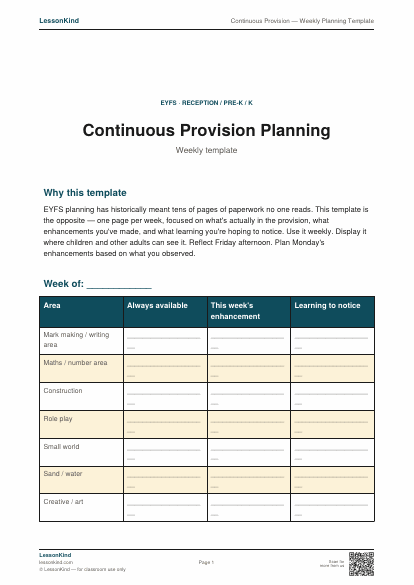
Continuous Provision — Weekly Planning Template
A simple weekly planning template for continuous provision — what's available where, what's been enhanced, what learning is being noticed. Replaces 30-page planning documents with one page that actually gets used.
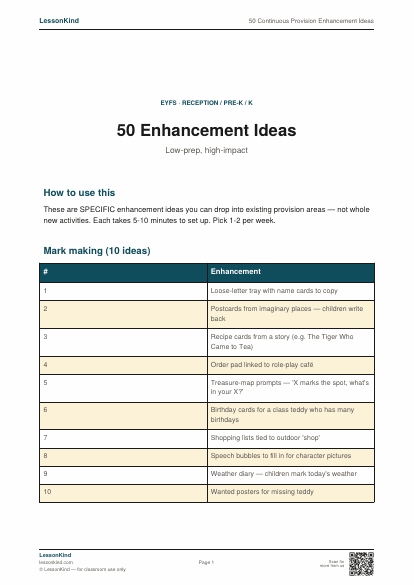
50 Continuous Provision Enhancement Ideas
50 specific, low-prep enhancements for the main provision areas — by area, by season, by skill. Useful for the Sunday-night moment when you're staring at the planning sheet.
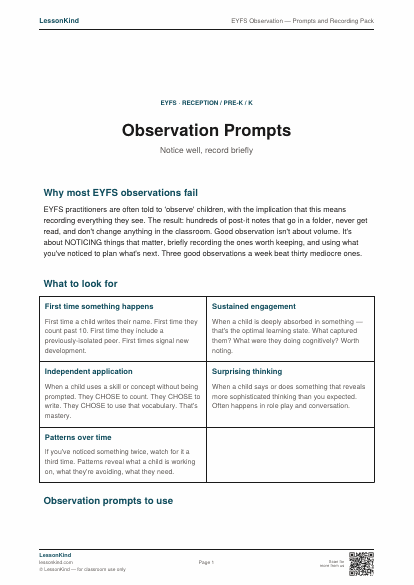
EYFS Observation — Prompts and Recording Pack
How to observe purposefully, what to write down, and how to avoid the all-too-common pattern of recording everything and learning nothing. With prompt cards.
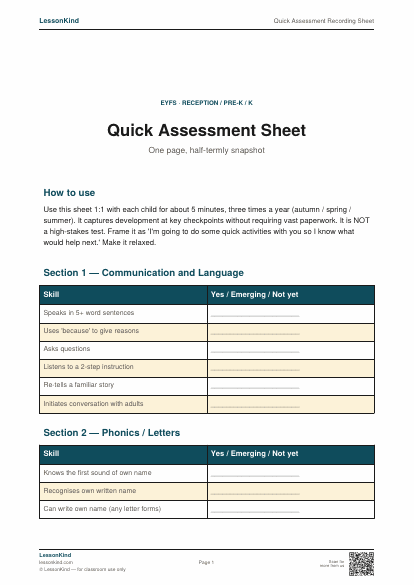
Quick Assessment Recording Sheet
A one-page recording sheet for quick formative assessments — phonics, number, fine motor, name writing. Use as a snapshot every half-term.
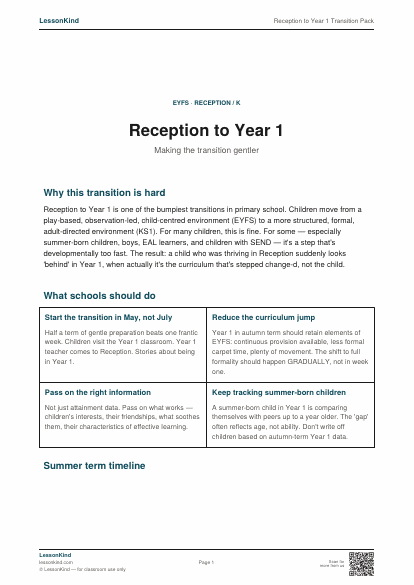
Reception to Year 1 Transition Pack
How to make the Reception-to-Year-1 transition gentler — when to start preparing, what to talk about with parents, what to pass to the next teacher, what to actually do in the last half-term.
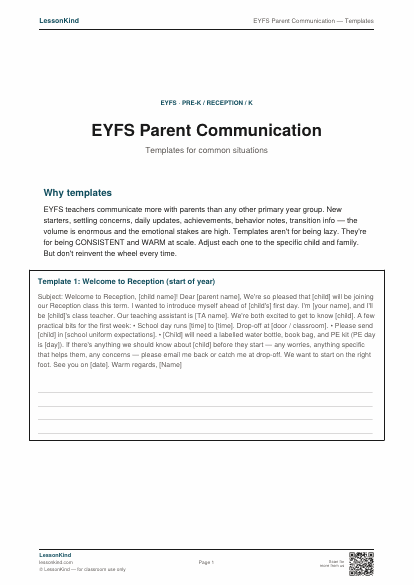
EYFS Parent Communication — Templates
Pre-written email and note templates for the most common EYFS parent comms — settling-in updates, behavior notes, achievement notes, transition info, end-of-day pickup messages.
Reception Classroom — Essential Picture Books
The 30 picture books every Reception classroom should have — read-aloud favourites, repeat-read classics, and the books that build the foundational vocabulary, rhythm, and story-sense Reception children need.
Going deeper
EYFS Lead — professional reading
The books on the desk of every confident UK EYFS lead.
Foundational
Convenience links to Amazon. As an Amazon Associate we earn from qualifying purchases at no extra cost to you. Read our affiliate disclosure.
Keep reading
EYFS & early years
Play-Based Learning Isn't Lower Expectations — It's Different Expectations
Walk into a Reception classroom and you'll see children playing. Walk into a Year 3 classroom and you'll see children working. The mistake most adults make is assuming the second is more rigorous than the first.
8 min read
EYFS & early years
What 'School Readiness' Actually Means (And What It Doesn't)
Every year, parents worry about whether their 4-year-old is 'ready for school.' Schools advertise 'school readiness' programmes. Politicians make speeches about it. Most of what gets said about school readiness is wrong.
7 min read
EAL & inclusion
How SENDCos Actually Run Their Cases
SENDCo is one of the most demanding roles in primary, done by people on a fraction of a day's release. This is what the role actually looks like from the inside — the cycles, the decisions, the difficult conversations, and the rhythms that separate the SENDCos who burn out from the ones who last.
9 min read
Behavior & classroom management
What Good Wraparound Care Actually Looks Like
Wraparound care is a quietly enormous part of primary children's lives. Some children spend more waking hours per week in breakfast and after-school clubs than in lessons. The quality varies enormously, and most parents have no framework for evaluating it. Here's what genuinely good wraparound care looks like — from the inside.
9 min read
Reading & literacy
How English Leads Actually Run Their Schools' Reading Culture
An honest account of what English Lead work actually involves at primary — the phonics scheme decision, building a school where children genuinely want to read, the staff team's varying confidence, and the long arc of cultural change that can take 3-5 years to embed.
9 min read
Assessment & feedback
How Assessment Coordinators Actually Run the Annual Cycle
An honest account of what assessment coordination actually involves at primary — the calendar that drives the year, the moderation conversations that bring teacher judgements into line, the parent meeting prep, and the long-running tension between collecting data and protecting teaching time.
9 min read