Reading & literacy · 6 min read
Reading Comprehension Isn't a Skill
Why comprehension lessons often don't improve comprehension — and what does
Published 2026-10-30
Visit a Year 5 reading lesson and you'll often see something like this: a passage on the board, four questions below it, and the teacher prompting the class through "comprehension strategies" — predict, visualise, question, summarise.
The children practise the strategies. They get better at answering the specific questions. They go home, and next week, they encounter a new text on a topic they don't know, and they understand none of it.
What's happening?
The honest, uncomfortable answer is that reading comprehension isn't really a transferable skill in the way schools often treat it. The cognitive science is pretty clear, and it changes how reading should be taught.
What the research actually shows
A landmark study (Recht and Leslie, 1988) compared four groups: - Strong readers with high baseball knowledge - Strong readers with low baseball knowledge - Weak readers with high baseball knowledge - Weak readers with low baseball knowledge
All four groups read the same passage about a baseball game, then answered comprehension questions.
The result was startling. The *weak readers with high baseball knowledge* outperformed the *strong readers with low baseball knowledge*. Domain knowledge mattered more than reading ability.
This isn't a one-off. Subsequent research has consistently shown the same thing: reading comprehension is mostly determined by whether you know about the topic, not by your "comprehension skills".
Why this is counterintuitive
We naturally treat reading like decoding — once you can decode the words, you can comprehend the text. And for very simple texts, that's true.
But for any text with substantive content, comprehension depends on a vast web of background knowledge — vocabulary, world knowledge, genre conventions, cultural references. A child reading about Roman aqueducts who has never heard of Romans can decode every word and still not understand what they've read.
This is why teaching "comprehension strategies" alone often fails. The child applies the strategy ("I'll predict what happens next") but they have no information to predict from.
What this means for teaching
Five practical implications:
**1. Build knowledge, not just skills.**
A curriculum rich in geography, history, science, art, music gives children the background knowledge they need to read effectively. A curriculum that's mostly literacy and maths *narrows* what children can comprehend.
The best reading instruction starts with: "Today we're going to read about volcanoes. Before we read, let's talk about what we know about volcanoes." Background knowledge is built first, then deployed during reading.
**2. Read on themes, not on isolated texts.**
Reading lessons that hop randomly from topic to topic miss the chance to build cumulative knowledge. Better: a half-term where reading material centres on a theme (Vikings, space, friendship, the rainforest). By week 4, children's knowledge of the theme is rich, and the texts get easier even though they're harder.
**3. Vocabulary is comprehension.**
If a child doesn't know what "fortress", "siege", "betrayal" mean, they can't understand a passage about a medieval battle, no matter how strong their decoding. Pre-teach the key vocabulary before reading the text.
**4. Read widely and often.**
The single biggest predictor of comprehension is the volume of reading a child does. Children who read a lot encounter vast amounts of background knowledge incidentally. Children who don't, miss it.
This is why "free reading" time matters. Not as a comprehension strategy, but as the engine of background knowledge accumulation.
**5. Use comprehension strategies sparingly and intentionally.**
Strategies (predict, visualise, summarise) aren't useless. They help children become more deliberate readers. But they should be taught briefly, applied to texts the children can actually understand, and not treated as the central thing.
A class spending 30 minutes "predicting" and "questioning" their way through a single passage is rarely better off than a class that read three passages on the same topic, building knowledge along the way.
What about SATs comprehension papers?
The KS2 SATs reading paper rewards background knowledge, vocabulary, and inference. It's not really testing "comprehension skills" as a separate construct — it's testing whether children can deploy their knowledge against an unfamiliar text under time pressure.
The schools that do well on SATs comprehension aren't the ones that drill comprehension skills hardest. They're the ones with rich, knowledge-building curriculums and a culture of reading widely.
The implication for primary curriculum
This research has significant implications. It suggests:
- The "literacy hour" focus on comprehension skills, in isolation from content, was probably a mistake. - A knowledge-rich curriculum (geography, history, science as substantive subjects from KS1) is itself a literacy intervention. - Limiting topics to "things that are interesting to children right now" without exposing them to wider knowledge is short-sighted.
Schools that have rebuilt their curriculum around knowledge-building (often called "knowledge-rich" curricula) frequently see substantial reading improvements as a side effect.
What to do this term
Three changes that are within most teachers' control:
**1. When introducing a new text, spend 5 minutes on background knowledge first.** Show pictures, share key facts, link to what they already know.
**2. Pre-teach 3-5 Tier 2 words from any new text.** Brief, direct, with examples.
**3. Read widely. If you have any read-aloud time, make sure the books span topics, periods, and cultures.** Variety builds the knowledge that powers later comprehension.
The teaching of reading is sometimes presented as a complex specialism. The cognitive science is, at heart, simpler than that: read a lot, build knowledge, learn vocabulary. The strategies are useful but secondary.
Free bundle for this topic
EYFS Essentials Pack
8 early-literacy essentials — provision, phonics-readiness, mark-making and storytime support.
Practical resources for this
Take this further
Printable, classroom-ready resources for the topics in this article.
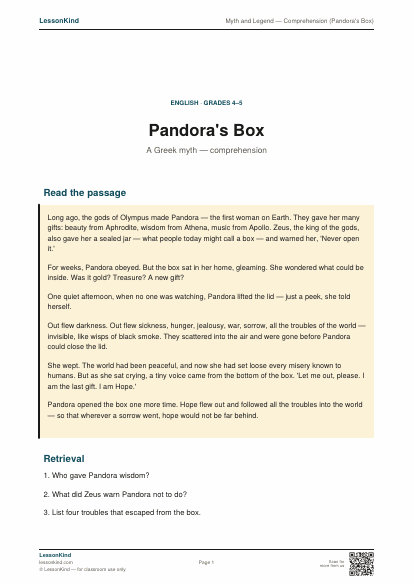
Myth and Legend — Comprehension (Pandora's Box)
Retold Pandora's Box myth (300 words) with retrieval, inference and language questions.
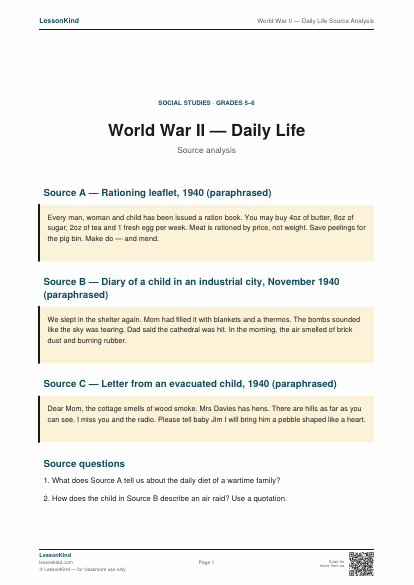
World War II — Daily Life Source Analysis
Three primary-source descriptions (rationing, air raids, evacuation) with analysis questions.
Going deeper
Books on knowledge-rich reading
Books we'd recommend on the topics raised in this article.
Practitioner
Convenience links to Amazon. As an Amazon Associate we earn from qualifying purchases at no extra cost to you. Read our affiliate disclosure.
Keep reading
Reading & literacy
The Vocabulary Gap (And How to Close It)
Vocabulary size at age 5 is one of the strongest predictors of academic outcome at 16. Here's why the gap exists, and what teachers can do to close it.
6 min read
Reading & literacy
What 'Reading Level' Actually Means in Year 2
If your child has come home with a book labelled 'orange band' or 'lime' or 'level 9,' you've probably wondered what it actually means. The honest answer is messier than schools tend to admit.
7 min read
Reading & literacy
Phonics vs Whole Language: The Fight Is (Mostly) Over
The 'reading wars' tore at education for decades. Here's where the science of reading has actually landed — and what it means for your classroom.
8 min read