Reading & literacy · 6 min read
The Vocabulary Gap (And How to Close It)
By age 5, some children know thousands more words than others — and it predicts everything
Published 2026-10-29
There's a piece of educational research that ought to be more famous than it is. Hart and Risley, in the 1990s, found that by age 4, children from professional-class families had heard, on average, 30 million more words than children from low-income families.
Subsequent studies have refined the number — it's not exactly 30 million, the methodology has been challenged, but the central finding is robust. Vocabulary exposure varies hugely by home environment, and that variation cascades through every aspect of school.
The vocabulary gap is the single largest contributor to the achievement gap. It is also one of the most addressable, if schools take it seriously.
Why vocabulary matters so much
Vocabulary isn't just about knowing more words. It's about:
- **Reading comprehension.** A child who doesn't know the words in a text can't understand the text. Roughly speaking, you need to know 95% of the words in a passage to follow it. - **Writing quality.** You can't write words you don't know. Rich vocabulary directly produces richer writing. - **Conceptual thinking.** Many concepts are *carried* by words. A child who doesn't have the word "perimeter" can't think effectively about perimeter. - **Cognitive flexibility.** Knowing multiple words for related concepts ("happy / pleased / delighted / euphoric") allows finer-grained thinking. - **Confidence.** Children who don't know words feel out of their depth. Over time, this corrodes academic identity.
Why the gap exists
Several reasons combine:
**Conversation in the home.** Some homes have constant, varied adult conversation, often with rare and abstract words. Other homes have less talk overall, and what talk there is sticks to common words. Both are normal — but the linguistic experience differs hugely.
**Reading aloud.** Children's books contain a vocabulary far richer than ordinary speech. A picture book aloud might contain words like "mischievous", "scuttled", "magnificent" — words children rarely hear in conversation. Children who are read to daily encounter thousands more rare words than children who aren't.
**Cumulative effect.** Children who arrive at school with bigger vocabularies *learn new words faster*, because they have more hooks to attach them to. The gap doesn't stay constant. It widens.
This last point is crucial. Without intervention, the vocabulary gap doesn't just persist — it grows.
What schools can actually do
The good news: schools are uniquely positioned to close this gap. They have all children for the same hours, they can choose the linguistic environment, and they have a proven set of strategies.
**1. Read aloud daily, every year, every age.**
Not just in Reception. Y6 children also benefit enormously from being read to — at this age, the books available to read aloud have far richer vocabulary than the books they can read alone.
When reading aloud, *don't skip the rich words*. If the book uses "indignant", read "indignant", and explain it briefly: "indignant means really cross because something feels unfair." Then move on. The cumulative effect over a year of read-alouds is enormous.
**2. Teach Tier 2 vocabulary explicitly.**
Linguists distinguish three tiers of vocabulary: - **Tier 1**: everyday words (cat, run, happy) - **Tier 2**: literate-but-broad words (reluctant, observe, considerable) - **Tier 3**: specialist subject words (photosynthesis, perpendicular)
Schools tend to teach Tier 1 (assumed) and Tier 3 (in subject lessons). The middle tier — the words that most distinguish high-vocabulary readers — gets neglected.
Pick 5-10 Tier 2 words a week. Teach them explicitly. Use them in your own speech for the next two weeks. Insist children try to use them in writing.
**3. Use "rare words" in normal classroom talk.**
Don't say "be quiet". Say "I need silence." Don't say "good job". Say "magnificent effort." Children pick up vocabulary from the language used around them. Modelling rich vocabulary is free and constant.
**4. Make vocabulary visible.**
Word walls with current Tier 2 vocabulary. Vocabulary mats for individual children. Word-of-the-week with a child-friendly definition. The reference materials compound.
**5. Read books with rich vocabulary, not "easy reads".**
In KS2, the temptation is to give struggling readers easier books. But struggling readers need *more* vocabulary exposure, not less. The fix is read-aloud — they hear rich language even if they can't yet read it themselves.
What doesn't work
- **Vocabulary worksheets in isolation.** "Match the word to the definition" without context. - **Lists of words to memorise.** Without exposure in context, retention is minimal. - **Trying to match vocabulary teaching to "ability".** Lower-attaining children need *more* rich vocabulary, not less.
What to tell parents
Parents who ask "What can I do at home?" — the single most useful thing is reading aloud. Twenty minutes a day, any age, picture books for younger children, novels for older. Don't worry about the child being "able to read it themselves" — the point is exposure to language patterns and rare words.
Other free things parents can do:
- Talk while doing things together. Cooking, walking, shopping — narrate what's happening with rich vocabulary. - Watch fewer cartoons, watch more nature documentaries (rich vocabulary, full sentences). - Use precise words. "Look how tall that building is" → "Look how *immense* that building is."
The compound interest on vocabulary exposure is enormous. A child who hears 50 extra rare words a day, every day, for 5 years, hears 90,000 extra rare words. That's the gap.
The professional question
Schools that take vocabulary seriously — that build it into every lesson, every subject, every conversation — see results. Schools that treat vocabulary as a literacy specialty, taught in 30-minute slots, don't.
Closing the gap isn't a programme. It's a culture: a school where rich language is normal, where children are read to, where words are noticed and treasured. The schools that get this right are doing something more valuable than any specific curriculum intervention.
Free bundle for this topic
EYFS Essentials Pack
8 early-literacy essentials — provision, phonics-readiness, mark-making and storytime support.
Practical resources for this
Take this further
Printable, classroom-ready resources for the topics in this article.
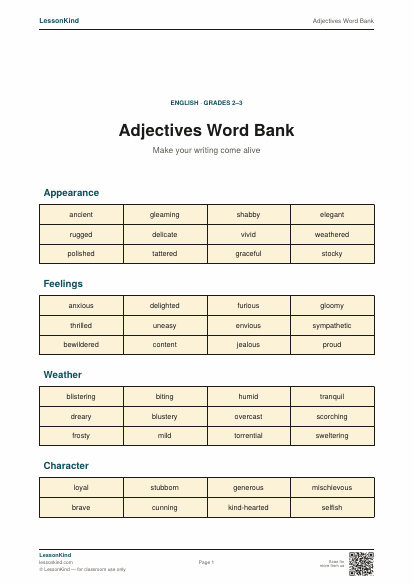
Adjectives Word Bank
Themed adjective banks (appearance, feeling, weather, character) for descriptive writing.
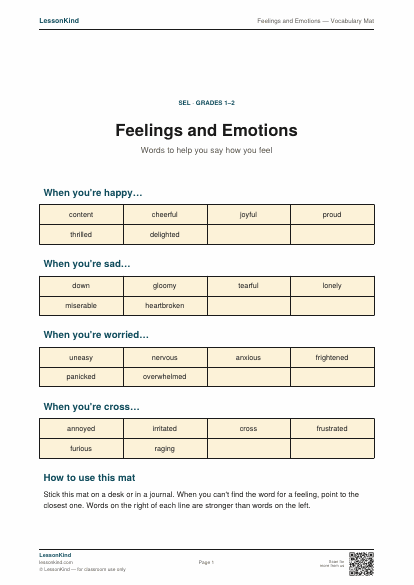
Feelings and Emotions — Vocabulary Mat
Twenty emotion words grouped by intensity. Helps children name and talk about feelings.
Feelings and Emotions — Vocabulary Mat
Twenty emotion words grouped by intensity. Helps children name and talk about feelings.
KS2 Reading List — Books for Year 3 to Year 6
Curated reading list for Year 3 through Year 6 — chapter books, mysteries, fantasy, contemporary fiction, graphic novels, and books for children developing their personal reading taste. Calibrated for fluent readers building lifelong reading habits.
Going deeper
Books on vocabulary instruction
Books we'd recommend on the topics raised in this article.
Practitioner
Convenience links to Amazon. As an Amazon Associate we earn from qualifying purchases at no extra cost to you. Read our affiliate disclosure.
Keep reading
Reading & literacy
What 'Reading Level' Actually Means in Year 2
If your child has come home with a book labelled 'orange band' or 'lime' or 'level 9,' you've probably wondered what it actually means. The honest answer is messier than schools tend to admit.
7 min read
Teaching strategy
The Quiet Power of Low-Stakes Quizzing
Frequent low-stakes quizzes might be the single highest-impact, lowest-effort change you can make to your teaching this year.
6 min read
Reading & literacy
Spelling Isn't Just Memorisation
Most schools still run weekly spelling tests where children get 10/10 on Friday and misspell the same words on Monday. Here's why memorisation isn't the answer.
5 min read