Reading & literacy · 7 min read
What 'Reading Level' Actually Means in Year 2
Decoded — what those colour-band labels are telling you (and what they aren't)
Published 2026-10-17
Many UK and US primary schools use some form of 'reading level' or 'reading band' system. Books are colour-coded (pink, red, yellow, blue, green, orange, turquoise, purple, gold, white, lime…). Or numbered (1 through 30). Or lettered (A through Z). Or graded by Lexile, by Reading Recovery level, by the Accelerated Reader system, or by the school's own home-grown scheme.
Children come home with a book labelled at their level. Parents look at the level. Compare with last term. Compare with the child next door. Worry, or feel relieved, depending on what they see.
Most parents have never been told clearly what these labels actually represent. Schools sometimes don't say, sometimes can't, sometimes know but don't have the time to explain.
This article is about what those labels actually mean, what they don't, and how to use them properly.
The basic concept
All reading-level systems are trying to do the same thing: match books to readers. The idea is that a book at the 'right' level is challenging enough to develop reading but accessible enough that the child can decode it. Too easy and they're not learning anything new. Too hard and they're frustrated. The level is a stab at the sweet spot in between.
Different systems use different methods to set the level. Most consider:
- The number and complexity of words on each page - Sentence length and grammatical complexity - Vocabulary difficulty - Whether the book uses phonics rules the child has learned - The themes and concepts (a book about complex emotions is harder than a book about a cat) - How much picture support there is
The result is a number, a colour, or a letter. The book is given a single label that's supposed to indicate where on a continuum of difficulty it sits.
What it doesn't tell you
Here's where the limitations bite. A 'level' is one number summarising many variables that don't always move together. Two books at the same 'level' can be very different.
Specifically, the level can NOT tell you:
**Whether your child will enjoy it.** Levelled book schemes are often about decoding difficulty, not engagement. A level-perfect book that bores your child is worse than a level-too-easy book they love.
**Whether your child can comprehend it.** Decoding (working out what the words say) and comprehension (understanding what the words MEAN) are different skills. Children can decode at one level and comprehend at another. The label only captures part of this.
**Whether your child can read it independently with confidence.** Confidence varies day to day, with mood, with energy, with whether they've had the wobble of being corrected at school that morning.
**How fluent they are at this level.** Reading slowly and laboriously at level 12 is not the same as reading fluently at level 12. Both technically 'pass' the level, but they're different reading experiences.
**Whether they are LEARNING from it.** A child who's stuck on the same level for months may need books that pull them forward more. A child being pushed up too fast may need consolidation at their current level.
**Anything about their long-term reading future.** Level at the end of Year 2 doesn't predict secondary-school reading. Children move at different speeds and arrive at fluency at different points.
These are limitations of the SYSTEM, not failures of any particular school. No single label can capture everything that matters about a child's reading.
What it CAN tell you
A few things the level genuinely is useful for.
**A rough indication of decoding capability.** A child reading independently at orange band can probably decode most words at that complexity. The level is a fairly good guide to mechanical reading capacity.
**Whether progress is being made over time.** A child who moves from yellow to blue to green to orange across Year 1 is progressing through decoding skills. A child who's been on yellow for a year may need a closer look.
**A useful filter for choosing books.** Faced with a library shelf of unfamiliar books, knowing your child's level helps you pick something they can actually access without frustration.
**A common language for talking with the school.** When the teacher says 'they're moving onto turquoise,' you know what that means. Useful for parents' evening conversations.
**A flag for significant gaps.** If your Year 2 child is still on red band when most peers are on orange or turquoise, that's a meaningful gap. It doesn't tell you WHY, but it tells you there's something to look at.
The myth of the single right level
Probably the biggest misconception about reading levels: that there's one 'right' level for any given child at any given moment.
There isn't. There's a RANGE.
A child can typically:
- Read INDEPENDENTLY at one level (about 95% accuracy, with comprehension) - Read with SUPPORT at a higher level (with help, with discussion, with re-reading) - Listen to and comprehend at a higher level still (when read to) - Read with FRUSTRATION at the highest level (where decoding breaks down)
These are sometimes called the independent, instructional, listening, and frustration levels. The 'level' assigned by the school is usually somewhere in the independent-to-instructional range, depending on the system.
What matters at home is matching the BOOK to the PURPOSE:
**Reading for pleasure / building fluency:** Use independent-level books. Easy ones. The child can read them confidently. Building fluency requires lots of practice with material that isn't a struggle.
**Reading practice for a specific challenge:** Use instructional-level books. Slightly harder. With your support. Where they have to think, but not so hard they give up.
**Listening time / vocabulary building:** Use much higher-level books. Read TO them. Talk about it. Don't worry about decoding — they're not trying to.
If you only ever match the level on the spine, you're missing two-thirds of the reading they should be doing.
The pressures schools and parents create
Reading levels can become a measure that distorts the activity it's measuring.
**'Levelling up' as goal.** Some schools track levels closely, and children become aware that 'going up' is the win. Children stop wanting to read books, and start wanting to read levels. They request the next colour band even when they'd benefit from consolidation. They lose the love of reading in favour of the metric.
**Public progression.** When children know what level their friends are on, comparison is inevitable. Children at lower levels develop weaker reader identities. Children at higher levels develop a sense of competition. Both are corrosive.
**Parent pressure.** Parents who scrutinise levels can pressure children — and the school — to push faster. The child who's been on lime for a term has 'plateaued'; the parent wants action. Sometimes action is right. Sometimes the child is consolidating exactly what they should be consolidating, and pushing them up will produce shallow performance.
**Teaching to the level.** When level data is used as the primary measure of reading progress, schools start teaching to that measure. Specific decoding strategies that move children up bands. Less attention to comprehension, vocabulary, fluency, joy. The reading becomes thinner.
**Levelled books as the only books.** Some schools, particularly under data pressure, restrict children to levelled scheme books. Real books — the chapter books, picture books, non-fiction texts that aren't part of any scheme — get sidelined. Children's reading lives narrow.
What good practice looks like
A few markers that suggest a school is using levels thoughtfully:
**The school uses levels as ONE indicator, not the indicator.** They talk about reading in richer terms — comprehension, fluency, engagement, range — not just colour band.
**Children are encouraged to read off-piste.** Library time. Choice books. Real books from home. The scheme is part of their reading life, not all of it.
**Levels aren't paraded.** Children know their own level but aren't asked to share publicly. The class chart with everyone's levels visible has been retired.
**Comprehension is tracked alongside decoding.** A child who decodes at lime but doesn't understand isn't 'on lime' for purposes of progress.
**Re-reading is encouraged.** Going back to easier books isn't a step backwards; it's how fluency builds.
**Children read for pleasure.** Reading time isn't only assessment. It's also enjoyment.
If your school looks like the opposite of these, that's a flag — not necessarily a fatal one, but worth a conversation.
What you can do at home
Practical things, given everything above.
**Don't obsess about the level.** Note where they are. Note progress over months, not days. Don't compare with siblings or other children.
**Use the level as a guide, not a prison.** If they want to read a 'too easy' book, let them. If they want to attempt a 'too hard' book, support them through it. Variety matters.
**Read TO them above their level.** Vocabulary, comprehension, listening skills — all built by being read to. Continue this through primary, even when they're reading independently.
**Talk about books.** Real conversation. Their thoughts. Predictions. What they liked. What they didn't.
**Have non-scheme books at home.** Picture books, chapter books, comics, magazines. The reading life shouldn't be restricted to a coloured scheme.
**Visit the library.** Free. Full of books. Liberates you from the scheme entirely.
**Praise effort and engagement, not level.** 'You stuck with that even when it was tricky' beats 'well done for being on orange.'
**Don't drill.** Especially levelled books. The drilling is the surest way to make the activity feel mechanical and sap the joy.
A final word
Reading levels are a useful but limited tool. They're an attempt to summarise something complex (a child's reading) with something simple (a label). They give you SOME information. They miss a lot.
The risk is not that schools use them — it's that everyone (teachers, parents, children) starts to treat the label as the thing itself. Reading isn't the colour band. The colour band is a (rough) snapshot of one component of reading at one moment.
If you remember that, you can use the level for what it's actually good for — a check-in on progress, a guide to book choice, a rough indicator of decoding capacity — without falling into the traps that come from over-weighting it.
The real measure of how your child is doing as a reader is whether they're growing — in skill, in vocabulary, in stamina, in pleasure. None of that fits neatly on a label. All of it can be built, gradually, over years, in conversation, in story-time, in libraries, in the quiet daily ritual of reading together.
The level on the spine is just a hint. The reading life is everything else.
Free bundle for this topic
EYFS Essentials Pack
8 early-literacy essentials — provision, phonics-readiness, mark-making and storytime support.
Practical resources for this
Take this further
Printable, classroom-ready resources for the topics in this article.
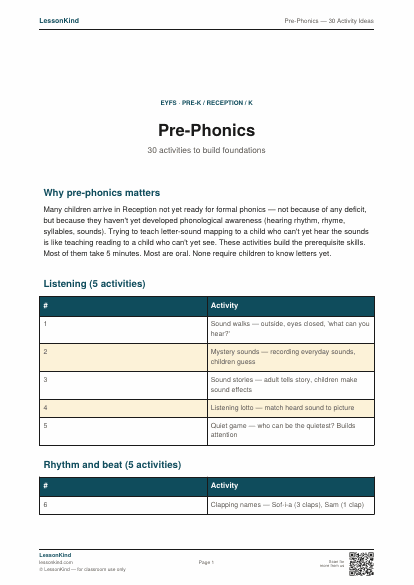
Pre-Phonics — 30 Activity Ideas
30 activities to develop the foundations BEFORE introducing letters — listening, rhythm, rhyme, alliteration, oral blending. The skills that determine how well phonics will land later.
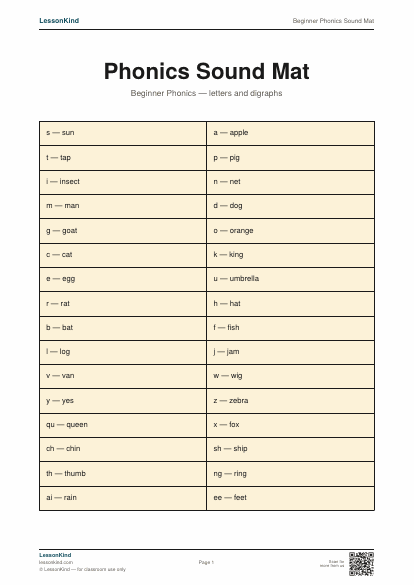
Beginner Phonics Sound Mat
All 26 single letters plus the most common digraphs. Stick on desks for independent writing support.
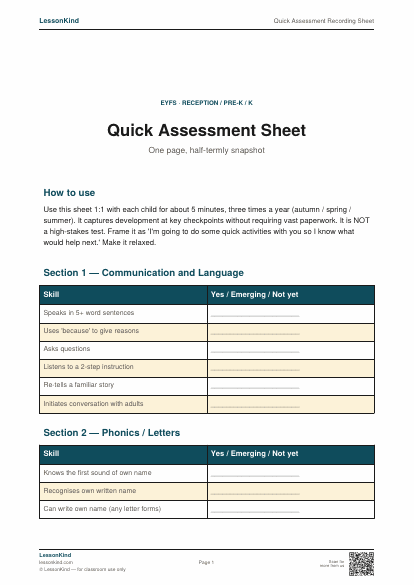
Quick Assessment Recording Sheet
A one-page recording sheet for quick formative assessments — phonics, number, fine motor, name writing. Use as a snapshot every half-term.
Y6 Reading List — Books for the Year of Secondary Transition
Books for Y6 children — the year before secondary, where reading taste matters most and reading is the strongest predictor of secondary attainment. Calibrated for the Y6 cohort specifically — friendship, identity, change, growing up.
Going deeper
Books to help children find their own reading taste
Reading levels matter less than reading regularly. These are universally-loved books for children developing their own reading taste.
For 5-7 year olds (KS1)
For 7-9 year olds (Y3-Y4)
For 9-11 year olds (Y5-Y6)
Convenience links to Amazon. As an Amazon Associate we earn from qualifying purchases at no extra cost to you. Read our affiliate disclosure.
Keep reading
Reading & literacy
Phonics Screening: A Parent's Honest Guide
Every June, parents of UK Year 1 children worry about a 40-word test their child has to take. Here's what it's actually measuring, what the result means, and what to do about it — including the bit most schools don't tell you.
8 min read
Reading & literacy
When to Worry About a Five-Year-Old Who's Not Reading Yet
Reception and Year 1 parents worry constantly about their child's reading. Most of the worry isn't warranted. Some of it is. Here's how to tell the difference — and what to do about both.
8 min read
Reading & literacy
Phonics vs Whole Language: The Fight Is (Mostly) Over
The 'reading wars' tore at education for decades. Here's where the science of reading has actually landed — and what it means for your classroom.
8 min read