Behavior & classroom management · 9 min read
Screen Time and Primary Children: What the Evidence Actually Says
Why most of the public discussion is wrong, why the worry is partly right, and what genuinely matters
Published 2026-10-28
Most parents of primary-aged children worry about screens. Some worry constantly. The dominant cultural narrative is that screens are damaging children's brains, attention spans, mental health, sleep, and futures. Books like Jonathan Haidt's *The Anxious Generation* hit bestseller lists. Schools ban phones. Pediatric organisations issue warnings.
The evidence base behind this narrative is genuinely mixed. Some of the worries are well-supported. Some are weaker than the public discussion suggests. And the research is moving fast, sometimes in surprising directions.
This article is about what's actually known, what's not, and what genuinely matters for primary-aged children. It's not a defence of unlimited screens; it's also not a moral panic. It's an attempt to give parents an accurate map of a topic where confident claims usually outrun the underlying research.
What the evidence does support
Some claims about screen time have solid backing.
**Sleep disruption is real.** Children who use screens — particularly bright, interactive ones — within the hour before bed take longer to fall asleep and have more disrupted sleep. The mechanism is partly the blue light suppressing melatonin and partly the cognitive arousal from interactive content. This effect is well-replicated across studies. A child who games or scrolls right up to bedtime sleeps worse, and sleep matters enormously for primary-aged children's regulation, learning, and growth.
**Replacement of higher-value activities.** When a child spends three hours on a tablet, they are not spending those three hours doing other things — playing outside, reading, drawing, talking, building, sleeping. The evidence here isn't really about screens themselves; it's about the OPPORTUNITY COST. Screens are time-efficient at filling time. The displaced activities matter.
**Some specific content is genuinely harmful.** Algorithmically-pushed content on TikTok, Instagram, and YouTube can lead children into rabbit holes — extreme dieting content, self-harm content, conspiratorial content, age-inappropriate violence. This isn't speculation; the research on algorithmic recommendation effects is substantial. Children whose feeds are unmonitored are at meaningfully higher risk than those whose adults have visibility.
**Attention to homework / reading suffers when interrupted.** A child trying to do homework with a phone visible (even silent) does the work less well than a child without one. The presence of the device pulls attention even unused. This is well-replicated and applies to adults too.
**Replacement of in-person social time has costs.** Children who substitute messaging for face-to-face contact develop weaker social skills, particularly around reading non-verbal cues, managing conflict, and tolerating boredom together. The effect is small per hour but compounds over years.
These are genuinely supported. A parent worried about these effects is not paranoid — they're tracking real things.
What the evidence does NOT clearly support
Other claims are weaker than they're portrayed.
**"Screens cause anxiety and depression in children."** The strongest version of this claim — that the rise in adolescent mental health problems is caused by smartphones — is genuinely contested in the research. The correlations exist but are smaller than commonly reported, and the causal mechanisms are debated. Researchers like Andrew Przybylski have argued that the effect sizes in major datasets are roughly equivalent to "regularly eating potatoes" — present but not dramatic. Jean Twenge's work suggesting strong effects has been challenged by other researchers re-analysing the same datasets.
What this means: the link between screens and mental health is real but probably smaller than headlines suggest, and confounded with many other things (poverty, family stress, educational pressure, post-2008-recession economics, post-pandemic disruption).
**"Screens damage children's brains."** Brain-imaging studies on screen-using children show some differences in brain structure compared to low-screen-users. But the question of whether screens CAUSE these differences or whether children with these patterns simply gravitate to screens is genuinely unresolved. The widely-reported "screens shrink children's brains" interpretation is going beyond what the studies support.
**"Screens shorten attention spans."** Often-quoted claims about declining attention spans (Goldfish! 8 seconds! Worse than 2000!) are largely fabricated. The original "8-second attention span" claim cited in news articles traces back to a Microsoft marketing report that never actually said what it's claimed to say. Serious research on attention has not shown a generational decline of the kind frequently cited.
**"All screen time is equivalent."** Old research bundled all screens together — TV, computers, video calls, educational apps, social media. Newer research consistently finds the TYPE matters more than the TOTAL. Video-calling grandma is not the same as solitary algorithmic scrolling. Educational gaming is not the same as TikTok. The "screen time" frame itself may be obsolete.
**"Children should have ZERO screens."** No major research body recommends this. The American Academy of Pediatrics recommends limits, not abstention, for primary-aged children. The "no screens at all" position is a parenting choice some families make for their own reasons, but it's not supported as the only safe option by any evidence base.
These distinctions matter because the conversation often defaults to its strongest claims. Worried parents take headlines at face value, feel guilty about every minute of screen time, and miss the more nuanced picture.
What probably matters more than total time
The research, when read carefully, suggests several things matter more than minutes-on-screen.
**WHEN screens happen.** Screens before bed (within 1 hour) genuinely disrupts sleep. Screens during meals genuinely reduces conversation and connection. Screens during homework genuinely reduces focus. Screens at 4pm on a wet Saturday — probably fine.
**WHAT screens contain.** Algorithmic content (TikTok, Instagram, YouTube Shorts, recommendation feeds) is more cognitively addictive than non-algorithmic content (a specific show, a video call, a known game). Multiplayer online games with chat have different risk profiles to single-player games. Educational content has different effects to entertainment.
**WHO they're with.** Solitary screen use has different effects than co-viewing or co-playing. A parent watching a film with a child is processing the film together. A child alone on YouTube is not. This is sometimes called "joint media engagement" in the research, and it consistently moderates effects.
**HOW PARENTS engage.** Children whose parents talk to them about what they're watching, ask questions, sometimes watch with them, set rules collaboratively — these children have different relationships with screens than children whose parents either ignore screens or set rigid bans without discussion.
**WHAT'S DISPLACED.** Two hours of screens after a day of school, sport, family dinner, reading and bedtime story is different to two hours of screens replacing all those activities. The displacement matters more than the duration.
**SOCIAL DYNAMICS.** Most concerning research findings cluster around a specific pattern: solitary use of algorithmically-driven content, often before bed, often comparison-driven, in children whose other activities are limited. That's not "screens" in general — it's a specific use pattern.
What this means for primary-aged children specifically
Most of the public conversation is about teenagers and smartphones. Primary children (ages 5-11) are a different situation.
**Most primary children don't have personal smartphones.** The major mental health concerns are concentrated in personal-phone-using adolescents, not 7-year-olds with shared family iPads. The evidence base for primary-age screens is thinner and the effects are smaller.
**Educational content can genuinely help.** Well-designed educational apps for early reading, maths and second languages have shown real learning gains for primary children. Sesame Street has 50 years of research showing positive effects. Educational screen time isn't equivalent to entertainment screen time.
**Active screen use is different from passive.** A child making a video, building in Minecraft, doing a coding game, video-calling cousins — these are creative or social uses. The research on these is more positive than on passive scrolling.
**Family screen-rules matter more than individual rules.** Children whose families have shared norms (no screens at meals, no screens in bedrooms, devices charged in the kitchen overnight) have better outcomes than children with rigid individual restrictions in chaotic family contexts.
**Modelling matters.** Children watch what adults do. A parent on their phone constantly while telling the child to put theirs down is teaching the child what's true (screens are compelling) over what's said (limit yourself).
Practical guidance that's defensible
Given the research, what's a defensible position for primary-aged children?
**Protect sleep.** No screens in the bedroom overnight. No screens in the hour before bed. This single rule has the strongest research backing and the largest behavioural effect.
**Protect connection.** No screens at family meals. No screens during one-on-one conversations. Phones charge in a shared family space, not in bedrooms.
**Protect homework and reading.** Phones aren't visible during homework. Reading time is screen-free. The research on attention is clear.
**Co-engage where you can.** Watch with them sometimes. Ask about what they're watching. Play the video game they like once a fortnight. Don't make screens "their world" you're locked out of.
**Curate, don't ban.** A child with a vetted list of YouTube channels (rather than autoplay) and a vetted list of games (rather than the App Store) gets most of the benefit with much of the risk reduced. Algorithmic platforms are the highest-risk format; non-algorithmic content is much safer.
**Talk about what they see.** Children encounter age-inappropriate content. Pretending they won't doesn't help. Talking openly about what they might see, why algorithms push things, what to do when content makes them feel bad — these conversations matter more than rules.
**Don't moralise.** "Screens are bad" produces guilty children who don't talk to you about what they're seeing. "Screens are useful and complicated and we manage them together" produces children who tell you when something weird happens.
**Vary by activity.** Two hours of LEGO video instructions ≠ two hours of TikTok scrolling. Quality matters more than quantity at primary age.
**Watch the displacement.** If screens are replacing outdoor play, sleep, reading, family time — the screens aren't the problem; the displacement is. Solve for what's missing, not just for the screen.
What about phones specifically?
The biggest phone-related question for primary parents: when does a child get one?
The evidence-led answer is: **later than most children currently get them, and with substantial scaffolding when they do.**
- The mental health concerns concentrate on personal smartphones with social media access in adolescence. - A primary child with an unsupervised personal phone is at meaningfully higher risk than one without. - "All my friends have one" is genuinely a hard pressure, but waiting until age 11-13 is supported by current research. - Smart watches with limited features, or basic phones for safety, are different from smartphones. - When a smartphone IS introduced, social media should follow much later, and parental visibility should be the default.
This is an area where the public discussion (Haidt's *The Anxious Generation* among others) has moved decisively toward "later is better." The evidence is mixed but the precautionary case is strong: the costs of waiting are small (some social pressure), the costs of early access can be substantial.
What schools could do better
Many schools are caught between two pressures: parents who want phones banned entirely, and parents who want children reachable for safety reasons.
Patterns that genuinely help:
- Phones off and away during the school day (in lockers or surrendered at the start) — the evidence on attention and bullying both supports this - Clear policies that are enforced, not just stated - Sensible exceptions (medical, accessibility, emergencies) handled discreetly - Teaching about digital literacy as a curriculum strand, not just one assembly - Open conversations about social media pressures, not just bans - Parent-school collaboration on out-of-school norms (collective family agreements about phone use among friends)
Patterns that don't work:
- Total bans without the curriculum context to explain why - Confiscation as punishment for academic issues - Policies that ignore that children will encounter screens regardless
A final word
The screen time topic is harder than the loudest voices make it sound. Some worries are well-founded; others are exaggerated. The research is moving and not yet settled. The "right" answer varies by family and child.
What seems robustly true: protect sleep, protect connection, protect homework focus, watch the algorithmic-content vector specifically, and talk about it more than you forbid it. These principles work even as the broader research shifts.
What seems robustly true at the meta level: be suspicious of confident claims in either direction. The strongest "screens are destroying children" claims are weaker than they sound. The "screens are fine, calm down" claims also overstate the case. The honest position is that screens are a real factor in children's lives that needs management, not a moral panic and not a non-issue.
Most primary-aged children will be fine with thoughtful, moderate, family-engaged screen use. A smaller number — the ones with unsupervised phones, algorithmic feeds, displaced sleep, displaced reading, and displaced family time — will not. The skill is knowing which kind of household you're running, and adjusting accordingly.
The conversation is likely to keep shifting. The principles probably won't.
Free bundle for this topic
Cover Day Survival Pack
9 resources for any cover day, including behavior strategies and morning meeting scripts.
Practical resources for this
Take this further
Printable, classroom-ready resources for the topics in this article.
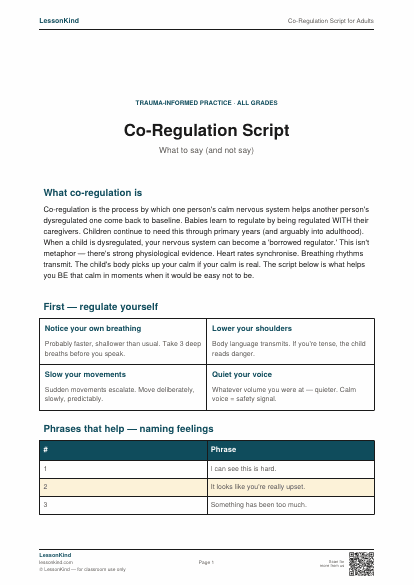
Co-Regulation Script for Adults
What to actually say (and not say) when a child is dysregulated. Phrase by phrase, based on the principles of co-regulation. Useful for the staff briefing.
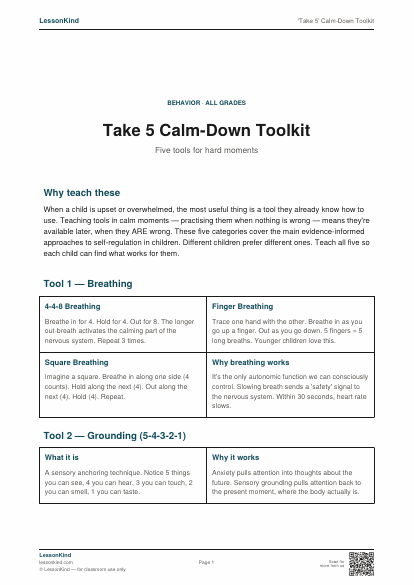
'Take 5' Calm-Down Toolkit
Five evidence-informed calming techniques children can use independently — breathing, grounding, movement, sensory, and cognitive. With age-appropriate adaptations and a take-home card.
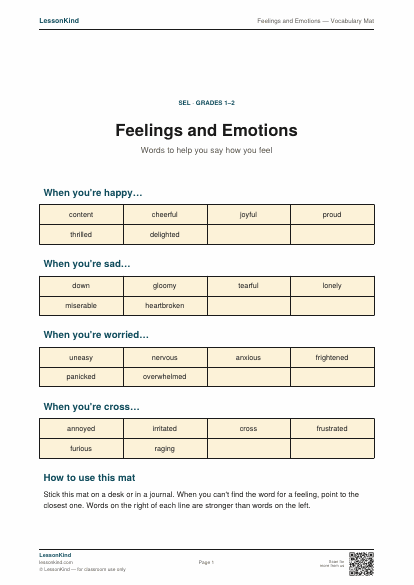
Feelings and Emotions — Vocabulary Mat
Twenty emotion words grouped by intensity. Helps children name and talk about feelings.
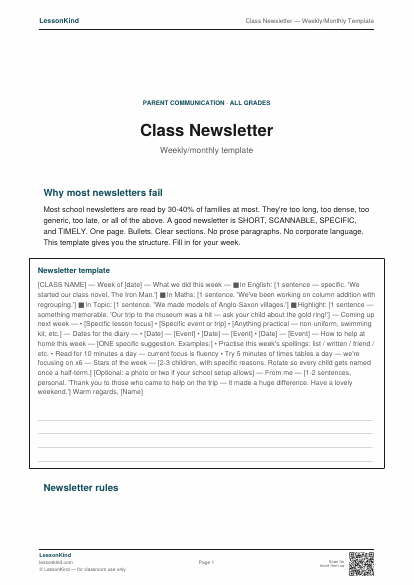
Class Newsletter — Weekly/Monthly Template
A simple, scannable class newsletter template — what we did, what's coming up, important dates, how to help. Designed to actually get read.
Keep reading
Behavior & classroom management
Anxiety in Primary Children: What's Normal and What's Not
Most primary-aged children worry. Some of them worry in ways that affect their lives. The line between these is the most consequential thing for parents to get right — and the most often blurred by anxiety culture going in both directions.
9 min read
Behavior & classroom management
Homework Battles: What Actually Works
Most homework battles aren't about homework. They're about tiredness, autonomy, executive function, or the child's relationship with the subject. The standard parental response — sit with them, push through, enforce — usually entrenches the problem. Here's what actually works.
8 min read
Behavior & classroom management
Why Your Child Is Different at School and at Home
If your child is angelic at school and a wreck at home (or vice versa), the explanation isn't about parenting failure or spoiled behaviour. It's about a phenomenon called 'after-school restraint collapse,' and once you understand it, almost everything makes more sense.
7 min read
Behavior & classroom management
School Refusal: What's Actually Going On
School refusal has risen sharply post-pandemic. The standard responses — punishment, fines, force — usually make things worse. Here's what's actually happening, what works, and what families can do when they realise their child genuinely cannot get through the school gates.
9 min read