Behavior & classroom management · 7 min read
Why Your Child Is Different at School and at Home
It's not that they save up bad behaviour for you. It's something more specific — and more useful to know.
Published 2026-10-16
Some scenes a parent of a 5-to-10-year-old will know. Your child's teacher tells you, at parents' evening, that your daughter is 'one of the most thoughtful, polite, hard-working children in the class.' You go home and that same daughter has a meltdown over the wrong colour cup. Or: your son is described as quiet, withdrawn, possibly anxious at school. At home he is loud, confident, hilariously rude to his siblings. Or, most commonly, the inverse: school says 'a bit disruptive, can struggle with rules.' Home says 'an absolute angel, never any trouble.'
The shared experience: parent and teacher describing what feels like two different children.
This phenomenon is so common that it's been studied formally. It has a name. It has clear causes. And once you know what's going on, a lot of confusing parenting moments suddenly make sense.
The official term
The phenomenon is called 'after-school restraint collapse,' a term coined by parenting expert Andrea Loewen Nair around 2014. The idea: children spend their school day exercising enormous self-control. By the time they get home, their reservoir of restraint is empty. They unleash everything they've been holding in — usually onto whoever's safest, which is almost always their parents.
This explains why the worst behaviour often happens between 3pm and 6pm. It's not that home triggers bad behaviour. It's that home is where the held-in stuff finally gets to come out.
The same phenomenon, run in the other direction, explains the inverse pattern. Some children find HOME stressful — for any number of reasons — and arrive at school with their reservoir of restraint already depleted. By 9am they're harder to manage. They're not bad children. They're empty.
Either way, the deeper insight is the same: children's behaviour is a function of WHERE they spend their regulation reserves and WHERE they cash in.
Why school takes so much
Adults tend to underestimate how cognitively and emotionally demanding the school day is for a young child. From the child's perspective, an average primary school day involves:
- Sustained attention for periods longer than they're naturally wired for - Complex social negotiation with 30 peers, most of whom they didn't choose - Constant rule-following — sitting still, hands up, walking quietly, turn-taking - Keeping their own emotional reactions in check, even when something feels unfair - Following multi-step instructions, often for tasks that are challenging - Eating lunch under social pressure (lunch-hall politics are real for children) - Coping with sensory overload — noise, lighting, smells, hundreds of bodies - Managing physical restrictions — toilet schedules, drink schedules, sit-here schedules - Performing as expected even when tired, hungry, sad, or anxious
For a 6-year-old, this is genuinely a full-time job. Most adults wouldn't manage it as well as the children do. The fact that 30 of them, in one room, can be largely calm and productive for a six-hour day is itself a small miracle.
But this performance has a cost. The child who is calm and on-task at school is BURNING glucose, oxygen, dopamine, and emotional reserves to stay there. The reserves run out at some point. The question is just when.
Why parents get the meltdown
You get the meltdown — and not the teacher — for a specific reason. You're safe.
Children, often unconsciously, work out who in their world they can fall apart in front of. Falling apart at school is risky. Other children might mock. Teachers might react badly. Friends might withdraw. So they hold it in.
Falling apart at home is safer. Mum and dad are unconditional. Even if they get cross, the relationship survives. Even if there are consequences, no one is going to abandon them. Their nervous system has learned: this is the place I can let go.
This is — paradoxically — a sign of secure attachment. Children who fall apart at home and hold it together at school have figured out that home is the safe place. They are choosing (without choosing consciously) to do the hard discharge in the safest available context.
That doesn't make the meltdown easier to deal with at 4pm on a Thursday. But it might reframe it. The meltdown isn't a failure of your parenting. It's an expression of trust.
The symmetric case — when school gets it
Some children show the inverse pattern. They are angels at home, often described as mature, helpful, and reasonable. At school, they struggle. Behaviour issues. Reluctance to engage. Disproportionate reactions.
When parents hear this from the teacher, they're often baffled. 'Are you sure you mean my child?'
The mechanism is the same, run in reverse. These children find HOME calm and SCHOOL overwhelming. Their reserves are depleted by the school environment, and they don't have the regulation capacity left to hold it together. The teacher gets what's left.
Common causes for this pattern:
- The child has SEND that home accommodates but school doesn't - The child finds the social demands of school particularly hard (often introverted or socially anxious children) - The child is masking an underlying difficulty (often the case for high-functioning autistic children or anxious children) - The school environment is stressful for that specific child (sensory overload, peer difficulty, teacher mismatch) - The child is bored or under-challenged and disengages
In all of these cases, the SCHOOL behaviour is the signal. The home behaviour is just what they're like when not being asked to do something hard. Telling parents 'they're fine at home so this must be a school issue' is sometimes accurate but often misses the point — both home and school are showing you the same child responding to different demands.
What to actually do — the after-school crash
If your child reliably falls apart between 3pm and 5pm, a few practical things help.
**Lower demand at the door.** The first 30 minutes home is not the time for 'how was school?' interrogations or homework. It's recovery time. Snack, drink, quiet, screen time, time alone — whatever helps them decompress. The conversation about their day, if it happens at all, often happens later.
**Provide food and drink immediately.** Most children are dehydrated and hungry by the end of a school day. Some of the after-school crash is purely physiological. Snack and water before anything else.
**Reduce stimulation.** Children coming out of school have processed enormous sensory input. Loud music, bright lights, busy shops, multiple voices — all of these overwhelm a depleted nervous system. Where possible, the trip home is calm.
**Don't take the meltdown personally.** Easier said than done. But remembering that this isn't about you — that this is the discharge of a long day's restraint — helps you respond rather than react.
**Set up the unwind environment in advance.** Snacks ready, calm space available, screen rules clear, expectations low. The first hour home is the most volatile of the day. Plan for it.
**Time the demanding bits later.** Homework. Music practice. Reading. Tidying. None of these go well in the after-school crash window. They go better at 5:30 or 6:00, after the reset.
**Skip the post-mortem.** 'Tell me three good things about school today!' is a parenting podcast classic. Some children love it. Many find it exhausting after the day they've just had. If your child resists, don't push. They'll talk when they're ready, often during bath time or bedtime.
**Plan calm activities for the late afternoon.** Bath. Lego. Quiet outdoor play. Audiobook. Drawing. The activities that allow regulation.
What to do — when school is the hard part
If your child holds it together at home and falls apart at school, the response is different.
**Talk to the teacher honestly.** Not 'they're fine at home so this is your problem' but 'they're calm at home — I'm wondering what's different about school for them.' The teacher's response may surface specific triggers.
**Look for sensory overload.** Many children who struggle at school are sensorily overwhelmed by the environment — noise, lights, crowds. This often goes undiagnosed. Mention it to the school. Ear defenders for the playground, a quiet corner, sensory breaks — small adaptations make big differences.
**Look for unmet learning needs.** Children who can't access the work, or who are massively under-challenged, often disengage. Both produce 'behaviour problems' that aren't really about behaviour.
**Look for social difficulty.** Quietly check whether your child has friends at school. Whether they're bullied. Whether peer dynamics are draining them. Children sometimes can't articulate this but show it in behaviour.
**Watch for masking.** Some children — particularly autistic children, very anxious children — work extraordinarily hard to APPEAR fine at school. The cost of this masking is enormous and often invisible. The school may genuinely not see what they're holding in. Sometimes the home behaviour IS the data telling you they're masking.
**Push for assessment if patterns persist.** Children who consistently struggle at school despite good support often have specific needs. SENDCo, educational psychologist, mental health support — these exist for a reason. Don't accept 'just give it time' for more than a term.
A note on differences
Different parenting styles handle the after-school crash very differently. Some families are calm and structured. Some are loud and warm. Some are organised. Some are chaotic. None of these are inherently better or worse for the post-school window.
What matters is that the child has SOMEWHERE they can decompress. If your home is the place where everyone unwinds together, that's fine. If your home is the place where everyone retreats to their own corner, that's fine too. Children adapt to the rhythm of their family — what they need is the rhythm to have a quiet patch in it after school.
If you have multiple children, this gets harder. One child's crash collides with another's. School-aged siblings often crash at the same time. There's no perfect solution; it just takes more planning.
A final word
The phrase 'they're an angel at school' is supposed to be a compliment to the parent. In a sense it is. The fact that your child can perform calmly at school is partly a reflection of the regulation skills you've helped build at home.
But the phrase also confuses the picture, because it suggests the home meltdowns are unjustified — bad behaviour by a child who could obviously do better. The reality is the opposite. Your child is doing it precisely BECAUSE they could obviously do better — and have been doing better, for six hours, and is now legitimately empty.
The meltdown isn't them being naughty. It's them being trusting.
You can hold the line — meltdowns still need limits, behaviour still has consequences — while also understanding what's going on. Both can be true. Both should be true. The understanding doesn't excuse the behaviour, but it does change the response from 'why are you like this?' to 'I get it. Take a moment. Let's eat something. We'll come back to this in a bit.'
Which, in the end, is what they actually need.
Free bundle for this topic
Cover Day Survival Pack
9 resources for any cover day, including behavior strategies and morning meeting scripts.
Practical resources for this
Take this further
Printable, classroom-ready resources for the topics in this article.
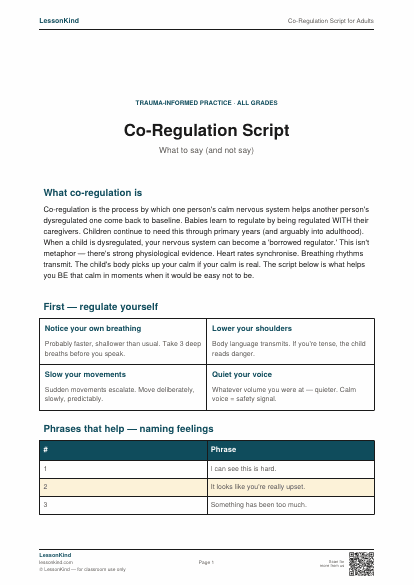
Co-Regulation Script for Adults
What to actually say (and not say) when a child is dysregulated. Phrase by phrase, based on the principles of co-regulation. Useful for the staff briefing.
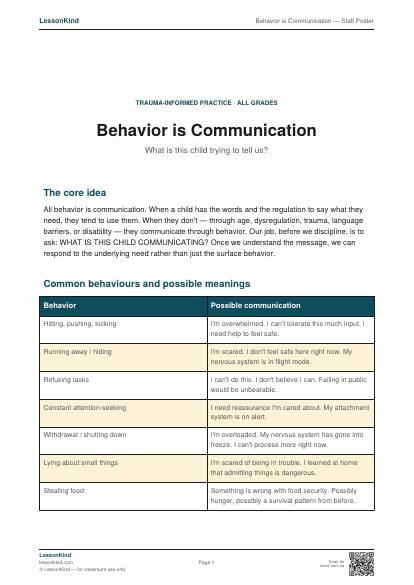
Behavior is Communication — Staff Poster
A staff-room poster reframing common 'difficult' behaviours as communications. The shift in lens is often the most powerful intervention there is.
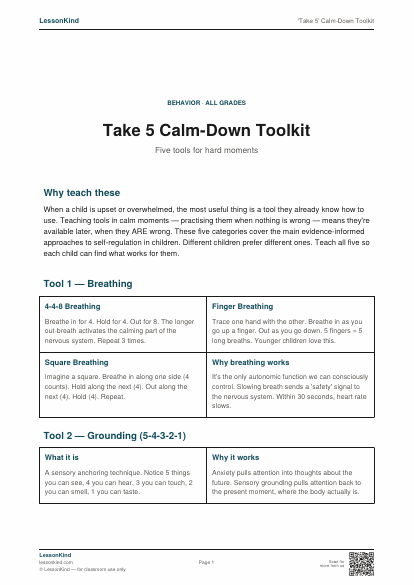
'Take 5' Calm-Down Toolkit
Five evidence-informed calming techniques children can use independently — breathing, grounding, movement, sensory, and cognitive. With age-appropriate adaptations and a take-home card.
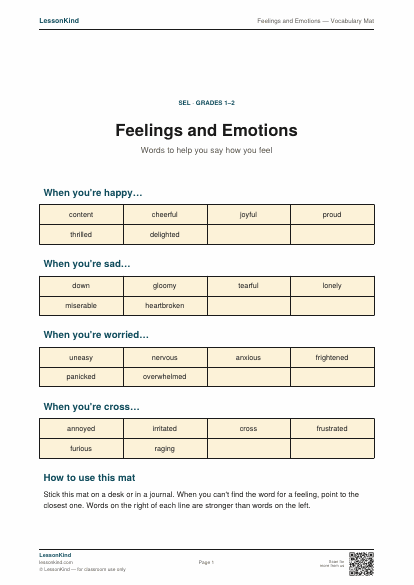
Feelings and Emotions — Vocabulary Mat
Twenty emotion words grouped by intensity. Helps children name and talk about feelings.
Going deeper
Reading on the school/home behaviour gap
Books for parents and teachers exploring why children behave so differently in different settings.
Foundational
Convenience links to Amazon. As an Amazon Associate we earn from qualifying purchases at no extra cost to you. Read our affiliate disclosure.
Keep reading
Behavior & classroom management
Anxiety in Primary Children: What's Normal and What's Not
Most primary-aged children worry. Some of them worry in ways that affect their lives. The line between these is the most consequential thing for parents to get right — and the most often blurred by anxiety culture going in both directions.
9 min read
Behavior & classroom management
School Refusal: What's Actually Going On
School refusal has risen sharply post-pandemic. The standard responses — punishment, fines, force — usually make things worse. Here's what's actually happening, what works, and what families can do when they realise their child genuinely cannot get through the school gates.
9 min read
Behavior & classroom management
When a Child's Behaviour Is Communication
Most adult responses to children's behaviour assume the behaviour IS the message. The trauma-informed reframe is simpler and more demanding: the behaviour is a SIGNAL of something underneath. The shift in response that follows is enormous.
8 min read