Behavior & classroom management · 8 min read
Homework Battles: What Actually Works
After 10 years of nightly homework arguments, here's what genuinely helps — and what makes things worse
Published 2026-10-26
The scene: it's 4:45pm. The homework was supposed to start 30 minutes ago. The child is on the sofa. The parent is asking for the third time. The child says they'll do it after this thing. The parent says now. The child says soon. The parent says NOW. The 5-question maths sheet that should take 10 minutes will take 90, and by the end of it nothing has been learned, only that homework is awful.
This scene plays out in millions of homes every weekday. Parents try standard responses — bribery, threats, sitting with them, doing it together, getting cross. Most produce short-term compliance and long-term damage to the relationship and the work.
The research on homework at primary age is mixed. The research on homework BATTLES is unambiguous: prolonged battles produce worse academic outcomes, worse relationships with school, and worse home life — without producing better learning.
This article is about what's actually going on when homework becomes a battle, why standard responses backfire, and what genuinely helps.
What's underneath the resistance
Homework resistance at primary age is rarely about homework. It's usually about something else, and identifying which something matters because the response differs.
**Tiredness.** Primary children are exhausted by 3:30pm. They've been concentrating, socialising, regulating, performing, for six hours straight. Their tank is empty. Asking them to do more cognitive work in the after-school crash window is fighting biology. The resistance is often justified.
**Autonomy.** Children's developmental need for autonomy peaks around 7-9 years old. The lesson is "I can do things myself." Homework imposed from outside, with parent hovering, denies that need at exactly the developmental moment they need it. The resistance isn't laziness — it's their identity protecting itself.
**Executive function gaps.** Some children have weak executive function — the ability to start, sustain, and finish self-directed tasks. They genuinely don't know HOW to begin. The standard "just get on with it" approach assumes a skill they don't yet have. They're not refusing; they're stuck.
**Subject anxiety.** Children with maths anxiety, reading difficulty, or writing struggle don't avoid homework because it's homework — they avoid it because the SUBJECT brings up their feelings of inadequacy. The battle isn't about chores; it's about identity.
**Relationship dynamics.** Parents who help nightly with homework often become the bad guy. Children who associate parent + homework with stress generalise the stress to the parent. Sometimes the homework battle is really about adolescent (or pre-adolescent) separation, where the child needs to push back against parental control.
**Genuine over-load.** Some teachers set too much homework. A child given 90 minutes of homework most nights at primary age is being mistreated. Fighting through this is wrong; advocating to the school is right.
**Curriculum mismatch.** Homework that's much too easy bores. Homework that's much too hard frustrates. Either way, the resistance is rational. Most homework battles are partly about whether the work is appropriately pitched.
A useful question to ask before the next homework session: "What is this child resisting?" If you can answer specifically — they're tired, they don't know how to start, they hate maths — your response will be different from a generic "just push through."
Why standard responses backfire
A list of common parental moves that don't usually help.
**Sit with them throughout.** Sometimes useful for very young children. With older children (7+), it teaches that they can't work independently. It also turns homework into a parent-supervised activity, removing autonomy. And it produces parent-child stress that bleeds into evenings, dinners, weekends.
**Bribery.** "Finish your homework and you can have screen time." Works briefly. Stops working as soon as the child works out the deal. Also teaches that homework is so awful it requires payment to endure — which entrenches the avoidance.
**Threats and consequences.** Same dynamic. Short-term compliance, long-term damage. The child learns that homework is associated with parental anger and lost privileges.
**Doing it WITH them (i.e., for them).** Tempting, especially when you're tired. Produces work that doesn't reflect what the child knows. The teacher gets misleading information about the child's level. Future work is pitched wrong as a result.
**"Just push through."** Sometimes appropriate, but rarely the first response. With a tired or anxious child, push-through produces hours of poor-quality work and worse next-day school behaviour.
**Constant reminding.** Eventually feels like nagging. Reduces the child's own sense of responsibility. Produces eye-roll, then resistance.
**Comparing to siblings.** Always backfires. Builds resentment. Damages relationships.
**Fighting over correctness.** "That's wrong." "It's right." Children don't learn from this; they fight back. The work isn't being done; the parent-child boundary is.
What actually works
Several things genuinely help, depending on what's underneath the resistance.
**Time it for after the crash.** Don't try homework in the 3:30-5:00 window. That's the after-school restraint collapse hour. Children need food, drink, downtime, low demand. Time homework for 5:30 or 6:00 — after the reset. Better still: morning before school for some children, or weekend chunks.
**Separate yourself from the policing.** "Homework needs to be done by 6pm. You decide when. I'm not going to ask again." Then don't. The natural consequence at school the next day is far more educative than your nagging. This is hard to maintain. It works.
**Build executive-function scaffolding, not enforcement.** A homework board with what's due when. A specific desk space. A homework folder. A start time written down. These remove the cognitive load of remembering and starting, which is where many children get stuck.
**Set a TIME LIMIT, not a TASK LIMIT.** "Spend 20 minutes on it. If you're not done at 20 minutes, stop." This stops the all-evening drag. The teacher gets a partial result with a parent note, which actually helps the teacher pitch better.
**Match the time to the school's expectation.** Most primary homework should take 10-30 minutes max. If your child's homework is regularly taking 60+, the work is mis-pitched. Talk to the school.
**Stop helping nightly.** Counter-intuitive but transformative. Children who are helped less, learn more — they have to engage with the work themselves. Be available for genuine stuck moments; don't sit with them throughout.
**Ask the teacher to send less.** Many primary teachers will reduce homework volume if asked. They often know the volume is too much; they're working within school policy.
**Address the underlying subject anxiety.** If your child resists maths homework specifically, you have a maths anxiety problem, not a homework problem. See the [maths anxiety article](/articles/maths-anxiety-in-primary/) for what helps.
**Make it social where possible.** Some children focus better with quiet music. Some with a sibling working alongside (no helping, just parallel). Some with an audiobook. The lone-desk-in-silence model isn't right for every child.
**Praise effort and finishing, not correctness.** "You sat down and got through it" is the praise that builds homework habit. Correctness is secondary.
**Don't review and correct.** That's the teacher's job. Reviewing and correcting at home: (a) replaces the diagnostic value of the homework for the teacher, (b) produces conflict, (c) signals to the child that home and school are merged into one demand environment.
When to push back at the school
Some homework patterns warrant parent intervention, not parent compliance.
- Volumes regularly over 30 minutes per night at KS1 (Years 1-2) - Volumes regularly over 60 minutes per night at KS2 (Years 3-6) - Tasks that require parental teaching ("explain long division to your child") — that's not home practice, that's outsourced teaching - Tasks that depend on materials most homes don't have - Tasks that are punishment-shaped ("if you didn't finish in class, do it at home") - Daily tests / assessments framed as homework - Tasks that consistently produce tears
If your school is doing these, raise it. Politely, but raise it. Most heads will moderate when parents flag the pattern.
What homework is actually for
The research on primary homework is broadly unflattering. The link between homework volume and academic gain at primary age is weak — mostly because well-intentioned homework gets ruined by the child being too tired, the parent being too involved, or the work being mis-pitched.
What homework CAN do well at primary age:
- Reading at home (the strongest single home-school link in the research) - Practising specific skills that need repetition (times tables, spellings) - Developing the HABIT of independent work — small, manageable, regular - Connecting school learning to home life (cooking is fractions; family history is social studies)
What homework usually does badly at primary age:
- Teaching new content (the parent ends up teaching, badly) - Building motivation (almost no primary child enjoys it) - Improving school performance much (the volume effects are weak)
Treating homework as the foundation of academic success is a misreading of the evidence. Treating it as a small habit-building activity that should fit calmly into evenings is closer to right.
A final note
Most homework battles are diagnostic. The fight tells you something — about tiredness, autonomy, anxiety, executive function, or curriculum fit. Listening to what the fight is about gives you a chance to fix the underlying thing rather than fighting the surface behaviour.
The most useful single move many families can make is to stop sitting with the child throughout. The second most useful move is to time-box (20 minutes, then stop). The third is to talk to the teacher about volume.
After those three, most homework conflicts shrink dramatically — because most of them weren't really about the work. They were about the family system that had grown up around the work.
Children who finish primary with a good relationship with effort, with school, and with their parents have something more valuable than completed worksheets. The work matters less than the relationship to the work. Protecting that — even at the cost of some short-term completion — is usually right.
Free bundle for this topic
Cover Day Survival Pack
9 resources for any cover day, including behavior strategies and morning meeting scripts.
Practical resources for this
Take this further
Printable, classroom-ready resources for the topics in this article.
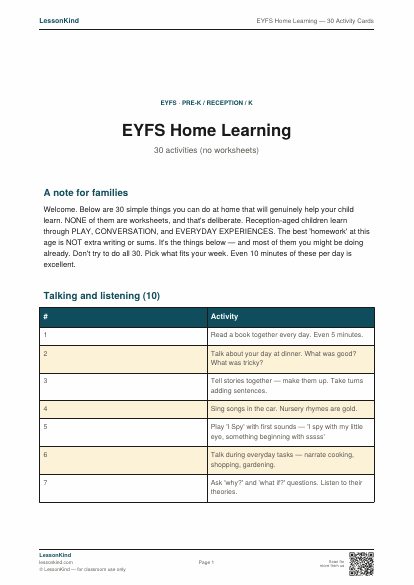
EYFS Home Learning — 30 Activity Cards
30 home-learning activities for Reception families — none of them worksheets. Cooking, walking, talking, counting, drawing — the things that actually develop young children.
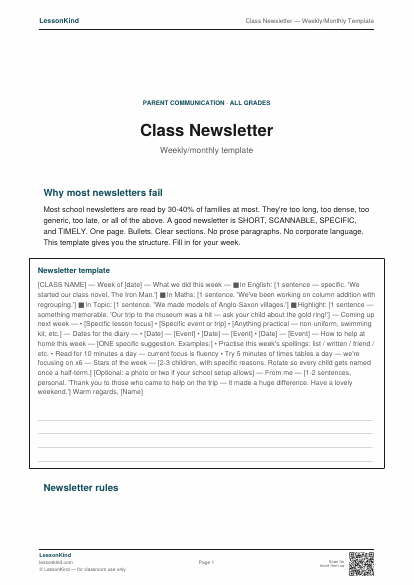
Class Newsletter — Weekly/Monthly Template
A simple, scannable class newsletter template — what we did, what's coming up, important dates, how to help. Designed to actually get read.
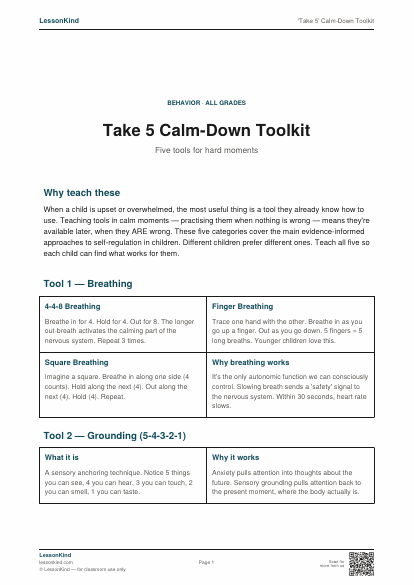
'Take 5' Calm-Down Toolkit
Five evidence-informed calming techniques children can use independently — breathing, grounding, movement, sensory, and cognitive. With age-appropriate adaptations and a take-home card.
Keep reading
Teaching strategy
Homework: What the Evidence Actually Says
Homework is one of the most-debated and least-evidence-based parts of elementary education. Here's a straight-talking summary of what we know.
7 min read
Math
Maths Anxiety in Primary Children
By Year 3, some children have already decided maths isn't for them. By Year 6, it's hard to shift. Maths anxiety is real, measurable, and largely preventable — but it requires understanding what actually causes it, which is rarely what parents assume.
8 min read
Behavior & classroom management
Anxiety in Primary Children: What's Normal and What's Not
Most primary-aged children worry. Some of them worry in ways that affect their lives. The line between these is the most consequential thing for parents to get right — and the most often blurred by anxiety culture going in both directions.
9 min read
Behavior & classroom management
Why Your Child Is Different at School and at Home
If your child is angelic at school and a wreck at home (or vice versa), the explanation isn't about parenting failure or spoiled behaviour. It's about a phenomenon called 'after-school restraint collapse,' and once you understand it, almost everything makes more sense.
7 min read
Behavior & classroom management
What Good Wraparound Care Actually Looks Like
Wraparound care is a quietly enormous part of primary children's lives. Some children spend more waking hours per week in breakfast and after-school clubs than in lessons. The quality varies enormously, and most parents have no framework for evaluating it. Here's what genuinely good wraparound care looks like — from the inside.
9 min read
Behavior & classroom management
Screen Time and Primary Children: What the Evidence Actually Says
Screen time is the parenting topic with the loudest opinions and the weakest evidence base. Most of what people believe is more confident than the research warrants. Here's what's actually known, what's still debated, and what actually matters for primary-aged children.
9 min read