Behavior & classroom management · 9 min read
School Refusal: What's Actually Going On
When 'I don't want to go' becomes 'I can't go,' the shift is rarely about laziness — and the right response looks nothing like discipline
Published 2026-10-19
There's a phrase that gets used in schools and education departments to describe children who don't attend: 'school refusers.' The phrase implies choice. The child REFUSES, the way an adult might refuse a meeting or a chore. The implied solution is to make refusing harder than complying — fines, punishments, threats of court.
The phrase is mostly wrong. Most children labelled 'school refusers' are not refusing in any meaningful sense. They are children whose nervous systems will not let them through the school gates. The behavior looks like refusal. The internal experience is closer to phobia, dread, or panic. The right response is therefore not 'how do we make refusing more costly' but 'what's so distressing about school for this child that they cannot face it?'
This article is about that question — what school refusal actually is, what's behind it, why standard responses fail, and what genuinely helps.
What it looks like
School refusal isn't usually obvious from day one. Most cases develop gradually:
- A few mornings of complaints and tummy aches - Reluctance dressed as illness ('I really do feel poorly') - Tears at the gate, calmed eventually - A bad week where Tuesday and Wednesday are missed - Then weeks where some days are missed and some aren't - Then weeks where most days are missed - Then weeks where the child cannot get out of bed for school at all
By the time families seek help, the pattern is often well established. Schools may have flagged it. Friends and relatives may have started commenting. The child may have lost weeks of education. The family may be in crisis.
What's almost always present:
- Significant physical symptoms (stomach aches, headaches, sometimes sickness) - Distress that escalates rapidly when school is mentioned - Calmness in the home environment outside school hours - Often, normal weekend behaviour - Reluctance to even discuss school - Sometimes, intense panic — racing heart, hyperventilation, vomiting
What is almost never present:
- Defiant pleasure at missing school - Complete absence of distress - Manipulation that disappears once they get their way
The child wanting to skip school for fun is a different phenomenon. School refusers usually look distressed even when they get to stay home. The win doesn't feel like a win.
Why it happens
Multiple things can lead to school refusal. Often it's a combination.
**Anxiety disorders.** Generalised anxiety, separation anxiety, social anxiety. School is a hostile environment for an anxious child — public, unpredictable, peer-loaded, performance-based. As anxiety worsens, school becomes increasingly intolerable.
**Bullying.** Either ongoing or historical. The child has experienced something at school — usually with peers, sometimes with adults — that has made school feel dangerous. Even if the bullying has stopped, the body remembers.
**Sensory overwhelm.** For children with sensory differences (often autistic or with sensory processing difficulties), school is sensorily punishing — noise, lights, smells, hundreds of bodies. They may hold it together for a while, then collapse.
**Unmet learning needs.** A child who can't access the work, day after day, eventually develops avoidance. School means failure. The body retreats.
**Bereavement, trauma, or family upheaval.** Sometimes a specific event — a death, a separation, a house move — destabilises the child enough that the school environment becomes one stressor too many.
**Mental health difficulties.** Depression, OCD, eating disorders, and other conditions can present partly as school avoidance.
**Burnout.** Especially in autistic children. Years of masking, performing, holding it together can lead to a collapse that looks like refusal but is actually exhaustion.
**Bad fit with the school.** Some children are in schools that genuinely don't suit them — academically, socially, or culturally. The 'refusal' is a signal that something fundamental needs to change.
Often, several of these combine. A child with mild anxiety, who experiences a difficult social moment, who is sensorily overwhelmed by their classroom, who has an unmet learning need — these may each be manageable alone, but together they tip the child over.
Why standard responses fail
Most schools and many parents respond to school refusal with what amounts to escalation. Threats, punishments, removal of privileges, eventually fines and legal action. The logic is: if missing school is more painful than going, the child will go.
This logic mostly fails, for two reasons.
**First, it misreads the cause.** The child isn't choosing not to go. They cannot get themselves there. Adding more pain doesn't change the underlying inability — it just adds suffering on top.
**Second, it makes the school anxiety worse.** Pressure, threats, parental anger — these add to the dread. The child now associates school with not just whatever was originally hard, but also with parental conflict, screaming mornings, and threats. The avoidance entrenches.
Some specific patterns that backfire:
- 'You're going whether you like it or not' — produces panic attacks at the gate, public scenes, body-shaped distress that other parents witness - Removing screens / treats / privileges — punishes the symptom, not the cause; produces resentment without changing capacity - Threats of fines or court — make the parent the antagonist; rarely produce attendance, often produce family rupture - Bribery — works briefly, then loses power as the child realises the underlying pain is still there - 'Just push through' — sometimes succeeds for a day, then fails harder
What has more chance of working is the opposite of escalation. It's slow, patient, often involves professional support, and accepts that the child is communicating something real.
What can actually help
The honest answer is: there's no single intervention. School refusal is hard. Recovery is often slow. But the patterns of recovery are fairly consistent.
**Take it seriously, fast.** Don't write off the first week as a phase. The longer the child is out of school, the harder it is to return. If a child has missed a week or more for vague reasons, start investigating.
**Find out what's underneath.** Patiently. Without pressure. Often the answer comes in pieces — at bedtime, in the car, in casual conversation. The adult question is: 'what's making school feel so hard?' Not: 'why won't you go?'
**Talk to the school.** Specifically the SENDCo or pastoral lead, not just the class teacher. Schools have considerable experience with this. The good ones will: - Investigate triggers (bullying, learning needs, classroom dynamics) - Discuss reasonable adjustments - Plan a graduated return - Communicate frequently - Avoid escalation
**Consider professional support.** GP, CAMHS, school counsellor, private therapist. Many cases of school refusal involve anxiety that needs targeted help. Waiting lists are long; start the referral process early.
**Plan a graduated return.** Once the worst is past, the return is rarely 'back to full days from Monday.' It's often:
- Visit the school building outside hours - Come in for 30 minutes with a parent - Come for one specific lesson with a trusted teacher - Come for half-days - Build to full days, with safety nets
**Identify a 'safe person' at school.** One adult the child can find when overwhelmed. The teacher whose class is calmest. The TA. The pastoral lead. The librarian. Someone known to the child, who knows the situation, who can provide the regulating presence the child needs.
**Reduce demands during recovery.** Homework, club expectations, social pressure — pull back. The child is using all available capacity to be at school at all.
**Address the underlying causes.** This is where the real work is. If anxiety, the anxiety needs treatment. If bullying, the bullying needs addressing. If learning needs, the needs need meeting. The 'go to school' demand alone doesn't solve any of these.
**Watch your own emotional state.** Family stress is enormous in these situations. Parents become exhausted, frustrated, sometimes angry. Children read this. Find your own support — partner, friends, therapy, online groups — so you can be the calm presence the child needs.
The recovery timeline
Honestly: it's slow. Most school refusal cases take weeks or months to resolve, sometimes longer. What recovery often looks like:
**Weeks 1-4.** Acute crisis. Lots of time at home. Sometimes hospital appointments, GP visits. Family in chaos. Often other family members affected.
**Weeks 4-12.** Investigations underway. Possibly therapy starting. School in dialogue. Some good days, many bad days. Forward and backward in roughly equal measure.
**Months 3-6.** Pattern stabilising. Some return — half-days, specific lessons, certain weeks. Better understanding of what triggers and what helps. Therapy work showing some traction.
**Months 6-12.** More consistent return, with continuing support. Capacity slowly rebuilding. Setbacks happen but don't undo all progress.
**Year 1+.** Either full return with ongoing care, or alternative arrangements (different school, EOTAS, EHE) where appropriate.
The trajectory varies enormously by case. Some children recover fully and quickly. Some don't return to mainstream schooling at all. Most fall somewhere in between. The factors that most help recovery are: early action, accurate identification of underlying causes, professional support, school cooperation, family stability.
The hardest cases
Some children, despite everything, don't return to mainstream school. This isn't always failure. Sometimes it's the right outcome.
For these children, options include:
**Different school.** A different mainstream school may work better — different ethos, different size, different staff. Sometimes a fresh start is exactly what's needed.
**Specialist provision.** For children whose needs are significant, specialist schools (often for SEND, mental health, or specific difficulties) can be transformative. EHCPs (Education, Health and Care Plans in the UK) can fund this if the need is recognised.
**Education Otherwise Than At School (EOTAS).** A package of education delivered outside school. Tutors, online learning, specific programmes. Funded by the local authority where appropriate.
**Elective Home Education (EHE).** The family takes responsibility for the child's education. This is a significant undertaking and isn't right for every family, but for some, it's the route that works.
**Online schools.** Increasingly viable for older children. Allows education without the social and sensory load of physical school.
The default assumption that mainstream school is the only path is often where families get stuck. For some children, mainstream school will not work. Recognising this earlier — rather than years into a crisis — saves enormous suffering.
What schools could do better
Some practices that genuinely help:
- Recognise emerging refusal early and engage families before crisis - Investigate, don't just police attendance - Have clear pastoral pathways — not 'go to the head' but a known person and a known process - Train staff in trauma-informed approaches - Make 'soft' accommodations easy — late start, quiet space, exit cards - Communicate openly with families about what's possible - Don't lead with fines and threats - Recognise when their setting isn't working and help families find alternatives
Some practices that make things worse:
- Treating absence purely as a data point - Sending automated 'fine warning' letters in the early stages - Public shaming (children who 'haven't been here' announced in assembly) - Inflexible rules about uniform, attendance, lateness during recovery - Insisting on full days as the only acceptable outcome - Blaming parents in front of children
The schools that do this well end up with significantly better attendance and significantly happier families. The schools that lead with discipline often end up in lengthy disputes that benefit no one.
A final word
School refusal is one of the most distressing situations a primary-age family can face. It's also more common than people realise — many families are quietly going through it, often feeling alone, often blaming themselves.
The truth is that most school refusal isn't about the family. It's about a mismatch between the child and an environment that, for them, has become too much. Sometimes the environment is genuinely the problem; sometimes the environment is fine but the child has reached a breaking point in capacity. Either way, the response that helps is investigation and support, not escalation.
If you're in this situation, you're not alone. Your child isn't 'lazy' or 'broken' or 'manipulative.' They're communicating something with the only tool available — their body's refusal to function. Your job isn't to override it. It's to listen carefully, work out what it's saying, and respond to that.
The recovery is rarely fast. It's almost always real. Children who get the right support, eventually, find their way back — sometimes to the same school, sometimes to a different setting, sometimes to a different way of learning. The pattern of full participation usually returns, in time, in a form that fits the actual child you have.
Hold the line. Get help. Be patient with yourself. The way through is slow, but there is a way through.
Free bundle for this topic
Cover Day Survival Pack
9 resources for any cover day, including behavior strategies and morning meeting scripts.
Practical resources for this
Take this further
Printable, classroom-ready resources for the topics in this article.
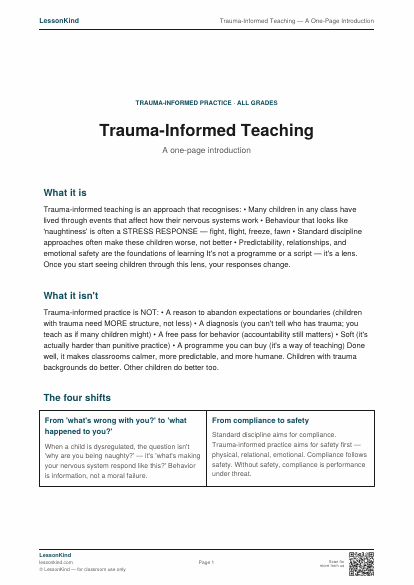
Trauma-Informed Teaching — A One-Page Introduction
What trauma-informed teaching actually is, what it isn't, and the four shifts that make a classroom safer for children with trauma backgrounds. Useful as a CPD opener.
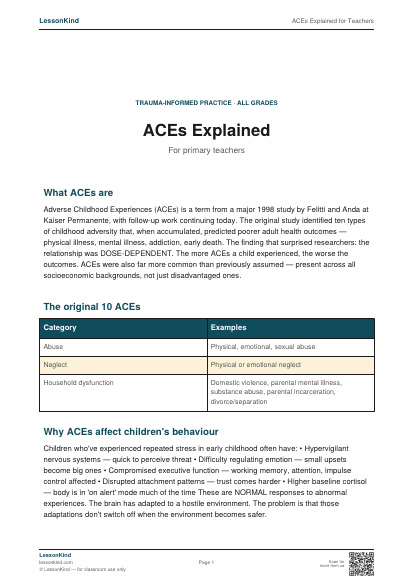
ACEs Explained for Teachers
Adverse Childhood Experiences — what they are, how they affect children's brains and behaviour, and what teachers can actually do. Based on the original Felitti and Anda research and subsequent decades of follow-up.
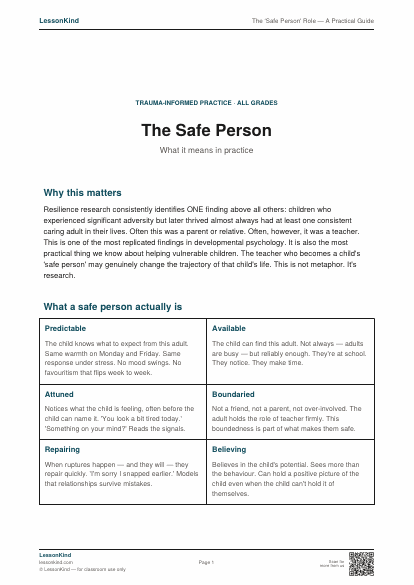
The 'Safe Person' Role — A Practical Guide
What it means to be a child's 'safe person' at school — for vulnerable children, this single relationship can be the difference between thriving and not. With practical guidance and what NOT to do.
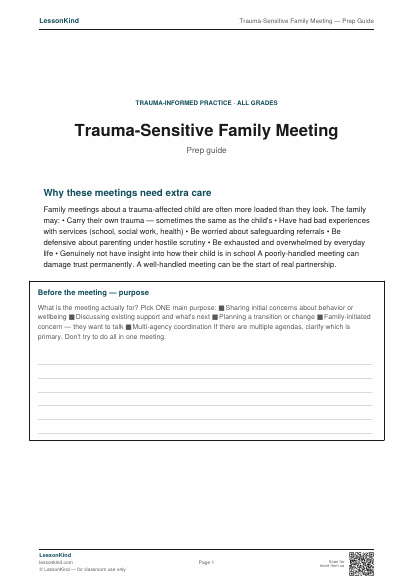
Trauma-Sensitive Family Meeting — Prep Guide
Preparing for a meeting with the family of a vulnerable or trauma-affected child — what to flag, what to avoid, how to share concerns without retraumatising or shaming the family.
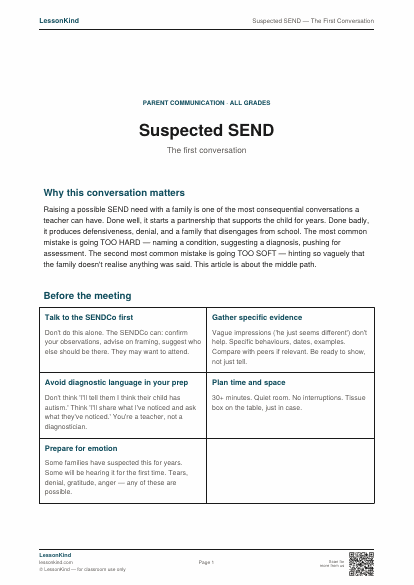
Suspected SEND — The First Conversation
How to raise the possibility of a SEND need with a family for the first time — without diagnosing, without panicking parents, and without backing off when you shouldn't.
Going deeper
Books on school refusal and avoidance
For parents and SENCos understanding emotionally-based school avoidance (EBSA).
For parents and professionals
Wider context — autism and PDA
School refusal is sometimes the visible end of an undiagnosed need.
Convenience links to Amazon. As an Amazon Associate we earn from qualifying purchases at no extra cost to you. Read our affiliate disclosure.
Keep reading
Behavior & classroom management
Anxiety in Primary Children: What's Normal and What's Not
Most primary-aged children worry. Some of them worry in ways that affect their lives. The line between these is the most consequential thing for parents to get right — and the most often blurred by anxiety culture going in both directions.
9 min read
Behavior & classroom management
What Trauma-Informed Teaching Actually Means in Year 4
'Trauma-informed' has become a school slogan, sometimes deployed by leadership without actually changing anything. This article is about what genuinely changes when the framework is taken seriously — and what doesn't.
9 min read
Behavior & classroom management
When a Child's Behaviour Is Communication
Most adult responses to children's behaviour assume the behaviour IS the message. The trauma-informed reframe is simpler and more demanding: the behaviour is a SIGNAL of something underneath. The shift in response that follows is enormous.
8 min read